
US-Israel conflict with Iran triggers unprecedented global oil supply crisis
Here's what it means for you.
Rising oil prices and inflation are likely to impact your household budget and travel plans.
Why it matters
This conflict has triggered the largest oil supply shock in decades, affecting global energy prices and economic stability.
What happened (in 30 seconds)
- The US and Israel launched airstrikes on Iran on February 28, 2026, escalating tensions into open conflict.
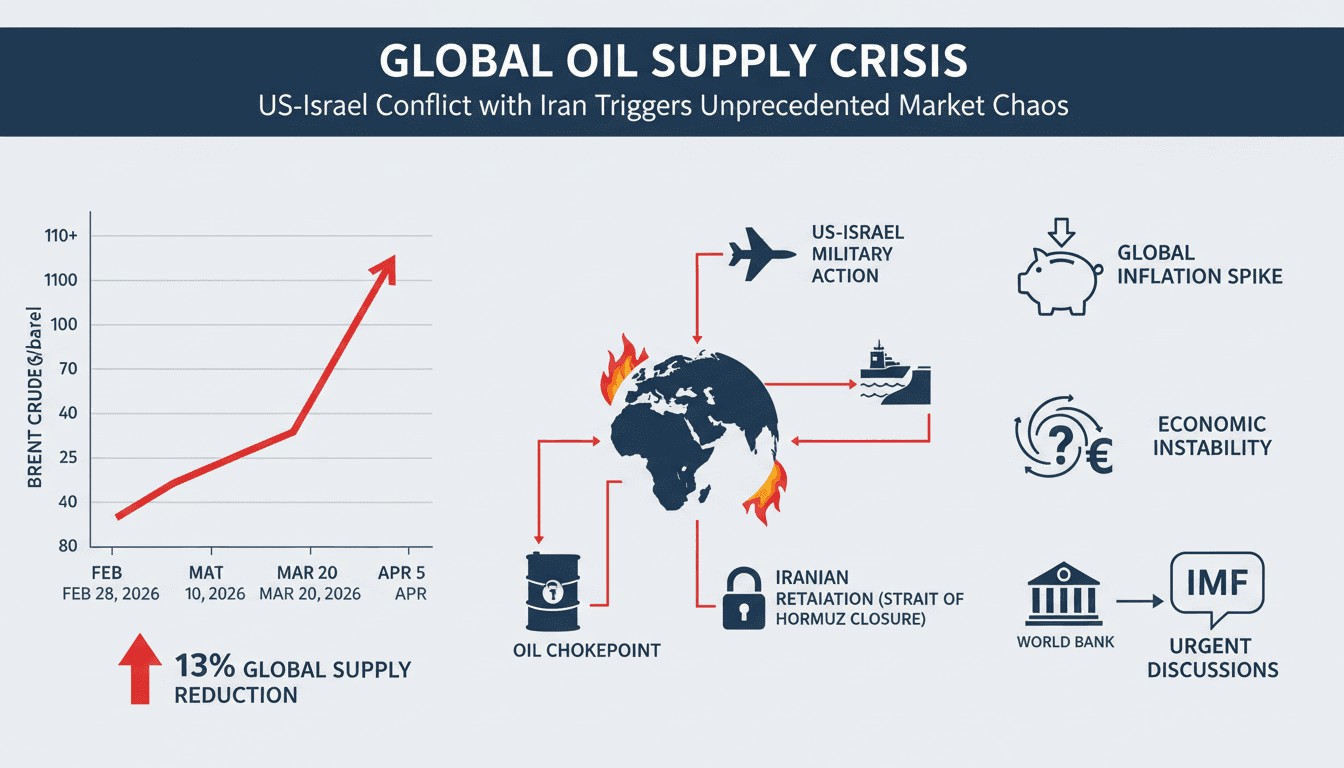
- Iran retaliated by closing the Strait of Hormuz, disrupting oil exports and causing Brent crude prices to surge over 50%.
- IMF and World Bank meetings are underway to address the economic fallout, with oil prices currently above $100 per barrel.
The context you actually need
- The Strait of Hormuz is crucial: It handles about 20% of the world's oil supply, making it a strategic chokepoint.
- Pre-war economic conditions were improving: Global growth was resilient, aided by an AI-driven investment boom and cooling inflation.
- The conflict is a culmination of escalating US-Iran tensions: These tensions have been building under President Donald Trump, exacerbated by previous global shocks like the COVID-19 pandemic and the Ukraine war.
What's really happening
The ongoing conflict between the US, Israel, and Iran has created a perfect storm for global oil markets. The war began with coordinated airstrikes that targeted Iranian military and government infrastructure, leading to significant casualties and the assassination of key Iranian leaders. In retaliation, Iran swiftly closed the Strait of Hormuz, a vital maritime route for oil shipments, effectively stranding exports and triggering immediate supply shortages.
As a result, Brent crude prices skyrocketed from $72 per barrel to nearly $120 within weeks, reflecting a staggering increase of over 50%. This price surge is not just a temporary spike; it represents a fundamental shift in the energy landscape, as the International Monetary Fund (IMF) estimates a 13% reduction in global oil supply due to the conflict. The ramifications of this supply shock are profound, affecting everything from household energy bills to global inflation rates.
The IMF and World Bank are now convening in Washington, D.C., to coordinate a response to the economic fallout. Central banks worldwide are expected to react by holding or raising interest rates to combat rising inflation, which is projected to worsen as energy prices remain elevated. The IMF has already indicated that it will downgrade growth forecasts for 2026, highlighting the risks of higher inflation.
In the Gulf region, countries like Saudi Arabia and the UAE face a mixed bag of outcomes. While higher oil prices could benefit their economies, the disruption of exports poses significant challenges. The ongoing military actions and the US naval blockade of the Strait of Hormuz, effective April 13, 2026, further complicate the situation, as they threaten to prolong the conflict and its economic consequences.
Who feels it first (and how)
- Households: Increased fuel prices and energy costs will strain budgets, particularly for expatriates in the UAE.
- Travel and tourism sectors: Higher oil prices could lead to increased travel costs, affecting tourism in Dubai and beyond.
- Global businesses: Companies reliant on oil and energy will face rising operational costs, impacting profitability and pricing strategies.
What to watch next
- Oil price trends: Continued fluctuations in oil prices will indicate the severity of the supply shock and its impact on inflation.
- IMF and World Bank policy responses: Watch for coordinated global actions to mitigate inflation and stabilize markets.
- Geopolitical developments: Any shifts in military actions or peace negotiations could alter the trajectory of oil supply and prices.
Oil prices have surged above $100 per barrel due to the conflict.
Central banks will raise interest rates to combat inflation resulting from rising energy costs.
The duration of the conflict and its long-term impact on global oil supply and economic growth.
This article was generated by AI from 3 verified sources and reviewed by A47 editorial systems.
UK and international business news, economics, and corporate coverage.
"The Guardian’s business section covers finance and markets with a progressive editorial tone."
— A47 Editor
Task for the week: limit the fallout from biggest oil shock in decades | Richard Partington
The ongoing conflict involving Iran has led to significant economic repercussions, as evidenced by rising energy prices and inflation, prompting the World Bank and IMF to convene in Washington to address these challenges. The situation is reminiscent...
Top international stories selected by The Guardian editors.
"The Guardian is known for its progressive editorial stance and in-depth analysis."
— A47 Editor
Task for the week: limit the fallout from biggest oil shock in decades | Richard Partington
The ongoing conflict involving Iran has led to significant economic repercussions, as evidenced by rising energy prices and inflation, prompting the World Bank and IMF to convene in Washington to address these challenges. The situation is reminiscent...
Arabic-language economic and business reporting with strong UAE market relevance.
"Emarat Al Youm business coverage often centers UAE property, banking, consumer issues, and economic policy."
— A47 Editor
تبعات حرب إيران تهيمن على اجتماعات صندوق النقد والبنك الدوليين تبعات حرب إيران تهيمن على اجتماعات صندوق النقد والبنك الدوليين
Senior financial officials from around the world are set to convene in Washington this week amid the ongoing war in the Middle East, which has raised expectations of reduced growth and increased inflation due to the conflict.
Global markets, investing, and macroeconomics from a premier financial newsroom.
"Bloomberg is respected for in-depth financial reporting and data-driven analysis."
— A47 Editor
The IMF Meetings Were Supposed to Be About Trade. Then Came the Iran War.
The recent IMF and World Bank meetings, initially focused on trade and economic growth, have shifted dramatically due to the ongoing war in Iran, prompting finance ministers and central bankers to address a looming global economic crisis. Chrystia Fr...