
Trump Signals Military Readiness Against Iran Amid Conditional Cease-Fire
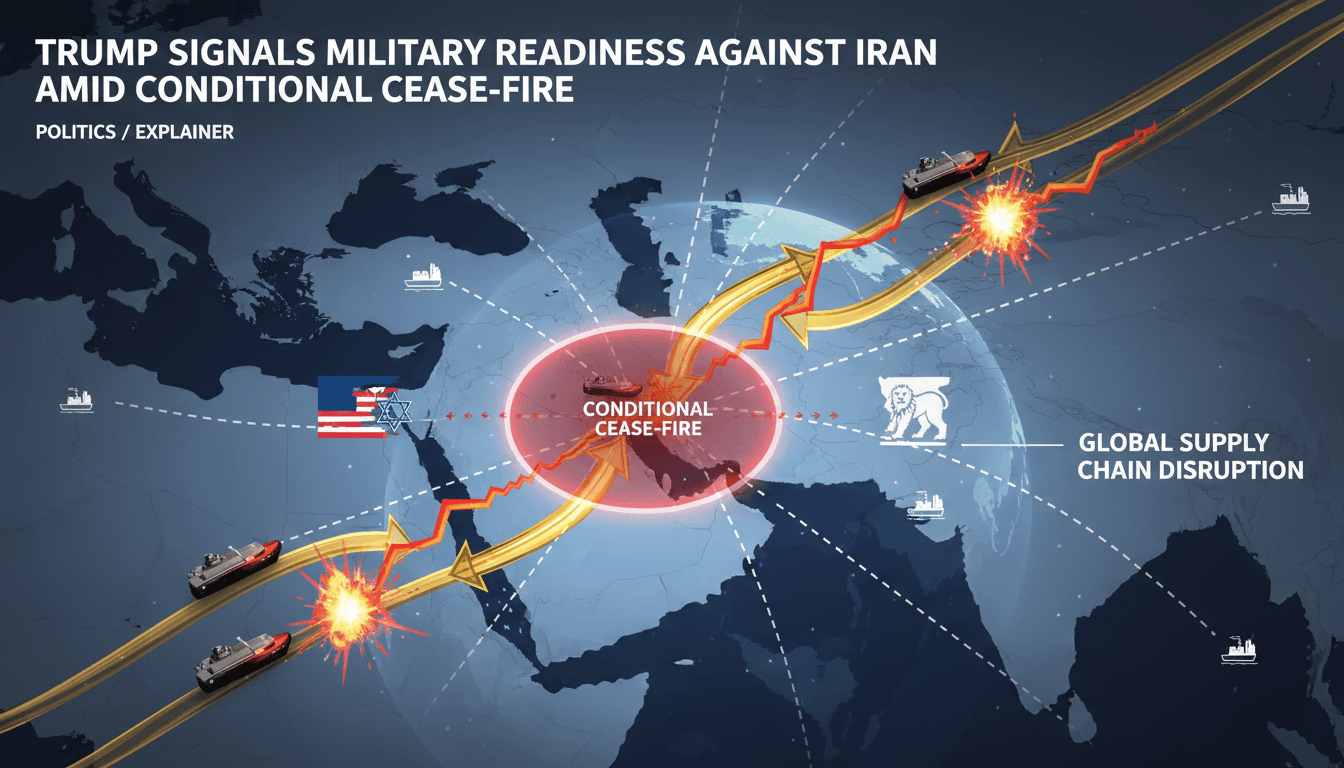
Here's what it means for you.
Your global supply chains and energy prices could face volatility as tensions in the Middle East escalate.
Why it matters
The ongoing military tensions between the U.S. and Iran have significant implications for global oil markets and geopolitical stability.
What happened (in 30 seconds)
- On April 8, 2026, President Trump stated he was ready to escalate military action against Iran, rejecting the 'madman theory' label.
- This statement followed a two-week conditional cease-fire, where Iran agreed to reopen the Strait of Hormuz after U.S.-Israel strikes began on February 28, 2026.
- Trump issued an ultimatum on April 7, warning of severe consequences if Iran did not comply, leading to negotiations in Pakistan.
The context you actually need
- Joint U.S.-Israel military strikes commenced on February 28, 2026, targeting over 11,000 Iranian sites in the first month.
- Iran's response included restricting maritime access through the Strait of Hormuz, a critical chokepoint for global oil shipments.
- The cease-fire was a strategic move by Iran to negotiate under pressure, highlighting the fragile nature of regional peace.
What's really happening
The recent escalation in U.S.-Iran tensions stems from a complex interplay of military strategy, geopolitical maneuvering, and economic interests. The U.S. and Israel initiated a series of coordinated strikes against Iran, targeting critical infrastructure linked to its nuclear program and military capabilities. This aggressive posture was designed to reassert U.S. dominance in the region, particularly following years of perceived Iranian expansionism through proxy forces.
President Trump's declaration of readiness for military escalation serves multiple purposes. It reinforces his administration's commitment to a strong military presence in the Middle East, which he argues is necessary to deter Iranian aggression. By framing his approach as a rejection of the 'madman theory'—a tactic used by former President Nixon—Trump seeks to project strength and resolve, positioning himself as a leader willing to take decisive action to protect U.S. interests.
The conditional cease-fire and Iran's agreement to reopen the Strait of Hormuz are tactical responses to the overwhelming military pressure exerted by the U.S. and Israel. The Strait is a vital artery for global oil transport, and Iran's previous restrictions had already begun to disrupt oil shipments, causing prices to fluctuate and raising concerns among global markets. By agreeing to negotiations, Iran aims to alleviate immediate economic pressures while maintaining its strategic posture.
However, the situation remains precarious. Despite the cease-fire, reports indicate continued attacks in the region, suggesting that hostilities may not be fully quelled. The U.S. military's readiness to escalate further complicates the landscape, as it signals to Iran that any misstep could lead to severe consequences. This dynamic creates a high-stakes environment where both sides must navigate their actions carefully to avoid triggering a broader conflict.
The implications of these developments extend beyond military strategy. Countries in the Gulf region, including the UAE and Saudi Arabia, are on heightened alert, impacting their security protocols and economic stability. The potential for increased military engagement could lead to significant shifts in oil prices and global supply chains, affecting consumers and businesses worldwide.
Who feels it first (and how)
- Energy sector professionals: Fluctuations in oil prices directly impact their operations and profitability.
- Global supply chain managers: Disruptions in shipping through the Strait of Hormuz could lead to delays and increased costs.
- Residents of Gulf states: Heightened security measures and potential conflict could affect daily life and economic stability.
What to watch next
- Iran's military responses: Monitoring Iran's actions in the wake of U.S. threats will be crucial for understanding potential escalations.
- Global oil prices: Fluctuations in oil prices will indicate market reactions to ongoing tensions and military readiness.
- Diplomatic negotiations: The outcomes of talks scheduled in Pakistan could either stabilize or further destabilize the region.
The U.S. military has significant capacity to escalate operations against Iran.
Continued tensions will affect global oil markets and regional security dynamics.
The long-term effects of the cease-fire on U.S.-Iran relations and regional stability remain uncertain.
Frequently Asked Questions
- Why it matters?
- The ongoing military tensions between the U.S. and Iran have significant implications for global oil markets and geopolitical stability.
- What happened (in 30 seconds)?
- On April 8, 2026, President Trump stated he was ready to escalate military action against Iran, rejecting the 'madman theory' label. This statement followed a two-week conditional cease-fire, where Iran agreed to reopen the Strait of Hormuz after U.S.-Israel strikes began on February 28, 2026. Trump issued an ultimatum on April 7, warning of severe consequences if Iran did not comply, leading to negotiations in Pakistan.
- What's really happening?
- The recent escalation in U.S.-Iran tensions stems from a complex interplay of military strategy, geopolitical maneuvering, and economic interests. The U.S. and Israel initiated a series of coordinated strikes against Iran, targeting critical infrastructure linked to its nuclear program and military capabilities. This aggressive posture was designed to reassert U.S. dominance in the region, particularly following years of perceived Iranian expansionism through proxy forces. President Trump's dec
- Who feels it first (and how)?
- Energy sector professionals: Fluctuations in oil prices directly impact their operations and profitability. Global supply chain managers: Disruptions in shipping through the Strait of Hormuz could lead to delays and increased costs. Residents of Gulf states: Heightened security measures and potential conflict could affect daily life and economic stability.
- What to watch next?
- Iran's military responses: Monitoring Iran's actions in the wake of U.S. threats will be crucial for understanding potential escalations. Global oil prices: Fluctuations in oil prices will indicate market reactions to ongoing tensions and military readiness. Diplomatic negotiations: The outcomes of talks scheduled in Pakistan could either stabilize or further destabilize the region.
Breaking news, politics, business, and entertainment from the U.S. and around the world.
"The New York Post is a tabloid-format newspaper known for its sensationalist headlines and conservative-leaning editorial tone."
— A47 Editor
Trump reveals he didn’t just play madman to scare Iran into cease-fire: ‘I was willing to do it’
President Trump issued a stark ultimatum to Iran, threatening that 'a whole civilization will die tonight' if Tehran does not comply with demands to reopen the Strait of Hormuz by an 8 PM ET deadline. This warning escalated tensions significantly, fo...
European coverage of Middle East politics and security issues.
"France 24 offers international reporting with a European editorial perspective."
— A47 Editor
Trump warns a 'whole civilization will die tonight' if a deal with Iran isn't reached
U.S. President Donald Trump issued a dire ultimatum to Iran, warning that a 'whole civilization will die tonight' if a deal to reopen the Strait of Hormuz is not reached by his 8 PM ET deadline. This threat follows Iran's rejection of a U.S. ceasefir...
Coverage of current events and conflicts in the Middle East.
"France 24 is viewed as a globally focused outlet with balanced coverage and a European perspective."
— A47 Editor
Trump warns a 'whole civilization will die tonight' if a deal with Iran isn't reached
U.S. President Donald Trump issued a dire ultimatum to Iran, warning that a 'whole civilization will die tonight' if a deal to reopen the Strait of Hormuz is not reached by his 8 PM ET deadline. This threat follows Iran's rejection of a U.S. ceasefir...
24/7 international news from a French perspective in multiple languages.
"France 24 is viewed as a globally focused outlet with balanced coverage and a European perspective."
— A47 Editor
Trump threatens to take out Iran in 'one night' as deadline looms
U.S. President Donald Trump has issued a stark ultimatum to Iran, threatening to destroy critical infrastructure, including bridges and power plants, if Tehran does not comply with demands to reopen the Strait of Hormuz by a specified deadline. This ...
European coverage of Middle East politics and security issues.
"France 24 offers international reporting with a European editorial perspective."
— A47 Editor
Trump threatens to take out Iran in 'one night' as deadline looms
U.S. President Donald Trump has issued a stark ultimatum to Iran, threatening to destroy critical infrastructure, including bridges and power plants, if Tehran does not comply with demands to reopen the Strait of Hormuz by a specified deadline. This ...
Global political, business, and cultural coverage from WSJ international desks.
"The Wall Street Journal offers extensive international reporting with a reputation for financial insight and a center-right editorial stance."
— A47 Editor
Hopes Fade for Deal With Iran Ahead of Tuesday-Night Deadline
President Donald Trump has issued a stark ultimatum to Iran, demanding the reopening of the strategic Strait of Hormuz within 48 hours or face severe military action targeting critical infrastructure, including power plants and bridges. This ultimatu...
International news coverage curated for readers in the UAE and Gulf region.
"Emirates 24|7 world coverage presents global developments through a UAE-facing and Gulf-relevant editorial lens."
— A47 Editor
Trump vows 'hell' for Iran if Strait stays shut, says a deal is possible Trump vows 'hell' for Iran if Strait stays shut, says a deal is possible
President Donald Trump has issued a stark ultimatum to Iran, demanding the reopening of the strategic Strait of Hormuz within 48 hours or face severe military action targeting critical infrastructure. This threat comes amid escalating tensions follow...