
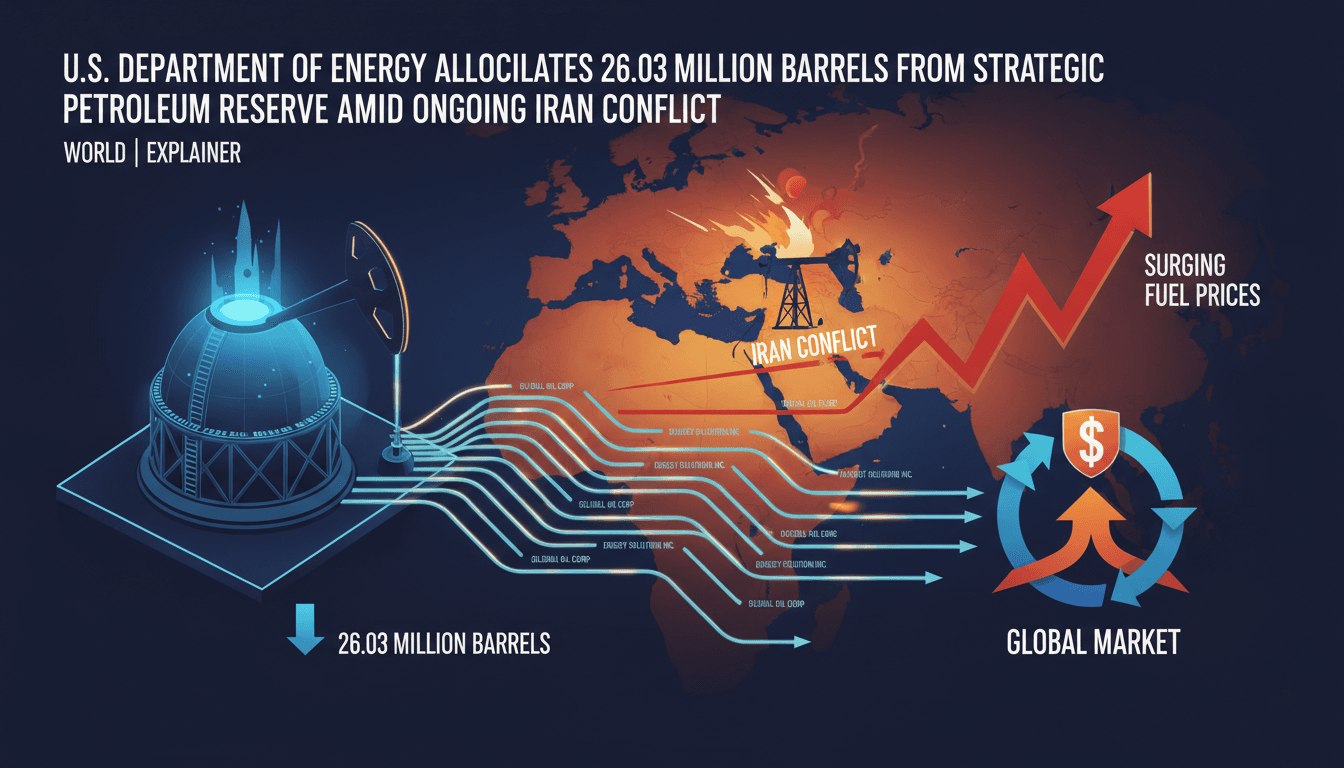
U.S. Department of Energy Allocates 26.03 Million Barrels from Strategic Petroleum Reserve Amid Ongoing Iran Conflict
Here's what it means for you.
Rising global oil prices could impact your fuel costs and economic stability, even if you're insulated by local subsidies.
Why it matters
The U.S. Department of Energy's strategic oil loans are a direct response to geopolitical tensions that affect global oil supply and prices.
What happened (in 30 seconds)
- On April 17, 2026, the U.S. Department of Energy awarded contracts for 26.03 million barrels of crude oil loans from the Strategic Petroleum Reserve to nine oil companies.
- This action is part of a broader strategy to stabilize fuel prices amid disruptions caused by the U.S.-Israeli war on Iran.
- The loans must be repaid with premium barrels, ensuring no cost to taxpayers while addressing immediate supply concerns.
The context you actually need
- The U.S.-Israeli conflict with Iran has escalated since early 2026, closing the Strait of Hormuz and driving Brent crude prices above $110 per barrel.
- In March 2026, President Trump authorized a 172 million barrel release from the Strategic Petroleum Reserve, aligning with a global drawdown coordinated by the International Energy Agency.
- The emergency exchanges leverage the DOE's authority to provide loans that are repaid with interest-equivalent premium barrels, avoiding taxpayer costs while stabilizing the market.
What's really happening
The recent award of 26.03 million barrels from the Strategic Petroleum Reserve (SPR) is the third phase of emergency exchanges initiated by the U.S. Department of Energy (DOE) in response to surging oil prices. This spike is largely attributed to the ongoing U.S.-Israeli military conflict with Iran, which has significantly disrupted oil flows through the critical Strait of Hormuz. As a result, Brent crude prices have soared above $110 per barrel, prompting the DOE to act decisively.
In March 2026, the Trump administration authorized a substantial release of 172 million barrels from the SPR, part of a coordinated effort with the International Energy Agency (IEA) to stabilize global oil supplies. The DOE's strategy involves a phased approach to emergency exchanges, allowing oil companies to borrow crude oil with the obligation to repay the principal plus additional premium barrels. This mechanism is designed to ensure that taxpayers are not burdened with costs while addressing immediate supply concerns.
The latest round of contracts awarded to nine oil companies, including major players like ExxonMobil and BP, reflects a high industry demand for crude oil amid persistent supply risks. With over 63% uptake in the latest round, the refining sector is clearly feeling the pressure to secure adequate supplies. The DOE's approach not only stabilizes the market but also signals a commitment to maintaining energy security without direct financial implications for taxpayers.
As global oil benchmarks remain elevated, the market is closely monitoring the situation in the Strait of Hormuz and the potential for further disruptions. The DOE has indicated that additional requests for proposals (RFPs) for exchanges may be forthcoming, suggesting that the government is prepared to take further action if necessary. This proactive stance underscores the importance of maintaining a stable oil supply in the face of geopolitical tensions.
Who feels it first (and how)
- Oil companies: Increased borrowing from the SPR to meet refining demands.
- Consumers: Potential rise in fuel prices, affecting transportation and living costs.
- Governments: Economic stability may be challenged if oil prices remain high, impacting budgets and subsidies.
- Exporting nations: Countries like the UAE may benefit from elevated oil prices, enhancing revenues and economic stability.
What to watch next
- Further RFPs from the DOE: Indications of additional emergency exchanges could signal ongoing supply concerns and price volatility.
- Global oil price trends: Monitoring Brent crude prices will provide insight into market reactions to geopolitical developments.
- Reopening of the Strait of Hormuz: Any changes in the security situation could significantly impact oil supply and pricing dynamics.
The U.S. has awarded 26.03 million barrels in loans from the SPR.
Global oil prices will remain elevated due to ongoing geopolitical tensions.
The long-term impact on consumer fuel prices and economic stability remains uncertain.
Frequently Asked Questions
- Why it matters?
- The U.S. Department of Energy's strategic oil loans are a direct response to geopolitical tensions that affect global oil supply and prices.
- What happened (in 30 seconds)?
- On April 17, 2026, the U.S. Department of Energy awarded contracts for 26.03 million barrels of crude oil loans from the Strategic Petroleum Reserve to nine oil companies. This action is part of a broader strategy to stabilize fuel prices amid disruptions caused by the U.S.-Israeli war on Iran. The loans must be repaid with premium barrels, ensuring no cost to taxpayers while addressing immediate supply concerns.
- What's really happening?
- The recent award of 26.03 million barrels from the Strategic Petroleum Reserve (SPR) is the third phase of emergency exchanges initiated by the U.S. Department of Energy (DOE) in response to surging oil prices. This spike is largely attributed to the ongoing U.S.-Israeli military conflict with Iran, which has significantly disrupted oil flows through the critical Strait of Hormuz. As a result, Brent crude prices have soared above $110 per barrel, prompting the DOE to act decisively. In March 20
- Who feels it first (and how)?
- Oil companies: Increased borrowing from the SPR to meet refining demands. Consumers: Potential rise in fuel prices, affecting transportation and living costs. Governments: Economic stability may be challenged if oil prices remain high, impacting budgets and subsidies. Exporting nations: Countries like the UAE may benefit from elevated oil prices, enhancing revenues and economic stability.
- What to watch next?
- Further RFPs from the DOE: Indications of additional emergency exchanges could signal ongoing supply concerns and price volatility. Global oil price trends: Monitoring Brent crude prices will provide insight into market reactions to geopolitical developments. Reopening of the Strait of Hormuz: Any changes in the security situation could significantly impact oil supply and pricing dynamics.
Pan-Arab news coverage spanning politics, business, sports, and regional affairs.
"Asharq Al-Awsat reflects a broad Arab editorial perspective with strong attention to regional geopolitics."
— A47 Editor
أميركا: منح 9 شركات 26 مليون برميل من الاحتياطي النفطي الاستراتيجي
The U.S. Department of Energy has allocated 26.03 million barrels of crude oil from the Strategic Petroleum Reserve to nine oil companies in an effort to alleviate rising fuel prices. This decision reflects the government's response to ongoing concer...
Sports reporting with a focus on Saudi and regional competitions.
"Okaz sports coverage is broad and audience-friendly, with strong attention to Saudi teams and leagues."
— A47 Editor
دولة عظمى تمنح 9 شركات 26 مليون برميل نفط من الاحتياطي
The U.S. Department of Energy has announced the allocation of 26.03 million barrels of crude oil from the Strategic Petroleum Reserve to nine oil companies, as part of the third round of efforts by the Trump administration to mitigate sharply rising ...