
Cryptocurrency Hacks Surpass $607 Million in April 2026
Here's what it means for you.
If you're involved in cryptocurrency, expect increased scrutiny and potential costs as security vulnerabilities reshape the landscape.
Why it matters
The surge in cryptocurrency hacks signals a critical vulnerability in decentralized finance (DeFi) systems, impacting investor confidence and market stability.
What happened (in 30 seconds)
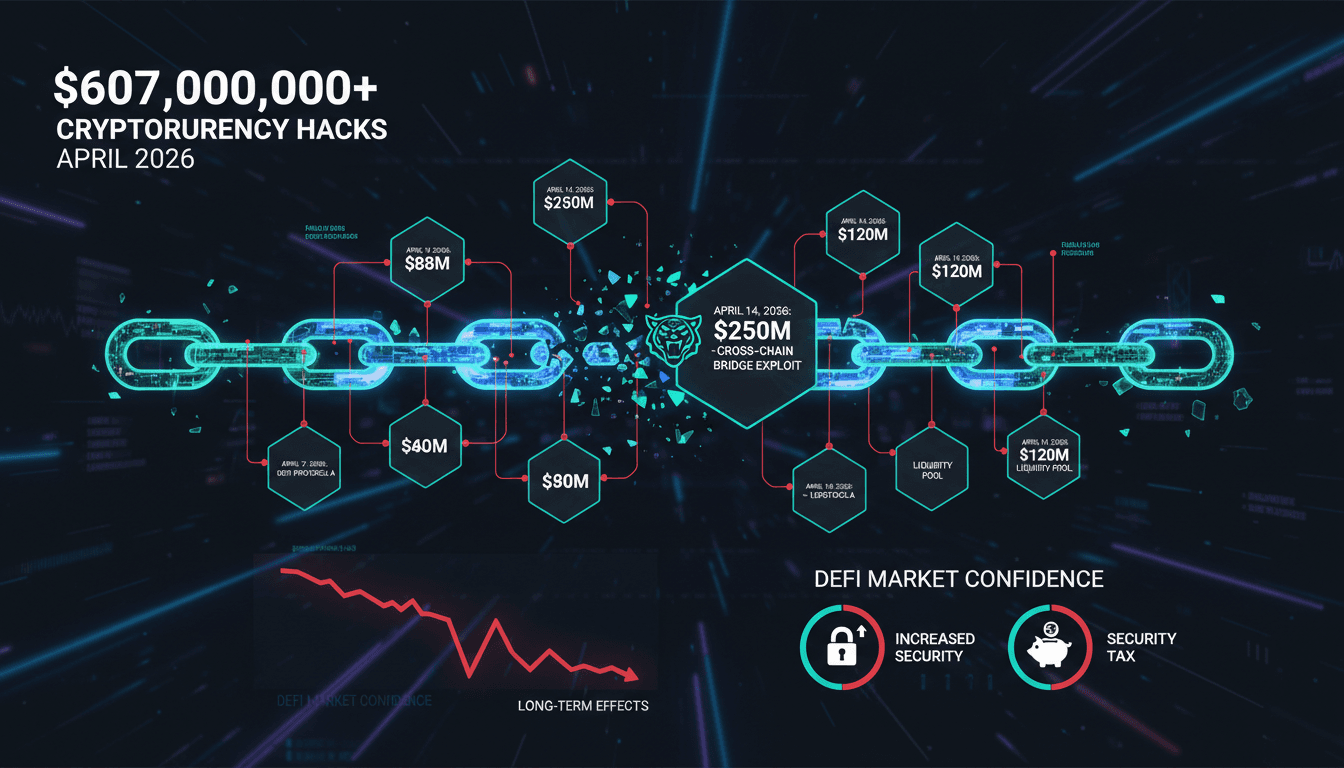
- Over $607 million was stolen in cryptocurrency hacks across 12 incidents in April 2026.
- Major losses occurred at Drift Protocol ($285 million) and KelpDAO ($293 million), accounting for 95% of total thefts.
- Security measures are being enhanced across protocols, with markets pricing in a 'security tax' through increased risk premiums.
The context you actually need
- Rising DeFi activity has expanded attack surfaces, making protocols more susceptible to sophisticated hacks.
- North Korean actors have been linked to many of these exploits, utilizing advanced social engineering tactics to manipulate systems.
- Market reactions include a 7% drop in DeFi total value locked (TVL) and shifts towards centralized platforms as users seek safer options.
What's really happening
In April 2026, the cryptocurrency landscape faced a significant upheaval as hackers exploited vulnerabilities across various decentralized finance (DeFi) protocols, resulting in over $607 million in losses. The most notable incidents involved Drift Protocol and KelpDAO, which together accounted for 95% of the total stolen funds. These hacks were not random; they were the culmination of a systematic approach by alleged North Korean actors, particularly the Lazarus Group (UNC1069), who have increasingly turned to sophisticated social engineering tactics to compromise systems.
The Drift Protocol hack on April 1 exemplified this trend, where a six-month campaign led to the compromise of admin keys, allowing attackers to manipulate token prices and siphon off funds. Similarly, the KelpDAO incident on April 18 involved a single-validator bridge exploit that highlighted the risks associated with cross-chain operations. These incidents underscore a broader issue: as DeFi's total value locked (TVL) rises, so does the attack surface, making protocols more vulnerable to breaches.
The aftermath of these hacks has been swift and severe. Following the KelpDAO exploit, the DeFi TVL dropped by 7%, with significant declines in major protocols like Aave. This has led to a market-wide reassessment of risk, with many investors rotating towards centralized and audited venues. The concept of a 'security tax' has emerged, where markets are pricing in the heightened risk of hacks through increased premiums on DeFi assets. This shift reflects a growing awareness of the inherent vulnerabilities in decentralized systems, prompting protocols to enhance their security measures.
In response to these events, many DeFi protocols are implementing stricter security protocols, including mandatory multi-validator setups and enhanced audits. However, the lack of major fund recoveries from these hacks raises questions about the effectiveness of these measures. As investigations continue, the industry is left grappling with the implications of these breaches, not just for security but for the future of decentralized finance itself.
Who feels it first (and how)
- Investors: Increased risk premiums and potential losses in DeFi assets.
- Developers: Pressure to enhance security measures and audits for protocols.
- Users of DeFi platforms: Potential disruptions and loss of funds, leading to a shift towards centralized options.
- Regulators: Heightened scrutiny on security practices within the cryptocurrency space.
What to watch next
- Security upgrades: Monitor how quickly and effectively protocols implement enhanced security measures in response to these hacks.
- Market reactions: Watch for further shifts in DeFi TVL and investor sentiment as the market adjusts to the new risk landscape.
- Regulatory developments: Keep an eye on potential regulatory responses that could emerge as a result of these high-profile hacks.
Over $607 million was stolen in cryptocurrency hacks in April 2026.
Increased security measures and a shift towards centralized platforms will continue as a response to these vulnerabilities.
The long-term impact on investor confidence and the overall health of the DeFi market remains uncertain.
Frequently Asked Questions
- Why it matters?
- The surge in cryptocurrency hacks signals a critical vulnerability in decentralized finance (DeFi) systems, impacting investor confidence and market stability.
- What happened (in 30 seconds)?
- Over $607 million was stolen in cryptocurrency hacks across 12 incidents in April 2026. Major losses occurred at Drift Protocol ($285 million) and KelpDAO ($293 million), accounting for 95% of total thefts. Security measures are being enhanced across protocols, with markets pricing in a 'security tax' through increased risk premiums.
- What's really happening?
- In April 2026, the cryptocurrency landscape faced a significant upheaval as hackers exploited vulnerabilities across various decentralized finance (DeFi) protocols, resulting in over $607 million in losses. The most notable incidents involved Drift Protocol and KelpDAO, which together accounted for 95% of the total stolen funds. These hacks were not random; they were the culmination of a systematic approach by alleged North Korean actors, particularly the Lazarus Group (UNC1069), who have increa
- Who feels it first (and how)?
- Investors: Increased risk premiums and potential losses in DeFi assets. Developers: Pressure to enhance security measures and audits for protocols. Users of DeFi platforms: Potential disruptions and loss of funds, leading to a shift towards centralized options. Regulators: Heightened scrutiny on security practices within the cryptocurrency space.
- What to watch next?
- Security upgrades: Monitor how quickly and effectively protocols implement enhanced security measures in response to these hacks. Market reactions: Watch for further shifts in DeFi TVL and investor sentiment as the market adjusts to the new risk landscape. Regulatory developments: Keep an eye on potential regulatory responses that could emerge as a result of these high-profile hacks.
Real-time updates, analysis, and reports on the blockchain and cryptocurrency sectors.
"Crypto News delivers real-time updates, analysis, and reports on the blockchain and cryptocurrency sectors."
— A47 Editor
Crypto hacks top $600m in April as market prices in ‘security tax’
In April 2026, the cryptocurrency sector has witnessed over $600 million stolen through hacks targeting decentralized finance (DeFi) platforms, bridges, and wallets, marking a significant escalation in security breaches. This surge in thefts has tran...
Research, news, and analysis on blockchain startups, DeFi, and regulations.
"Crypto Briefing provides research, news, and analysis on blockchain startups, DeFi, and crypto regulations with investor-focused coverage."
— A47 Editor
KelpDAO bridge hack drains $292M in largest DeFi exploit of 2026
The KelpDAO bridge hack has resulted in a staggering loss of $292 million, marking it as the largest exploit in decentralized finance (DeFi) for 2026. This incident has raised alarms about the security vulnerabilities inherent in interconnected crypt...
Covers blockchain, cryptocurrency news, project analysis, and market insights.
"CoinDesk is a well-established cryptocurrency and blockchain news provider, offering comprehensive insights, market data, and industry research."
— A47 Editor
'DeFi is dead': crypto community scrambles after this year's biggest hack exposes contagion risk
The decentralized finance (DeFi) sector is facing a crisis following a significant exploit that has led to fears of contagion, prompting billions to withdraw from various DeFi platforms. This incident has raised alarms about the structural vulnerabil...
Technology business and AI-related headlines.
"Data-driven tech newsroom with global scope."
— A47 Editor
Crypto Hack Worth $290 Million Triggers DeFi Contagion Shock
Hackers exploited a cross-chain bridge on Saturday, draining nearly $300 million from a key piece of decentralized finance infrastructure, which has triggered a ripple effect across multiple crypto platforms. This incident highlights vulnerabilities ...
Technology business news, market impacts, and innovation trends.
"Bloomberg is a premier financial and tech news provider, respected for its in-depth reporting and analytical rigor."
— A47 Editor
Crypto Hack Worth $290 Million Triggers DeFi Contagion Shock
Hackers exploited a cross-chain bridge on Saturday, draining nearly $300 million from a crucial component of decentralized finance infrastructure, leading to a significant ripple effect across various crypto platforms. This incident highlights vulner...