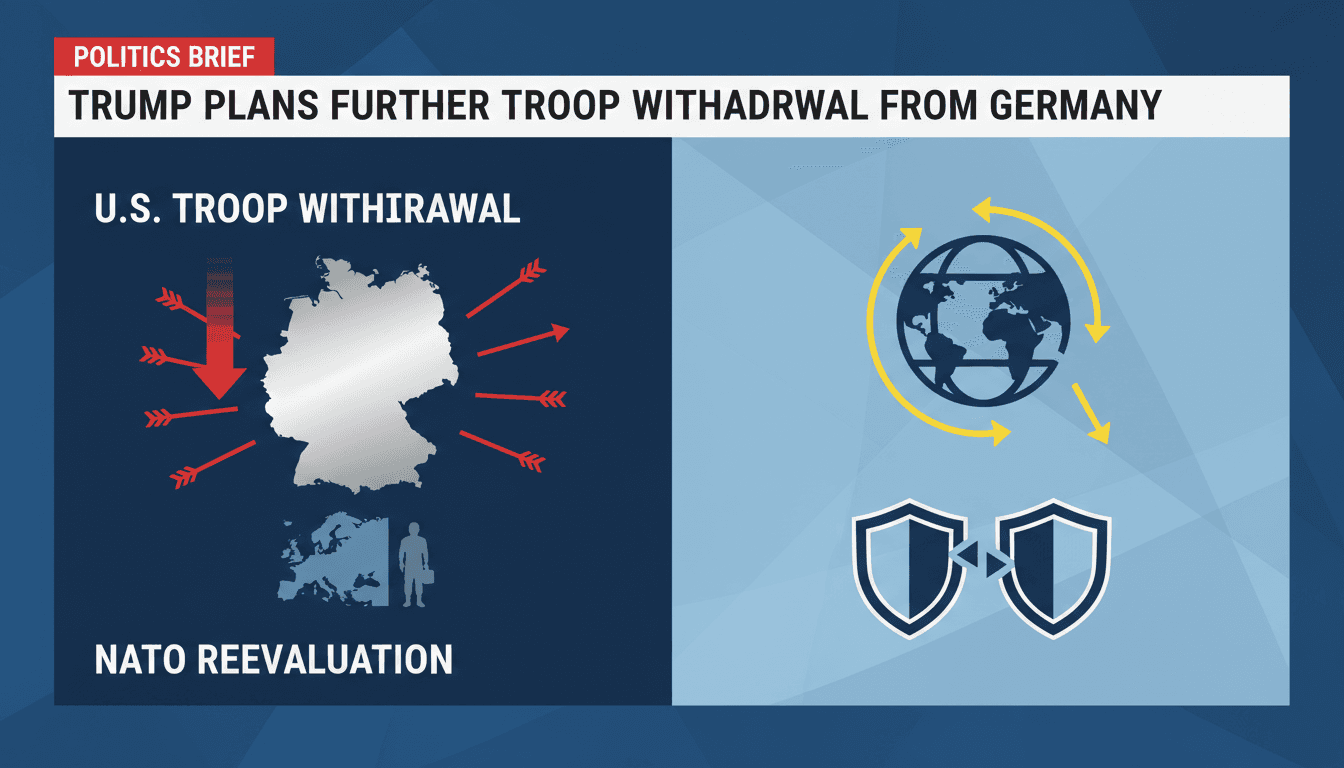
United States to Withdraw 5,000 Troops from Germany Amid NATO Tensions

Here's what it means for you.
If you’re in the defense sector or a NATO ally, this shift could reshape your strategic landscape.
Why it matters
This withdrawal signals a significant shift in U.S. military strategy and European defense responsibilities.
What happened (in 30 seconds)
- On May 1, 2026, the U.S. announced the withdrawal of approximately 5,000 troops from Germany, directed by President Trump.
- The move responds to European allies' perceived insufficient support in the Middle East crisis and NATO spending grievances.
- European leaders are interpreting this as a prompt for greater self-reliance in security matters.
The context you actually need
- U.S. troops have been stationed in Germany since World War II, with around 40,000 personnel serving as a critical logistics hub for NATO operations.
- President Trump has long criticized NATO allies for not meeting the 2% GDP defense spending target, particularly targeting Germany.
- Tensions escalated following a public dispute between Trump and German Chancellor Friedrich Merz over U.S. actions in the Middle East.
What's really happening
The decision to withdraw 5,000 troops from Germany is rooted in a complex interplay of geopolitical tensions and longstanding grievances regarding NATO defense spending. The U.S. has maintained a significant military presence in Germany since World War II, with approximately 40,000 troops stationed there as of 2026. This presence has served as a critical logistics hub for U.S. European Command and NATO operations, providing a strategic advantage in the region.
However, President Trump has consistently pushed for increased defense spending from NATO allies, particularly Germany, which has historically fallen short of the 2% GDP threshold. This pressure has created friction between the U.S. and its European allies, culminating in a public dispute with German Chancellor Friedrich Merz. Merz's criticism of U.S. actions in the Middle East, describing them as a humiliation, further strained relations.
The withdrawal announcement on May 1, 2026, was made by Pentagon spokesman Sean Parnell, fulfilling Trump's directive and signaling a potential shift in U.S. military strategy. The planned completion of this withdrawal within six to twelve months indicates a significant recalibration of U.S. military commitments in Europe. Trump has hinted that the cuts could extend beyond the initial 5,000 troops, raising concerns about the future of U.S. military presence in the region.
European leaders have reacted with a mix of concern and resolve. German Defense Minister Boris Pistorius emphasized the need for Europe to assume greater responsibility for its security, which may lead to increased military spending and infrastructure development across the continent. Polish Prime Minister Donald Tusk described the troop withdrawal as a "disastrous trend," urging a reversal of this trajectory. Meanwhile, U.K. Prime Minister Keir Starmer has called for Europe to step up its defense efforts, positioning Britain as a central player in this evolving landscape.
The implications of this withdrawal extend beyond military logistics; they touch on the very fabric of transatlantic relations and the future of NATO. As the U.S. reduces its footprint in Europe, European nations may be compelled to enhance their military capabilities and invest more heavily in defense. This shift could lead to a more self-reliant Europe, but it also raises questions about the stability of NATO and the collective security framework that has underpinned European defense for decades.
Who feels it first (and how)
- Defense contractors in Europe may see shifts in contracts and funding as nations ramp up military spending.
- NATO member states will need to reassess their defense strategies and budgets in light of reduced U.S. support.
- Military personnel and families in Germany will experience direct impacts from troop reductions and potential relocations.
What to watch next
- Increased military spending in Europe: Watch for announcements from European nations regarding defense budgets and military expansions, as they respond to the U.S. withdrawal.
- NATO's strategic realignment: Monitor how NATO adapts to the changing landscape and whether it can maintain cohesion among member states.
- U.S.-Iran relations: Keep an eye on developments in the Middle East, as ongoing tensions may influence further U.S. military decisions in Europe.
The U.S. is withdrawing approximately 5,000 troops from Germany.
European nations will increase their defense spending and military capabilities in response.
The long-term impact on NATO cohesion and U.S. military strategy in Europe remains uncertain.
This article was generated by AI from 9 verified sources and reviewed by A47 editorial systems.
Frequently Asked Questions
- Why it matters?
- This withdrawal signals a significant shift in U.S. military strategy and European defense responsibilities.
- What happened (in 30 seconds)?
- On May 1, 2026, the U.S. announced the withdrawal of approximately 5,000 troops from Germany, directed by President Trump. The move responds to European allies' perceived insufficient support in the Middle East crisis and NATO spending grievances. European leaders are interpreting this as a prompt for greater self-reliance in security matters.
- What's really happening?
- The decision to withdraw 5,000 troops from Germany is rooted in a complex interplay of geopolitical tensions and longstanding grievances regarding NATO defense spending. The U.S. has maintained a significant military presence in Germany since World War II, with approximately 40,000 troops stationed there as of 2026. This presence has served as a critical logistics hub for U.S. European Command and NATO operations, providing a strategic advantage in the region. However, President Trump has consi
- Who feels it first (and how)?
- Defense contractors in Europe may see shifts in contracts and funding as nations ramp up military spending. NATO member states will need to reassess their defense strategies and budgets in light of reduced U.S. support. Military personnel and families in Germany will experience direct impacts from troop reductions and potential relocations.
- What to watch next?
- Increased military spending in Europe: Watch for announcements from European nations regarding defense budgets and military expansions, as they respond to the U.S. withdrawal. NATO's strategic realignment: Monitor how NATO adapts to the changing landscape and whether it can maintain cohesion among member states. U.S.-Iran relations: Keep an eye on developments in the Middle East, as ongoing tensions may influence further U.S. military decisions in Europe.
Conservative-leaning political and national coverage.
"The Washington Times is a conservative-leaning newspaper known for its political coverage and advocacy of right-of-center viewpoints."
— A47 Editor
Trump says U.S. will pull 'a lot' more troops from Germany; key Republicans push back on drawdown
President Trump has announced plans to withdraw a significant number of U.S. troops from Germany, following an initial reduction of 5,000 troops. This decision has raised concerns among key Republican leaders in Congress, who fear it may send the wro...
International coverage of politics, culture, and current affairs.
"BBC News is widely regarded as a reputable international news organization, known for its impartial tone and public service mandate."
— A47 Editor
Germany troop cuts send wrong signal to Russia, say two top US Republicans
The Pentagon has announced the withdrawal of approximately 5,000 U.S. troops from Germany, a decision that has been criticized by top U.S. Republicans who argue it sends the wrong signal to Russia and undermines deterrence efforts. This move is seen ...
English-language news from Qatar covering domestic and regional affairs.
"Gulf Times reflects Qatari perspectives on regional developments."
— A47 Editor
US drawdown should spur Europe’s defence: Germany
The United States has announced a planned drawdown of approximately 5,000 troops from Germany, a decision articulated by Pentagon spokesperson Sean Parnell. This move is part of a broader reassessment of the U.S. military presence in Europe amid ongo...
International coverage from The Guardian's global desks.
"The Guardian is known for its progressive editorial stance and in-depth analysis."
— A47 Editor
Top Republicans express concern over withdrawal of US troops from Germany – as it happened
The Pentagon has announced the withdrawal of approximately 5,000 U.S. troops from Germany, a decision that has raised concerns among top Republicans, including Senator Roger Wicker and Representative Mike Rogers, who argue it undermines deterrence ag...
U.S. political news and right-leaning commentary.
"Fox News is a highly influential conservative news outlet known for right-leaning political commentary and coverage."
— A47 Editor
Trump's troop cuts in Europe could be blocked by Congress — here’s how he might get around it
President Trump has threatened to withdraw U.S. troops from NATO allies Germany, Italy, and Spain, citing their lack of support for operations related to the ongoing conflict in Iran. This potential troop reduction follows escalating tensions with Ge...
Comprehensive coverage of global events, politics, and international issues.
"NBC News is a mainstream outlet known for comprehensive national and international coverage with a centrist to slightly left-leaning editorial tone."
— A47 Editor
Europe rattled by 'disastrous trend' as Trump pulls 5,000 troops out of Germany
The Pentagon has announced the withdrawal of approximately 5,000 U.S. troops from Germany, a decision that has raised alarms among European leaders who are urging the continent to enhance its own defense capabilities. This move is seen as a significa...
National headlines across the United States including breaking stories and societal issues.
"NBC News is a mainstream media outlet known for comprehensive national and international news coverage with a centrist to slightly left-leaning editorial tone."
— A47 Editor
Europe rattled by 'disastrous trend' as Trump pulls 5,000 troops out of Germany
The Pentagon has announced the withdrawal of approximately 5,000 U.S. troops from Germany, a decision that follows escalating tensions between President Donald Trump and German Chancellor Friedrich Merz, particularly regarding U.S. strategies in the ...
Global news coverage with extensive reporting on Middle Eastern conflicts and geopolitics.
"Al Jazeera is a Qatar-based broadcaster known for wide regional coverage and alternative perspectives."
— A47 Editor
NATO assessing details of US troop withdrawal from Germany
The U.S. government has announced plans to withdraw approximately 5,000 troops from Germany over the next six to twelve months, a decision that has arisen amid escalating tensions between President Donald Trump and German Chancellor Friedrich Merz, p...
Comprehensive coverage of Middle Eastern and global issues.
"Al Jazeera is a prominent voice from the Global South, especially the Middle East, with an emphasis on underreported stories."
— A47 Editor
NATO assessing details of US troop withdrawal from Germany
The U.S. government has announced plans to withdraw approximately 5,000 troops from Germany over the next six to twelve months, a decision that has arisen amid escalating tensions between President Donald Trump and German Chancellor Friedrich Merz, p...
Top international stories selected by The Guardian editors.
"The Guardian is known for its progressive editorial stance and in-depth analysis."
— A47 Editor
‘We love our Americans’: the German town rocked by Trump’s plan to withdraw US troops
The announcement of the withdrawal of approximately 5,000 U.S. troops from Germany has deeply affected the town of Landstuhl, where American soldiers have been a significant part of the community since 1945. Local resident Nadine Firmont expressed he...
International coverage from The Guardian's global desks.
"The Guardian is known for its progressive editorial stance and in-depth analysis."
— A47 Editor
Trump threatens to withdraw US troops from Italy and Spain – as it happened
U.S. President Donald Trump has threatened to withdraw American troops from Italy and Spain, alongside a review of military presence in Europe, following public criticism regarding the U.S.-Israeli war on Iran. This announcement reflects escalating t...