
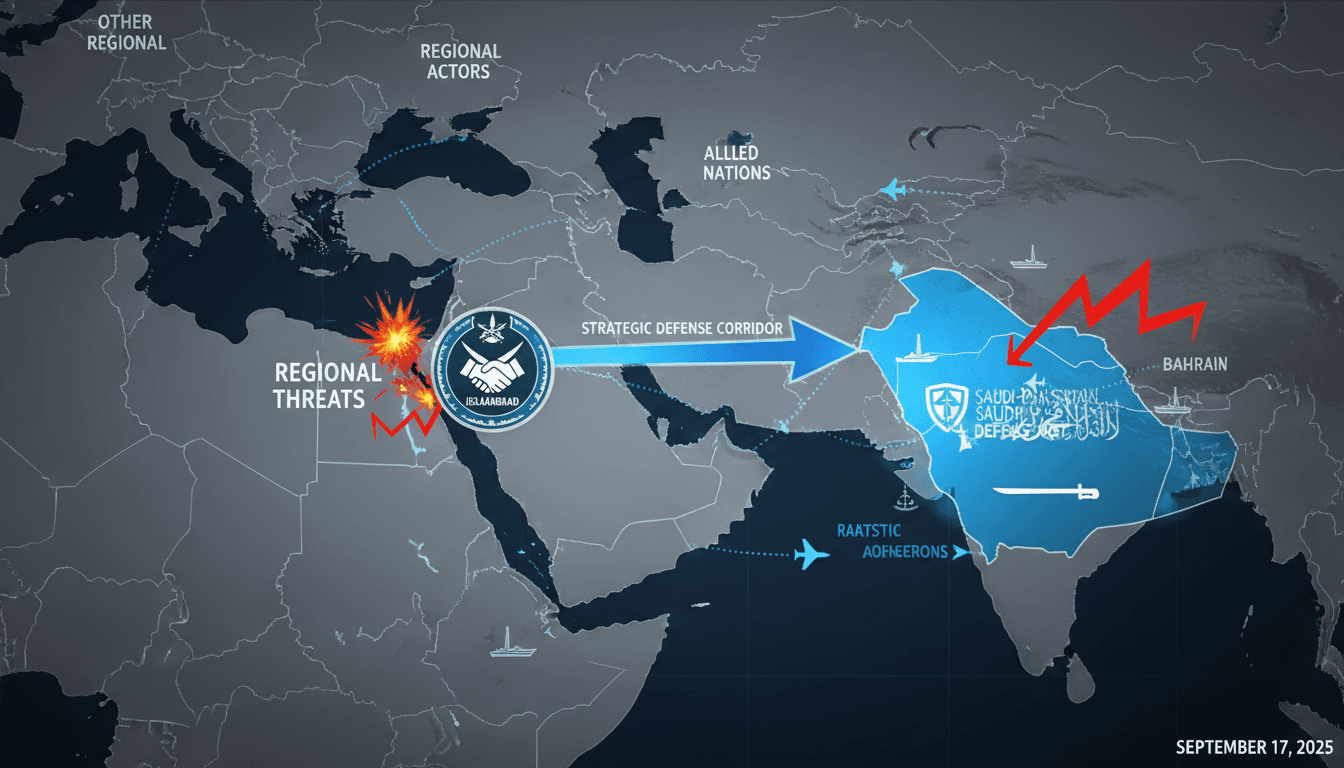
Saudi Arabia and Pakistan sign mutual defense agreement to enhance regional security
Here's what it means for you.
This agreement reshapes regional security dynamics, impacting global markets and geopolitical alliances.
Why it matters
The pact signals a shift in defense strategies among Gulf states, potentially altering the balance of power in the region.
What happened (in 30 seconds)
- On 17 September 2025, Saudi Arabia and Pakistan signed a Strategic Mutual Defense Agreement in Riyadh, formalizing military cooperation.
- The agreement treats aggression against either nation as an attack on both, enhancing deterrence against regional threats, particularly from Iran.
- Pakistani F-16 fighter jets were deployed to Saudi bases in April 2026, marking the first military collaboration under the new pact.
The context you actually need
- Saudi Arabia and Pakistan have a long history of military cooperation, dating back to the 1960s, which includes training and joint exercises.
- The agreement emerges amid a regional shift, as Gulf states seek alternatives to U.S. security guarantees following escalating tensions, such as Israel's strikes on Qatar.
- Pakistan's military capabilities, including an estimated 170 nuclear warheads, provide a significant deterrent, complementing Saudi Arabia's strategic resources.
What's really happening
The Saudi Arabia–Pakistan Strategic Mutual Defense Agreement represents a pivotal moment in Middle Eastern geopolitics, driven by a confluence of security concerns and strategic interests. With Iran's influence growing and the U.S. reducing its footprint in the region, Gulf states are increasingly looking to diversify their defense partnerships. This agreement formalizes a long-standing relationship between Saudi Arabia and Pakistan, which has been characterized by military training, financial support, and joint exercises.
The pact institutionalizes military cooperation, allowing both nations to respond collectively to threats. By treating aggression against one as an attack on both, the agreement aims to deter potential aggressors, particularly Iran, which has been a source of regional instability. The deployment of Pakistani F-16s to Saudi bases is a tangible manifestation of this commitment, enhancing operational readiness and coordination.
Moreover, the agreement has broader implications for the Gulf Cooperation Council (GCC) and the Islamic world. It signals a shift in the regional security architecture, where traditional alliances are being reevaluated. The inclusion of Pakistan, with its nuclear capabilities, adds a layer of deterrence that could alter the strategic calculus of adversaries in the region.
This development is also a response to the changing dynamics of U.S. foreign policy in the Middle East. As Gulf states seek to reduce their reliance on American security guarantees, they are looking to forge new alliances that can provide a robust defense framework. The Saudi-Pakistan agreement is a clear indication of this trend, as both nations seek to bolster their military capabilities in the face of external threats.
In essence, this agreement is not just about military cooperation; it reflects a broader strategic realignment in the region. By combining Pakistan's military expertise and nuclear arsenal with Saudi Arabia's resources and strategic position, the two nations are creating a formidable deterrent against potential aggressors, while also signaling to the international community their commitment to regional stability.
Who feels it first (and how)
- Military personnel in both Saudi Arabia and Pakistan will experience increased collaboration and joint training exercises.
- Defense contractors and the military-industrial sector in both countries may see increased investment and procurement opportunities.
- Regional governments in the Gulf will need to reassess their security strategies and alliances in response to this new military partnership.
- Investors and businesses in Dubai and the broader Gulf region may experience shifts in market stability and security perceptions, impacting economic activities.
What to watch next
- Military exercises: Look for upcoming joint military drills between Saudi Arabia and Pakistan, which will indicate the depth of their cooperation.
- Iran's response: Monitor Iran's diplomatic and military maneuvers in light of this agreement, as it may seek to counterbalance the new alliance.
- Regional economic impacts: Watch for shifts in investment patterns and economic stability in the Gulf, particularly in response to heightened security dynamics.
The agreement formalizes military cooperation between Saudi Arabia and Pakistan, enhancing regional security dynamics.
Other Gulf states may seek similar defense agreements with Pakistan or other nations to bolster their security frameworks.
The long-term effects on U.S.-Gulf relations and how this agreement will influence broader geopolitical alliances remain uncertain.
Frequently Asked Questions
- Why it matters?
- The pact signals a shift in defense strategies among Gulf states, potentially altering the balance of power in the region.
- What happened (in 30 seconds)?
- On 17 September 2025, Saudi Arabia and Pakistan signed a Strategic Mutual Defense Agreement in Riyadh, formalizing military cooperation. The agreement treats aggression against either nation as an attack on both, enhancing deterrence against regional threats, particularly from Iran. Pakistani F-16 fighter jets were deployed to Saudi bases in April 2026, marking the first military collaboration under the new pact.
- What's really happening?
- The Saudi Arabia–Pakistan Strategic Mutual Defense Agreement represents a pivotal moment in Middle Eastern geopolitics, driven by a confluence of security concerns and strategic interests. With Iran's influence growing and the U.S. reducing its footprint in the region, Gulf states are increasingly looking to diversify their defense partnerships. This agreement formalizes a long-standing relationship between Saudi Arabia and Pakistan, which has been characterized by military training, financial s
- Who feels it first (and how)?
- Military personnel in both Saudi Arabia and Pakistan will experience increased collaboration and joint training exercises. Defense contractors and the military-industrial sector in both countries may see increased investment and procurement opportunities. Regional governments in the Gulf will need to reassess their security strategies and alliances in response to this new military partnership. Investors and businesses in Dubai and the broader Gulf region may experience shifts in market sta
- What to watch next?
- Military exercises: Look for upcoming joint military drills between Saudi Arabia and Pakistan, which will indicate the depth of their cooperation. Iran's response: Monitor Iran's diplomatic and military maneuvers in light of this agreement, as it may seek to counterbalance the new alliance. Regional economic impacts: Watch for shifts in investment patterns and economic stability in the Gulf, particularly in response to heightened security dynamics.
Arabic-language reporting focused on domestic developments in Saudi Arabia.
"Okaz is a mainstream Saudi newspaper that often reflects domestic priorities and official-facing coverage."
— A47 Editor
اتفاقية الدفاع المشترك بين السعودية وباكستان.. مظلة ردع لحماية الخليج والعالم الإسلامي
In September 2025, Saudi Arabia and Pakistan signed a strategic defense agreement, stating that an attack on one nation would be considered an attack on both. The signing took place at the royal palace in Riyadh, with Crown Prince Mohammed bin Salman...
Pan-Arab news coverage spanning politics, business, sports, and regional affairs.
"Asharq Al-Awsat reflects a broad Arab editorial perspective with strong attention to regional geopolitics."
— A47 Editor
قوة عسكرية باكستانية تصل إلى السعودية ضمن «اتفاقية الدفاع المشترك»
The Saudi Ministry of Defense announced the arrival of a military force from Pakistan at King Abdulaziz Air Base in the Eastern Province, as part of a strategic defense agreement between the two nations. This development highlights the ongoing milita...
Egyptian politics, economy, and society coverage.
"Al Masry Al Youm is a major Egyptian newspaper with broad national coverage."
— A47 Editor
قوة باكستانية تصل السعودية ضمن اتفاقية الدفاع المشترك
The Saudi Ministry of Defense announced the arrival of a military force from Pakistan to the country as part of a joint defense agreement between the two nations. This development highlights the ongoing collaboration and strategic partnership in defe...
Arabic-language coverage of Saudi, regional, and international affairs.
"Al Bilad offers mainstream Saudi newspaper coverage across domestic and broader Arab topics."
— A47 Editor
وصول قوة عسكرية باكستانية إلى المملكة ضمن اتفاقية الدفاع الإستراتيجي المشترك
The Ministry of Defense announced the arrival of a military force from the Islamic Republic of Pakistan at King Abdulaziz Air Base in the Eastern Province, as part of a joint strategic defense agreement between the two countries. This Pakistani conti...