
South Korea implements AI surveillance system for cryptocurrency market regulation
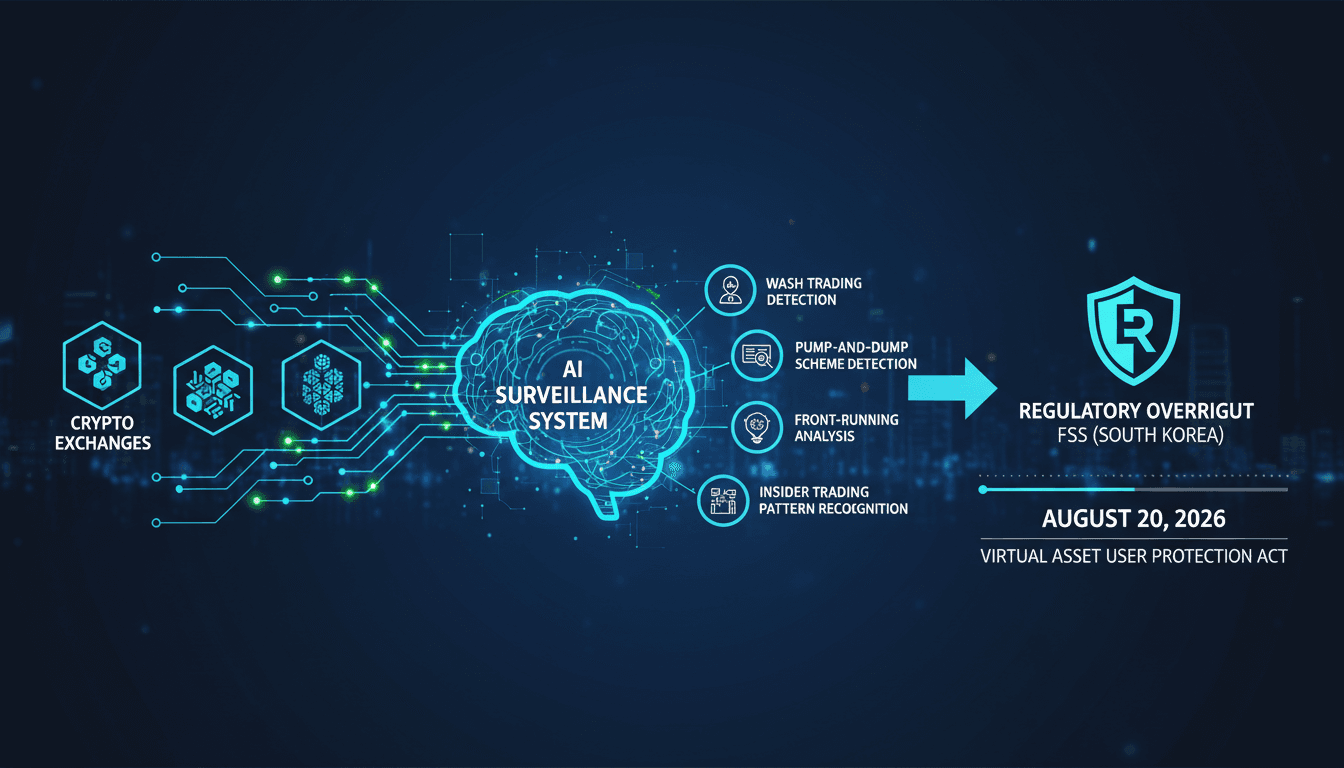
Here's what it means for you.
If you trade cryptocurrencies, be aware that South Korea's new AI system could influence market dynamics and regulatory scrutiny.
Why it matters
This deployment represents a significant step in regulatory technology, aiming to enhance market integrity and protect investors.
What happened (in 30 seconds)
- On August 20, 2026, South Korea's Financial Supervisory Service (FSS) launched a real-time AI surveillance platform for cryptocurrency trading.
- The system uses generative AI and machine learning to detect suspicious trading activities, including price manipulation and wash trading.
- Human investigators will review AI-generated alerts before any formal actions are taken against suspected violators.
The context you actually need
- The Virtual Asset User Protection Act, enacted in July 2024, established a regulatory framework for cryptocurrency trading in South Korea.
- In the first two years, authorities examined over 40 suspected unfair trading cases, with average unlawful gains of approximately 1.4 billion won ($940,000) per case.
- The new AI system builds on earlier algorithms that supported post-alert analysis, now integrating real-time monitoring and preliminary reviews.
What's really happening
The FSS's deployment of the AI surveillance system marks a pivotal moment in the regulation of cryptocurrency markets. By leveraging advanced technologies like generative AI and machine learning, the platform aims to automate the detection of unfair trading practices that have historically required extensive manual review.
The system operates under the Virtual Asset User Protection Act, which was designed to safeguard investors and ensure fair trading practices in the rapidly evolving cryptocurrency landscape. The AI platform identifies abnormal price or volume spikes in real-time, utilizing historical investigation patterns to classify various trading schemes. For instance, it can detect 'racehorse' schemes characterized by sharp short-term price movements and 'cage' schemes that occur during deposit or withdrawal restrictions.
Once suspicious activity is flagged, the AI cross-references news and exchange announcements to identify legitimate market catalysts. If no valid explanations are found, the system triggers requests for additional data from exchanges. This proactive approach aims to minimize the time taken to identify and address potential market manipulation.
Moreover, the platform employs Benford’s Law and machine learning techniques to flag wash trading, while also scanning social media platforms and online forums for coordinated promotional activities or misinformation. This comprehensive monitoring framework ensures that human investigators retain the final decision-making authority on all alerts, thereby reducing the risk of false positives that could arise from automated systems.
The introduction of this AI surveillance system is a response to the increasing sophistication of manipulation tactics in cryptocurrency markets. As trading strategies evolve, regulators are compelled to adopt more advanced tools to maintain market integrity. The FSS's initiative reflects a broader trend in regulatory technology, where automation and AI are becoming integral to compliance and oversight functions.
This deployment also extends existing exchange-level controls, such as API-key monitoring introduced earlier in May 2026. Industry experts emphasize the importance of reliable data inputs and human oversight to ensure the effectiveness of such systems. The parallel practices observed in U.S. regulatory frameworks, which also require human review of AI outputs, further underscore the necessity of maintaining a balance between automation and human judgment.
Who feels it first (and how)
- Cryptocurrency traders: Increased scrutiny may affect trading strategies and market behavior.
- Crypto exchanges: They will need to adapt to new compliance requirements and potential operational changes.
- Regulatory bodies: Other countries may look to South Korea's model as a benchmark for their own regulatory frameworks.
What to watch next
- Market reactions: Monitor how traders adjust their strategies in response to heightened regulatory scrutiny.
- Regulatory developments: Watch for potential adoption of similar AI systems in other jurisdictions, which could influence global trading practices.
- Technological enhancements: Keep an eye on updates to the AI platform, particularly regarding fund-flow and on-chain analysis capabilities.
The FSS has deployed a real-time AI surveillance system for cryptocurrency trading.
Other countries may adopt similar regulatory technologies in response to market manipulation concerns.
The long-term impact on trading volumes and market behavior remains to be seen.
Frequently Asked Questions
- Why it matters?
- This deployment represents a significant step in regulatory technology, aiming to enhance market integrity and protect investors.
- What happened (in 30 seconds)?
- On August 20, 2026, South Korea's Financial Supervisory Service (FSS) launched a real-time AI surveillance platform for cryptocurrency trading. The system uses generative AI and machine learning to detect suspicious trading activities, including price manipulation and wash trading. Human investigators will review AI-generated alerts before any formal actions are taken against suspected violators.
- What's really happening?
- The FSS's deployment of the AI surveillance system marks a pivotal moment in the regulation of cryptocurrency markets. By leveraging advanced technologies like generative AI and machine learning, the platform aims to automate the detection of unfair trading practices that have historically required extensive manual review. The system operates under the Virtual Asset User Protection Act, which was designed to safeguard investors and ensure fair trading practices in the rapidly evolving cryptocu
- Who feels it first (and how)?
- Cryptocurrency traders: Increased scrutiny may affect trading strategies and market behavior. Crypto exchanges: They will need to adapt to new compliance requirements and potential operational changes. Regulatory bodies: Other countries may look to South Korea's model as a benchmark for their own regulatory frameworks.
- What to watch next?
- Market reactions: Monitor how traders adjust their strategies in response to heightened regulatory scrutiny. Regulatory developments: Watch for potential adoption of similar AI systems in other jurisdictions, which could influence global trading practices. Technological enhancements: Keep an eye on updates to the AI platform, particularly regarding fund-flow and on-chain analysis capabilities.
Real-time updates, analysis, and reports on the blockchain and cryptocurrency sectors.
"Crypto News delivers real-time updates, analysis, and reports on the blockchain and cryptocurrency sectors."
— A47 Editor
South Korea deploys real-time AI crypto surveillance
South Korea's Financial Supervisory Service has implemented a real-time AI surveillance system designed to monitor trading data, news, and online content to identify potential cryptocurrency price manipulation. This initiative aims to enhance regulat...
Covers Bitcoin plus altcoin news, market updates, and educational resources.
"Bitcoin.com provides news, market data, and guides focused on Bitcoin and the wider crypto industry."
— A47 Editor
South Korea Deploys AI to Bust Crypto Market Manipulation
South Korea has deployed artificial intelligence (AI) technology to combat cryptocurrency market manipulation, a move led by the Financial Supervisory Service. This initiative aims to enhance regulatory oversight and ensure a fair trading environment...
Covers blockchain, cryptocurrency news, project analysis, and market insights.
"Cointelegraph is a leading crypto-focused media outlet known for timely news, analysis, and educational content related to blockchain and digital assets."
— A47 Editor
South Korean lawmakers seek expanded FIU powers over unregistered crypto firms
South Korean lawmakers are proposing to expand the powers of the Financial Intelligence Unit (FIU) to investigate unregistered cryptocurrency firms and refer suspected violations directly to law enforcement. This initiative aims to enhance regulatory...