
U.S. Treasury's Long-Term Bond Buyback Expansion Sparks Bitcoin Surge
Here's what it means for you.
If you’re invested in cryptocurrencies or financial markets, this event could reshape your portfolio strategy.
Why it matters
This event highlights the interconnectedness of traditional finance and cryptocurrency markets, signaling potential shifts in investment strategies.
What happened (in 30 seconds)
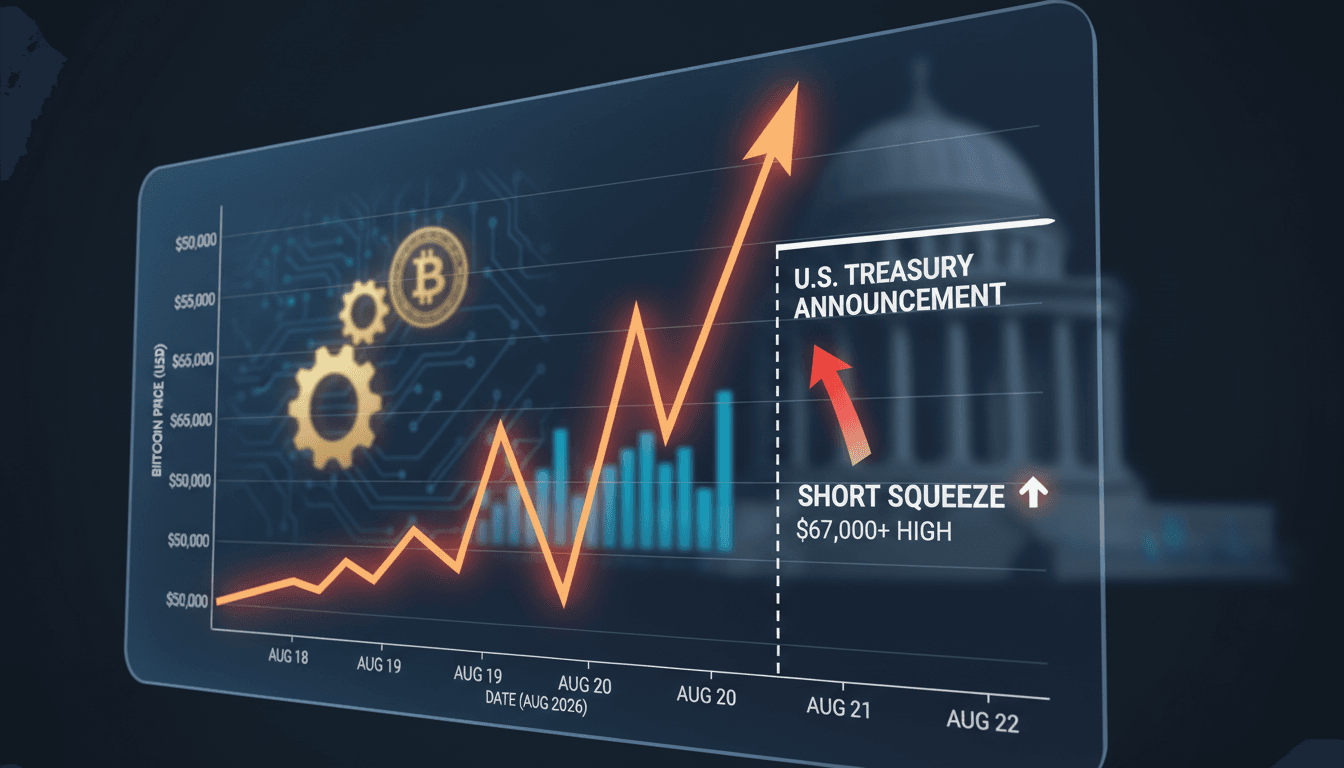
- On August 19-20, 2026, the U.S. Treasury announced it would double long-term Treasury buybacks, leading to a significant market reaction.
- Bitcoin surged above $67,000, reaching over $77,000 within days, as traders closed short positions amid rising demand.
- Over $4 billion in bearish crypto positions were liquidated, amplifying the price rally and indicating a shift in market sentiment.
The context you actually need
- National debt exceeded $40 trillion in August 2026, raising concerns about fiscal sustainability and inflation.
- Geopolitical tensions, particularly related to Iran, contributed to inflationary pressures, affecting energy prices and investor confidence.
- Regulatory momentum was building, with the White House advocating for pro-crypto legislation, including the Clarity Act.
What's really happening
The U.S. Treasury's decision to double its long-term bond buybacks from approximately $2 billion to at least $4 billion per operation was a strategic move aimed at stabilizing the bond market after a recent sell-off. This intervention was necessary as the national debt had surpassed $40 trillion, and rising inflation concerns were exacerbated by geopolitical tensions, particularly those involving Iran. The Treasury's action effectively lowered long-term yields, which in turn weakened the U.S. dollar.
As the dollar weakened, investors began to rotate their capital into alternative assets, notably Bitcoin and gold, in what is termed a "debasement trade." This shift was further fueled by President Trump's push for crypto-friendly legislation, which created a more favorable environment for cryptocurrency investments. The combination of these factors led to a significant increase in demand for Bitcoin, which broke through its resistance level of $67,000.
The forced closure of short positions—where traders had bet against Bitcoin—added fuel to the fire. As Bitcoin's price began to rise, those holding short positions were compelled to buy back Bitcoin to cover their losses, further driving up the price. By the end of the week, Bitcoin had surged over 20%, reaching above $77,000, while gold also saw gains, surpassing $4,661.
This event is significant not only for its immediate impact on Bitcoin prices but also for its implications for the broader financial landscape. It signals a potential shift in how traditional financial policies can influence cryptocurrency markets. The liquidity signal sent by the Treasury's actions suggests that investors may increasingly view cryptocurrencies as a hedge against traditional market volatility and inflation.
Who feels it first (and how)
- Cryptocurrency traders: Those with short positions faced immediate financial repercussions due to forced liquidations.
- Investors in alternative assets: Individuals and institutions holding Bitcoin or gold benefited from the price surge.
- Financial analysts and economists: They will need to reassess models that link traditional finance with cryptocurrency dynamics.
- Regulatory bodies: Increased scrutiny and potential changes in policy may arise as the market reacts to these developments.
What to watch next
- Regulatory developments: Watch for updates on the Clarity Act and other pro-crypto legislation, as these could further influence market dynamics.
- Inflation indicators: Keep an eye on inflation rates and energy prices, particularly in relation to geopolitical events, as they could impact investor sentiment.
- Market liquidity trends: Monitor how liquidity in both traditional and cryptocurrency markets evolves in response to fiscal policies and market interventions.
The U.S. Treasury's bond buyback expansion has immediate effects on Bitcoin prices and market sentiment.
Continued regulatory momentum will shape the future landscape of cryptocurrency trading and investment.
The long-term implications of this event on inflation and fiscal policy remain uncertain.
Frequently Asked Questions
- Why it matters?
- This event highlights the interconnectedness of traditional finance and cryptocurrency markets, signaling potential shifts in investment strategies.
- What happened (in 30 seconds)?
- On August 19-20, 2026, the U.S. Treasury announced it would double long-term Treasury buybacks, leading to a significant market reaction. Bitcoin surged above $67,000, reaching over $77,000 within days, as traders closed short positions amid rising demand. Over $4 billion in bearish crypto positions were liquidated, amplifying the price rally and indicating a shift in market sentiment.
- What's really happening?
- The U.S. Treasury's decision to double its long-term bond buybacks from approximately $2 billion to at least $4 billion per operation was a strategic move aimed at stabilizing the bond market after a recent sell-off. This intervention was necessary as the national debt had surpassed $40 trillion, and rising inflation concerns were exacerbated by geopolitical tensions, particularly those involving Iran. The Treasury's action effectively lowered long-term yields, which in turn weakened the U.S. do
- Who feels it first (and how)?
- Cryptocurrency traders: Those with short positions faced immediate financial repercussions due to forced liquidations. Investors in alternative assets: Individuals and institutions holding Bitcoin or gold benefited from the price surge. Financial analysts and economists: They will need to reassess models that link traditional finance with cryptocurrency dynamics. Regulatory bodies: Increased scrutiny and potential changes in policy may arise as the market reacts to these developments.
- What to watch next?
- Regulatory developments: Watch for updates on the Clarity Act and other pro-crypto legislation, as these could further influence market dynamics. Inflation indicators: Keep an eye on inflation rates and energy prices, particularly in relation to geopolitical events, as they could impact investor sentiment. Market liquidity trends: Monitor how liquidity in both traditional and cryptocurrency markets evolves in response to fiscal policies and market interventions.
Corporate leadership, finance, technology, and market trends.
"Fortune covers financial trends, leadership, and innovation with a pragmatic editorial approach."
— A47 Editor
Traders bet bitcoin was stuck below $67,000. The Treasury blew that trade up in one afternoon
A surprise bond buyback by the U.S. Treasury triggered a significant market reaction, resulting in the liquidation of over $4 billion in bearish crypto bets and propelling bitcoin's price past $77,000. This unexpected move disrupted traders who had a...
Covers blockchain, cryptocurrency news, project analysis, and market insights.
"CoinDesk is a well-established cryptocurrency and blockchain news provider, offering comprehensive insights, market data, and industry research."
— A47 Editor
How a Treasury buyback tweak helped bitcoin surge 25% to nearly $80,000 in days
Bitcoin's price surged nearly 25% to approach $80,000 following the U.S. Treasury's decision to double its bond buyback operations, which analysts noted is not quantitative easing (QE) but has effectively eased long-term yields from 19-year highs. Th...
Real-time updates, analysis, and reports on the blockchain and cryptocurrency sectors.
"Crypto News delivers real-time updates, analysis, and reports on the blockchain and cryptocurrency sectors."
— A47 Editor
Bitcoin just had its best week since 2024; sentiment flipped from fear to greed in a day
Bitcoin experienced a significant surge, surpassing $75,000, following a U.S. Treasury announcement to double its bond buyback operations to $4 billion. This unexpected policy shift triggered short liquidations and a rapid change in market sentiment ...
UAE-based English-language newspaper covering regional politics, economics, and global affairs.
"The National reflects Emirati policy perspectives while maintaining international editorial standards."
— A47 Editor
Bitcoin climbs past $75,000 in extended Asia crypto rally
Bitcoin's price surged past $75,000 during early trading in Asia, continuing a rally that began after the US Treasury announced measures to control long-term bond yields. This increase reflects a growing investor confidence in cryptocurrencies amid s...