
Ethereum Foundation Sets December 2029 Deadline for Quantum-Resistant Layer 1 Upgrade
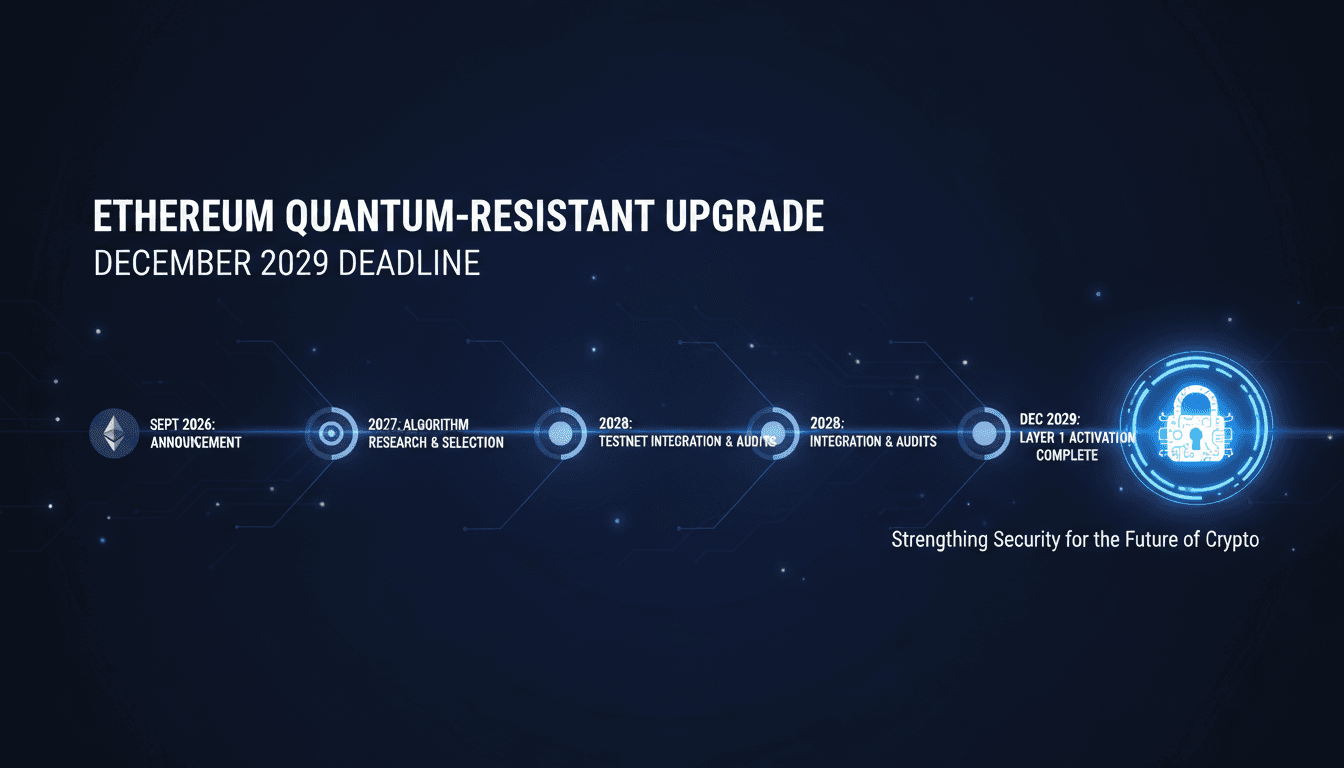
Here's what it means for you.
If you're involved in blockchain or crypto, Ethereum's move to quantum resistance could enhance the security of your digital assets.
Why it matters
This initiative addresses potential vulnerabilities in Ethereum's cryptographic framework, ensuring long-term security against future quantum computing threats.
What happened (in 30 seconds)
- Ethereum Foundation announced a target for quantum-resistant Layer 1 by December 2029.
- 60 specialists from nine teams evaluated 62 proposals to enhance Ethereum's security.
- Hegotá upgrade will serve as an initial checkpoint in the implementation process.
The context you actually need
- Quantum computers could theoretically break current cryptographic standards, posing a risk to Ethereum accounts and validators.
- NIST's post-quantum standards, approved in 2024, set a transition timeline extending to 2035, prompting Ethereum's proactive measures.
- Major tech firms like Google and Microsoft are also aligning their timelines with Ethereum's, indicating a broader industry shift towards quantum resistance.
What's really happening
On September 7, 2026, the Ethereum Foundation unveiled a comprehensive roadmap aimed at achieving quantum resistance by December 2029. This ambitious target is not merely a reaction to emerging threats but a strategic initiative to future-proof the Ethereum blockchain against the anticipated capabilities of quantum computers. The foundation's Protocol Cluster, led by Fredrik Svantes, has mobilized approximately 60 specialists from nine teams to assess and prioritize 62 Ethereum Improvement Proposals (EIPs).
The core narrative revolves around the Hegotá upgrade, which will serve as a critical milestone in this transition. The Ethereum Foundation has set an aggressive fork cadence of approximately 7.2 months, indicating a commitment to rapid development and implementation. Preparatory work includes the introduction of account-level post-quantum signatures and a variable-length validator deposit contract, which are essential for enhancing the network's security framework.
The urgency of this initiative stems from the theoretical capabilities of quantum computers, which could potentially break 256-bit elliptic curve cryptography—currently used by Ethereum—requiring an estimated 1,200 logical qubits, significantly fewer than previous estimates. This stark reality underscores the need for Ethereum to transition to post-quantum cryptographic standards well before the 2035 deadline set by NIST.
Moreover, Ethereum's proactive stance aligns with the broader industry trend, as major technology firms are also targeting similar timelines for quantum resistance. This alignment not only strengthens Ethereum's position in the blockchain ecosystem but also enhances the overall security landscape for digital assets. The Ethereum Foundation's commitment to this upgrade reflects a deep understanding of the long-term implications of quantum computing on decentralized networks.
As the implementation planning progresses, an Ask Me Anything (AMA) session is scheduled for September 16, 2026, allowing stakeholders to engage directly with the development team and gain insights into the roadmap's specifics. This transparency is crucial for fostering trust and collaboration within the Ethereum community as it navigates this complex transition.
Who feels it first (and how)
- Blockchain developers: They will need to adapt to new protocols and standards.
- Crypto investors: Enhanced security may increase confidence in Ethereum as a long-term investment.
- Tech firms: Companies aligning with Ethereum's timeline may benefit from improved security measures.
What to watch next
- Implementation milestones: Keep an eye on the progress of the Hegotá upgrade and subsequent forks, as they will indicate the pace of development.
- Industry alignment: Monitor how other tech firms respond to Ethereum's timeline and whether they adopt similar measures.
- Market reactions: Watch for shifts in investor sentiment and market dynamics as Ethereum's quantum resistance efforts unfold.
Ethereum is targeting quantum resistance by December 2029.
Other blockchain networks may follow suit in enhancing their security protocols.
The exact impact of quantum computing on current cryptographic standards remains theoretical.
Frequently Asked Questions
- Why it matters?
- This initiative addresses potential vulnerabilities in Ethereum's cryptographic framework, ensuring long-term security against future quantum computing threats.
- What happened (in 30 seconds)?
- Ethereum Foundation announced a target for quantum-resistant Layer 1 by December 2029. 60 specialists from nine teams evaluated 62 proposals to enhance Ethereum's security. Hegotá upgrade will serve as an initial checkpoint in the implementation process.
- What's really happening?
- On September 7, 2026, the Ethereum Foundation unveiled a comprehensive roadmap aimed at achieving quantum resistance by December 2029. This ambitious target is not merely a reaction to emerging threats but a strategic initiative to future-proof the Ethereum blockchain against the anticipated capabilities of quantum computers. The foundation's Protocol Cluster, led by Fredrik Svantes, has mobilized approximately 60 specialists from nine teams to assess and prioritize 62 Ethereum Improvement Propo
- Who feels it first (and how)?
- Blockchain developers: They will need to adapt to new protocols and standards. Crypto investors: Enhanced security may increase confidence in Ethereum as a long-term investment. Tech firms: Companies aligning with Ethereum's timeline may benefit from improved security measures.
- What to watch next?
- Implementation milestones: Keep an eye on the progress of the Hegotá upgrade and subsequent forks, as they will indicate the pace of development. Industry alignment: Monitor how other tech firms respond to Ethereum's timeline and whether they adopt similar measures. Market reactions: Watch for shifts in investor sentiment and market dynamics as Ethereum's quantum resistance efforts unfold.
Real-time updates, analysis, and reports on the blockchain and cryptocurrency sectors.
"Crypto News delivers real-time updates, analysis, and reports on the blockchain and cryptocurrency sectors."
— A47 Editor
Ethereum targets quantum-resistant L1 by 2029
The Ethereum Foundation has announced plans to develop a quantum-resistant Layer 1 (L1) blockchain by 2029, following the release of ratings for 62 proposals related to the upcoming Hegotá upgrade. This initiative was detailed in a post on X, highlig...
Covers blockchain, cryptocurrency news, project analysis, and market insights.
"Cointelegraph is a leading crypto-focused media outlet known for timely news, analysis, and educational content related to blockchain and digital assets."
— A47 Editor
Ethereum Foundation names 2 ‘must ship’ EIPs for Hegotá upgrade
The Ethereum Foundation has identified two essential Ethereum Improvement Proposals (EIPs), FOCIL and Frame Transactions, for the upcoming Hegotá upgrade, which is part of its ongoing development strategy. This upgrade aims to enhance transaction pro...
Real-time updates, analysis, and reports on the blockchain and cryptocurrency sectors.
"Crypto News delivers real-time updates, analysis, and reports on the blockchain and cryptocurrency sectors."
— A47 Editor
Ethereum EIP-8141 could remove need for users to hold ETH for gas
Ethereum developers have committed to EIP-8141, known as Frame Transactions, as part of the upcoming Hegotá upgrade scheduled for 2027. This proposal aims to allow users to pay gas fees without needing to hold ETH, thereby simplifying the transaction...