
Cronos Blockchain Validators Rollback $111.2 Million Following Tectonic Exploit
Why it matters
This incident underscores the vulnerabilities in DeFi protocols and the drastic measures that can be taken to protect funds, affecting user trust and market stability.
What happened (in 30 seconds)
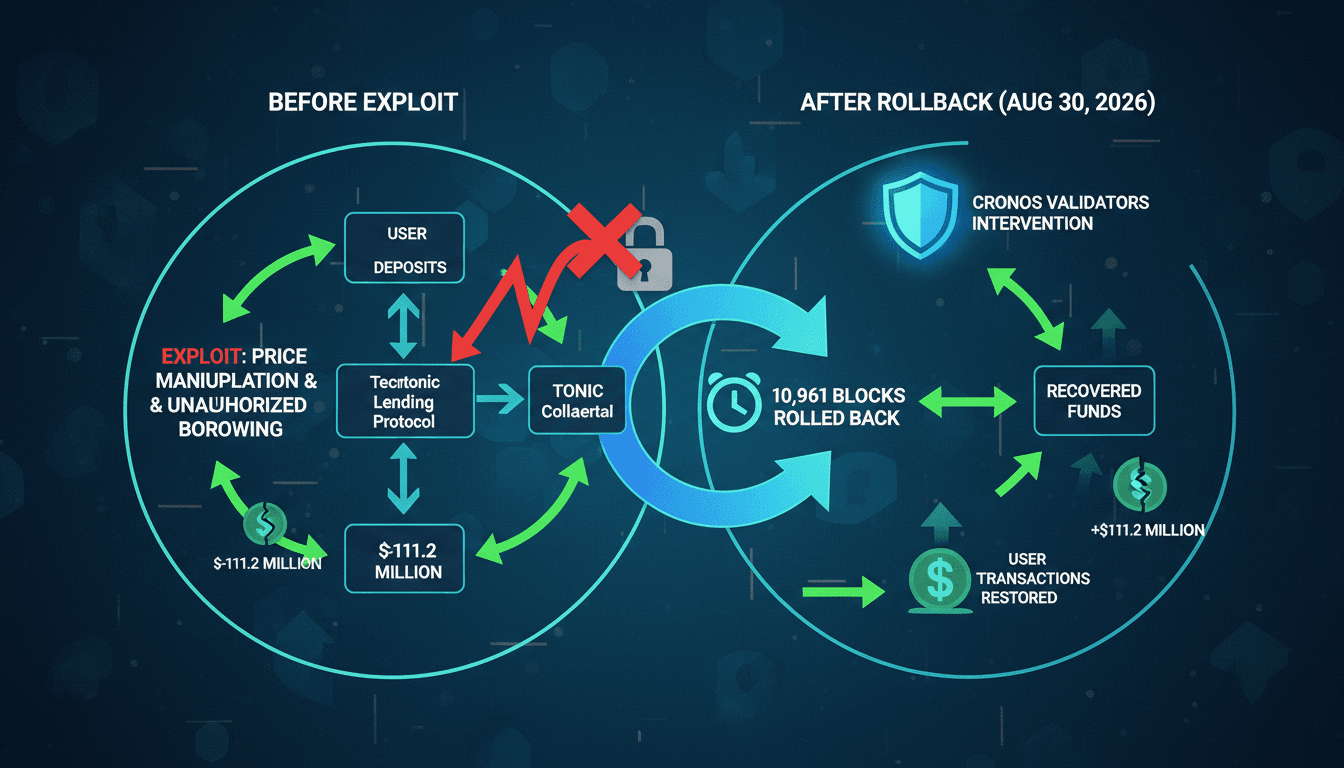
- Cronos validators executed a rollback on August 30, 2026, reversing 10,961 blocks to recover $111.2 million after a Tectonic exploit.
- The exploit involved price manipulation of the TONIC token, allowing unauthorized borrowing of $120.4 million across nine markets.
- Despite recovering 92% of the funds, the rollback nullified all transactions in the affected window, leaving $9.19 million unrecovered.
The context you actually need
- The Tectonic exploit targeted a lending protocol on Cronos, inflating the price of the TONIC token through low-liquidity decentralized exchanges (DEX).
- Cronos operates as a permissioned validator network, enabling coordinated emergency interventions like the rollback to protect user funds.
- Market confidence in Cronos has been shaken, with significant drops in total value locked (TVL) and ecosystem-wide risk management reviews initiated post-incident.
What's really happening
On August 30, 2026, the Cronos blockchain faced a significant challenge when validators detected anomalous activity linked to the Tectonic lending protocol. The exploit involved an attacker manipulating the price of the TONIC governance token, inflating it nearly 100-fold. This manipulation allowed the attacker to borrow $120.4 million across nine markets using the artificially inflated token as collateral.
In response, Cronos validators halted block production approximately two hours after the exploit was detected, effectively freezing the network to prevent further unauthorized transactions. After reaching consensus, they executed a rollback to restore the blockchain to its state before the exploit, specifically to block 90,896,188. This rollback involved discarding nearly two hours of transaction history, totaling 10,961 blocks, and resumed operations roughly nine to eleven hours later.
While the rollback successfully recovered $111.2 million—representing 92% of the exploited funds—it also nullified all transactions that occurred during the rollback window, including legitimate user activities. This decision has drawn criticism for overriding the principle of transaction finality, a core tenet of blockchain technology. The aftermath saw $9.19 million unrecovered, as these funds had exited the network before the rollback was executed.
The incident has prompted a reevaluation of risk management protocols within the Cronos ecosystem. Tectonic deposits and loans collapsed following the exploit, leading to a broader impact on market confidence in Cronos's DeFi offerings. Validators described the rollback as a difficult but necessary decision to protect user funds, highlighting the tension between maintaining decentralization and ensuring user security.
As the DeFi landscape continues to evolve, this incident serves as a cautionary tale about the vulnerabilities inherent in these systems and the potential for drastic measures to be taken in the face of exploitation.
Who feels it first (and how)
- DeFi users: Individuals who engaged with Tectonic and Cronos may face losses and diminished trust in the platform.
- Investors in TONIC: Those holding the token may see its value plummet due to the exploit and subsequent rollback.
- Validators and developers: They will need to reassess risk management strategies and the implications of emergency interventions on user trust.
What to watch next
- Regulatory responses: Watch for any emerging regulations or guidelines from authorities regarding blockchain rollbacks and user protections.
- Market recovery indicators: Monitor the recovery of the Cronos DeFi ecosystem, particularly the total value locked (TVL) and user engagement metrics.
- Security enhancements: Look for announcements regarding new security measures or protocols aimed at preventing similar exploits in the future.
The rollback recovered $111.2 million, but $9.19 million remains unrecovered.
Increased scrutiny on DeFi protocols and potential regulatory actions may follow.
The long-term impact on user trust and market confidence in Cronos and similar platforms.
Frequently Asked Questions
- Why it matters?
- This incident underscores the vulnerabilities in DeFi protocols and the drastic measures that can be taken to protect funds, affecting user trust and market stability.
- What happened (in 30 seconds)?
- Cronos validators executed a rollback on August 30, 2026, reversing 10,961 blocks to recover $111.2 million after a Tectonic exploit. The exploit involved price manipulation of the TONIC token, allowing unauthorized borrowing of $120.4 million across nine markets. Despite recovering 92% of the funds, the rollback nullified all transactions in the affected window, leaving $9.19 million unrecovered.
- What's really happening?
- On August 30, 2026, the Cronos blockchain faced a significant challenge when validators detected anomalous activity linked to the Tectonic lending protocol. The exploit involved an attacker manipulating the price of the TONIC governance token, inflating it nearly 100-fold. This manipulation allowed the attacker to borrow $120.4 million across nine markets using the artificially inflated token as collateral. In response, Cronos validators halted block production approximately two hours after th
- Who feels it first (and how)?
- DeFi users: Individuals who engaged with Tectonic and Cronos may face losses and diminished trust in the platform. Investors in TONIC: Those holding the token may see its value plummet due to the exploit and subsequent rollback. Validators and developers: They will need to reassess risk management strategies and the implications of emergency interventions on user trust.
- What to watch next?
- Regulatory responses: Watch for any emerging regulations or guidelines from authorities regarding blockchain rollbacks and user protections. Market recovery indicators: Monitor the recovery of the Cronos DeFi ecosystem, particularly the total value locked (TVL) and user engagement metrics. Security enhancements: Look for announcements regarding new security measures or protocols aimed at preventing similar exploits in the future.
Covers blockchain, cryptocurrency news, project analysis, and market insights.
"CoinDesk is a well-established cryptocurrency and blockchain news provider, offering comprehensive insights, market data, and industry research."
— A47 Editor
Cronos executes controversial blockchain rollback to recover crypto worth $111 million
Cronos executed a controversial rollback of nearly two hours of blockchain history to recover approximately $111 million in user assets following a significant exploit. Despite this intervention, attackers managed to siphon off $9.19 million before t...
Covers blockchain, cryptocurrency news, project analysis, and market insights.
"Cointelegraph is a leading crypto-focused media outlet known for timely news, analysis, and educational content related to blockchain and digital assets."
— A47 Editor
Cronos confirms $9.2M slipped away before Tectonic exploit rollback
Cronos has confirmed that $9.2 million was lost before the rollback of the Tectonic exploit, which had affected borrowing worth $120.4 million, with 7.6% of the funds transferred off-network prior to intervention by validators.
Real-time updates, analysis, and reports on the blockchain and cryptocurrency sectors.
"Crypto News delivers real-time updates, analysis, and reports on the blockchain and cryptocurrency sectors."
— A47 Editor
Cronos says $9.19M remains unrecovered after $120M Tectonic exploit
Cronos has reported that $9.19 million remains unrecovered following a significant exploit involving Tectonic, where an attacker borrowed $120.4 million. A validator-backed rollback managed to reverse approximately $111.2 million in affected value, b...