
Polymarket US Platform Faces $10 Million Fraud Attempt Due to Weakened AML Controls
Why it matters
This incident highlights vulnerabilities in anti-money laundering (AML) controls that can impact the integrity of financial platforms.
What happened (in 30 seconds)
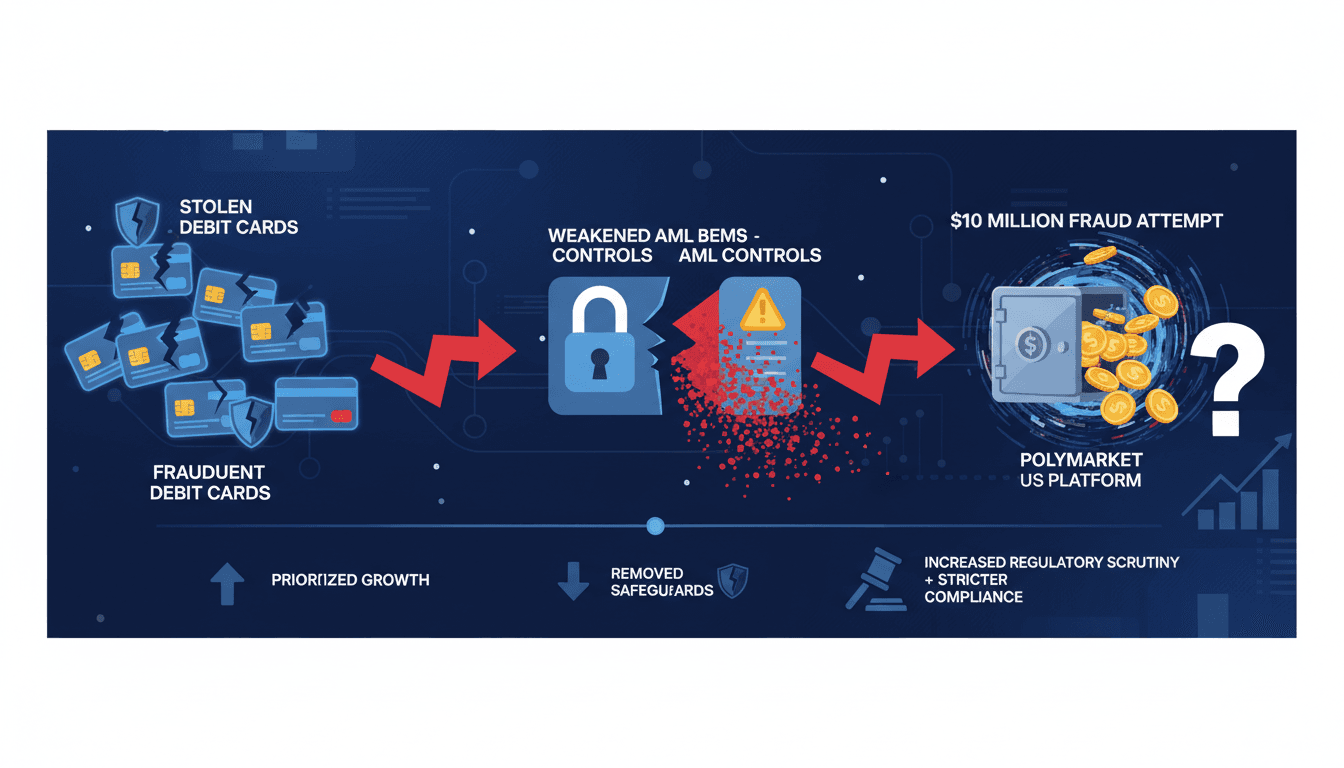
- Fraudsters exploited weakened AML controls on Polymarket US, attempting to siphon off $10 million through stolen debit cards.
- Checkout.com flagged over 80% of deposits as fraudulent, revealing significant lapses in the platform's security measures.
- Executive turnover followed the incident, with key leaders resigning or being fired amid regulatory scrutiny and internal investigations.
The context you actually need
- Polymarket expanded rapidly in late 2025, removing critical AML safeguards to accelerate user onboarding, despite internal warnings.
- The CFTC regulates Polymarket as a designated contract market, meaning it must adhere to strict compliance standards, which were compromised in this case.
- Fraud rates returned to normal by May 2026 after the implementation of tighter controls, but the incident raised questions about the platform's governance and risk management.
What's really happening
In February 2026, Polymarket US faced a significant fraud attempt that exploited its weakened anti-money laundering (AML) controls. The platform, which allows users to place bets on various outcomes, had recently lifted several safeguards to expedite user growth. This included the removal of the 'same-source' withdrawal requirement, a critical measure designed to prevent money laundering and fraud. Internal warnings about the risks associated with these changes were reportedly ignored by leadership, who prioritized rapid expansion over compliance.
Fraudsters took advantage of this environment by creating thousands of accounts linked to stolen debit cards. They deposited funds, placed wagers, and attempted to withdraw the proceeds to accounts they controlled. The scale of the fraud was staggering, with attempted deposits and withdrawals totaling at least $10 million. Payment processor Checkout.com detected the suspicious activity and flagged over 80% of these transactions as fraudulent, a rejection rate far exceeding the industry norm of approximately 1%.
Despite these red flags, Polymarket's leadership, including CEO Shayne Coplan, reportedly directed the company's focus toward growth, deferring any necessary compliance actions to address the fraud. This decision led to significant executive turnover, including the resignation of Andrew Clifford, the Chief Compliance Officer, and the firing of Justin Hertzberg, the US CEO. The fallout from this incident has drawn the attention of the Commodity Futures Trading Commission (CFTC), which has since opened an investigation into the platform's practices.
In response to the fraud attempt, Polymarket implemented tighter card limits and engaged external antifraud providers, successfully reducing fraud rates back to around 1% by May 2026. However, the incident has raised broader questions about the balance between growth and compliance in the rapidly evolving landscape of online prediction markets. As platforms like Polymarket continue to expand, the need for robust AML controls becomes increasingly critical to maintain user trust and regulatory compliance.
Who feels it first (and how)
- Investors and users of Polymarket US, who may face increased scrutiny and tighter controls on their accounts.
- Compliance officers in financial institutions, who will need to reassess risk management strategies in light of this incident.
- Regulatory bodies like the CFTC, which may impose stricter regulations on prediction markets to prevent future fraud.
What to watch next
- CFTC's ongoing investigation: The outcomes could lead to new regulations affecting how prediction markets operate, impacting user experience and compliance costs.
- Polymarket's compliance measures: Watch for updates on how the platform strengthens its AML controls and whether these changes restore user confidence.
- Market reactions: Monitor how other prediction markets respond to this incident, as they may adjust their own policies to mitigate similar risks.
The fraud attempt involved at least $10 million in attempted deposits and withdrawals.
Increased regulatory scrutiny on prediction markets will lead to tighter compliance requirements across the industry.
The long-term impact on Polymarket's user base and market position remains to be seen.
Frequently Asked Questions
- Why it matters?
- This incident highlights vulnerabilities in anti-money laundering (AML) controls that can impact the integrity of financial platforms.
- What happened (in 30 seconds)?
- Fraudsters exploited weakened AML controls on Polymarket US, attempting to siphon off $10 million through stolen debit cards. Checkout.com flagged over 80% of deposits as fraudulent, revealing significant lapses in the platform's security measures. Executive turnover followed the incident, with key leaders resigning or being fired amid regulatory scrutiny and internal investigations.
- What's really happening?
- In February 2026, Polymarket US faced a significant fraud attempt that exploited its weakened anti-money laundering (AML) controls. The platform, which allows users to place bets on various outcomes, had recently lifted several safeguards to expedite user growth. This included the removal of the 'same-source' withdrawal requirement, a critical measure designed to prevent money laundering and fraud. Internal warnings about the risks associated with these changes were reportedly ignored by leaders
- Who feels it first (and how)?
- Investors and users of Polymarket US, who may face increased scrutiny and tighter controls on their accounts. Compliance officers in financial institutions, who will need to reassess risk management strategies in light of this incident. Regulatory bodies like the CFTC, which may impose stricter regulations on prediction markets to prevent future fraud.
- What to watch next?
- CFTC's ongoing investigation: The outcomes could lead to new regulations affecting how prediction markets operate, impacting user experience and compliance costs. Polymarket's compliance measures: Watch for updates on how the platform strengthens its AML controls and whether these changes restore user confidence. Market reactions: Monitor how other prediction markets respond to this incident, as they may adjust their own policies to mitigate similar risks.
Stock market news, investing ideas, and trading analysis.
"TheStreet provides market news and retail-investor-focused analysis."
— A47 Editor
Loose Polymarket controls lead to $10 million fraud scheme
Polymarket, a prediction market platform, has been implicated in a $10 million fraud scheme due to lax security controls that prioritized rapid growth over robust safeguards. Reports indicate that a cluster of accounts profited significantly from com...
Markets desk coverage, trading insights, and investor updates.
"WSJ’s markets reporting provides in-depth analysis and context for investors."
— A47 Editor
The Morning Risk Report: Polymarket’s Rush to Grow Left a Door Wide Open for Fraudsters
Polymarket, a prediction market platform, is facing increasing scrutiny as concerns about potential fraud have emerged, particularly involving stolen debit cards. The company's rapid growth strategy has reportedly left security gaps, leading to signi...
U.S. business news, corporate developments, and economy.
"The Wall Street Journal is respected for deep financial and economic reporting with a center-right editorial perspective."
— A47 Editor
The Morning Risk Report: Polymarket’s Rush to Grow Left a Door Wide Open for Fraudsters
Polymarket, a prediction market platform, is facing increasing scrutiny as concerns about potential fraud have emerged, particularly involving stolen debit cards. The company's rapid growth strategy has reportedly left security gaps, leading to signi...
Real-time updates, analysis, and reports on the blockchain and cryptocurrency sectors.
"Crypto News delivers real-time updates, analysis, and reports on the blockchain and cryptocurrency sectors."
— A47 Editor
Polymarket hit by alleged $10M stolen-card fraud
Polymarket is under scrutiny following a report by the Wall Street Journal detailing a $10 million stolen-card fraud attempt, alongside unusually high rates of rejected deposits on its U.S. platform. This incident raises concerns about the platform's...