
Bitget Exchange Reports $387.5 Million Unauthorized Transfer from Wallets
Why it matters
This breach highlights vulnerabilities in cryptocurrency exchanges, potentially shaking investor confidence and impacting market stability.
What happened (in 30 seconds)
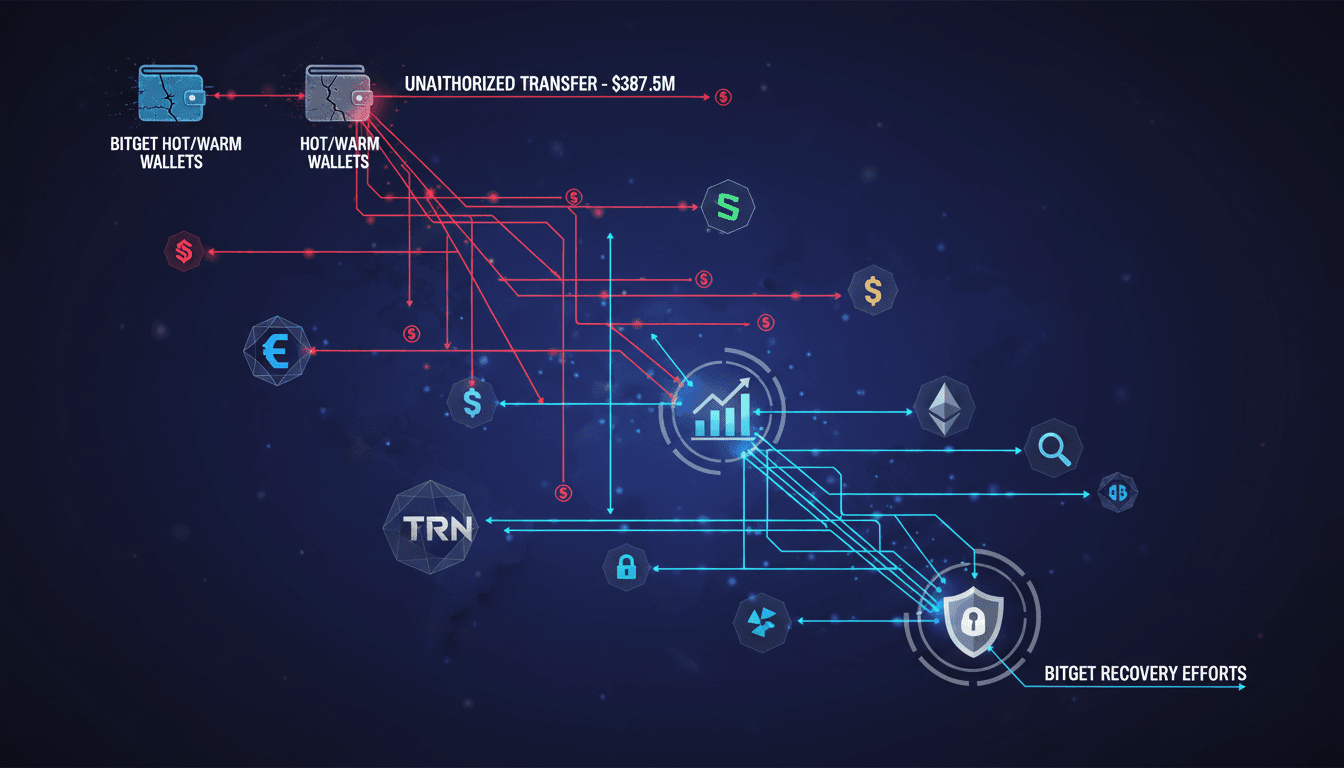
- Unauthorized transfers: Bitget reported $387.5 million in unauthorized transfers from its hot and warm wallets due to a backend system compromise.
- Rapid laundering: The stolen funds were quickly laundered, primarily consolidated into Bitcoin through cross-chain protocols.
- Ongoing recovery efforts: Bitget has initiated tracing and recovery efforts, with a significant portion of the stolen funds still under the attacker's control.
The context you actually need
- High-profile incidents: The breach occurred amid a series of similar attacks on cryptocurrency exchanges in 2026, raising concerns about security across the sector.
- User Protection Fund: Bitget had a User Protection Fund exceeding $464 million, which is intended to cover losses for users affected by such incidents.
- Third-party vulnerabilities: The attack exploited a flaw in third-party security software, emphasizing the risks associated with relying on external security solutions.
What's really happening
On September 24, 2026, Bitget, a prominent cryptocurrency exchange, detected unauthorized transfers totaling approximately $387.5 million from its hot and warm wallet infrastructure. This incident was particularly alarming as it involved spoofed transaction data submitted through a compromised backend system, rather than a direct compromise of private keys or cold wallets. The breach was attributed to a vulnerability in third-party security software, which allowed attackers to gain high-level credentials and issue forged withdrawal commands, bypassing normal security protocols.
The funds were rapidly moved across 12 different blockchains in 23 transfers, with XRP making up the largest share at around $157 million. The attackers quickly consolidated the stolen assets into Bitcoin, primarily using THORChain, which facilitated the movement of approximately $269 million. This swift laundering process underscores the sophisticated methods employed by cybercriminals, particularly in the cryptocurrency space where anonymity and speed are often prioritized.
As of late September 2026, it was estimated that around $342 million remained under the control of the attackers, with only a small fraction of the stolen funds publicly frozen. Bitget responded by temporarily suspending withdrawals and initiating on-chain tracing and recovery efforts. They also confirmed that user balances were unaffected and that losses would be covered by their User Protection Fund. This incident has raised alarms within the cryptocurrency community, as it reflects ongoing vulnerabilities and the potential for significant financial losses.
The market's reaction included a temporary suspension of services and heightened on-chain monitoring, but no widespread contagion across exchanges was reported. Investigations are ongoing, with firms like Mandiant and Chainalysis involved in tracing the funds and analyzing laundering patterns. While North Korean state-sponsored groups have been suspected in similar incidents, no formal attribution has been made by law enforcement.
Who feels it first (and how)
- Traders and investors: Increased scrutiny on exchange security may lead to hesitance in trading activities.
- Cryptocurrency exchanges: Heightened regulatory pressure and potential reputational damage could affect operations and user trust.
- Cybersecurity firms: Demand for enhanced security solutions may rise as exchanges seek to bolster defenses against similar attacks.
What to watch next
- Regulatory responses: Watch for potential regulatory changes aimed at increasing security standards for cryptocurrency exchanges, which could reshape operational protocols.
- Market reactions: Monitor trading volumes and user activity on Bitget and other exchanges, as shifts in confidence may impact liquidity and price volatility.
- Recovery efforts: Keep an eye on the progress of fund recovery initiatives by Bitget and other involved parties, as successful recoveries could influence market sentiment.
- Bitget reported a total loss of $387.5 million from unauthorized transfers.
- Increased regulatory scrutiny on cryptocurrency exchanges will follow this incident.
- The full extent of the attackers' network and whether they are linked to state-sponsored groups remains uncertain.
Frequently Asked Questions
- Why it matters?
- This breach highlights vulnerabilities in cryptocurrency exchanges, potentially shaking investor confidence and impacting market stability.
- What happened (in 30 seconds)?
- Unauthorized transfers: Bitget reported $387.5 million in unauthorized transfers from its hot and warm wallets due to a backend system compromise. Rapid laundering: The stolen funds were quickly laundered, primarily consolidated into Bitcoin through cross-chain protocols. Ongoing recovery efforts: Bitget has initiated tracing and recovery efforts, with a significant portion of the stolen funds still under the attacker's control.
- What's really happening?
- On September 24, 2026, Bitget, a prominent cryptocurrency exchange, detected unauthorized transfers totaling approximately $387.5 million from its hot and warm wallet infrastructure. This incident was particularly alarming as it involved spoofed transaction data submitted through a compromised backend system, rather than a direct compromise of private keys or cold wallets. The breach was attributed to a vulnerability in third-party security software, which allowed attackers to gain high-level cr
- Who feels it first (and how)?
- Traders and investors: Increased scrutiny on exchange security may lead to hesitance in trading activities. Cryptocurrency exchanges: Heightened regulatory pressure and potential reputational damage could affect operations and user trust. Cybersecurity firms: Demand for enhanced security solutions may rise as exchanges seek to bolster defenses against similar attacks.
- What to watch next?
- Regulatory responses: Watch for potential regulatory changes aimed at increasing security standards for cryptocurrency exchanges, which could reshape operational protocols. Market reactions: Monitor trading volumes and user activity on Bitget and other exchanges, as shifts in confidence may impact liquidity and price volatility. Recovery efforts: Keep an eye on the progress of fund recovery initiatives by Bitget and other involved parties, as successful recoveries could influence market sent
Real-time updates, analysis, and reports on the blockchain and cryptocurrency sectors.
"Crypto News delivers real-time updates, analysis, and reports on the blockchain and cryptocurrency sectors."
— A47 Editor
Bitget hack: Where did the stolen $387M go?
Bitget, a cryptocurrency exchange, recently experienced a significant security breach resulting in the theft of approximately $387.5 million. Investigations by BlockSec have traced the stolen funds into various platforms, including Bitcoin, THORChain...
Covers blockchain, cryptocurrency news, project analysis, and market insights.
"Cointelegraph is a leading crypto-focused media outlet known for timely news, analysis, and educational content related to blockchain and digital assets."
— A47 Editor
Bitget’s $388M hack pushes Q3 crypto security losses past $1B
Bitget, a cryptocurrency exchange, suffered a significant security breach resulting in unauthorized transfers totaling approximately $388 million. This incident contributed to a staggering $1.26 billion in crypto security losses in Q3 2026, with Sept...
Covers blockchain, cryptocurrency news, project analysis, and market insights.
"Cointelegraph is a leading crypto-focused media outlet known for timely news, analysis, and educational content related to blockchain and digital assets."
— A47 Editor
Could THORChain face prosecution over stolen Bitget funds? Legal opinion
THORChain is facing potential legal scrutiny after refusing to block addresses linked to a $387.5 million hack of the cryptocurrency exchange Bitget. Legal expert Yuriy Brisov indicated that the situation is complex, raising questions about whether T...
Covers blockchain, cryptocurrency news, project analysis, and market insights.
"CoinDesk is a well-established cryptocurrency and blockchain news provider, offering comprehensive insights, market data, and industry research."
— A47 Editor
Bitget hackers move $4 million into Zcash’s private pool, making funds harder to trace
Hackers associated with Bitget have transferred approximately $4 million of stolen Zcash (ZEC) into Ironwood, a private pool that obscures transaction details, making the funds more difficult to trace. This move follows a significant security breach ...
Covers blockchain, cryptocurrency news, project analysis, and market insights.
"Cointelegraph is a leading crypto-focused media outlet known for timely news, analysis, and educational content related to blockchain and digital assets."
— A47 Editor
SlowMist traces Bitget hack activity to Aug. 31 zero-day exploit
SlowMist has traced the recent Bitget hack to a zero-day exploit that occurred on August 31, revealing that malicious activity was detected weeks prior to the theft. The breach involved two security products and a custom withdrawal tool, highlighting...