
Open USD Launches Shared Ownership Stablecoin Model
Why it matters
The introduction of Open USD challenges the traditional stablecoin model, potentially redistributing economic power within the digital currency ecosystem.
What happened (in 30 seconds)
- Open USD (OUSD) launched on September 30, 2026, with a shared ownership model across multiple blockchains.
- Founding partners including Coinbase, Mastercard, and Visa committed over $1 billion to establish initial liquidity.
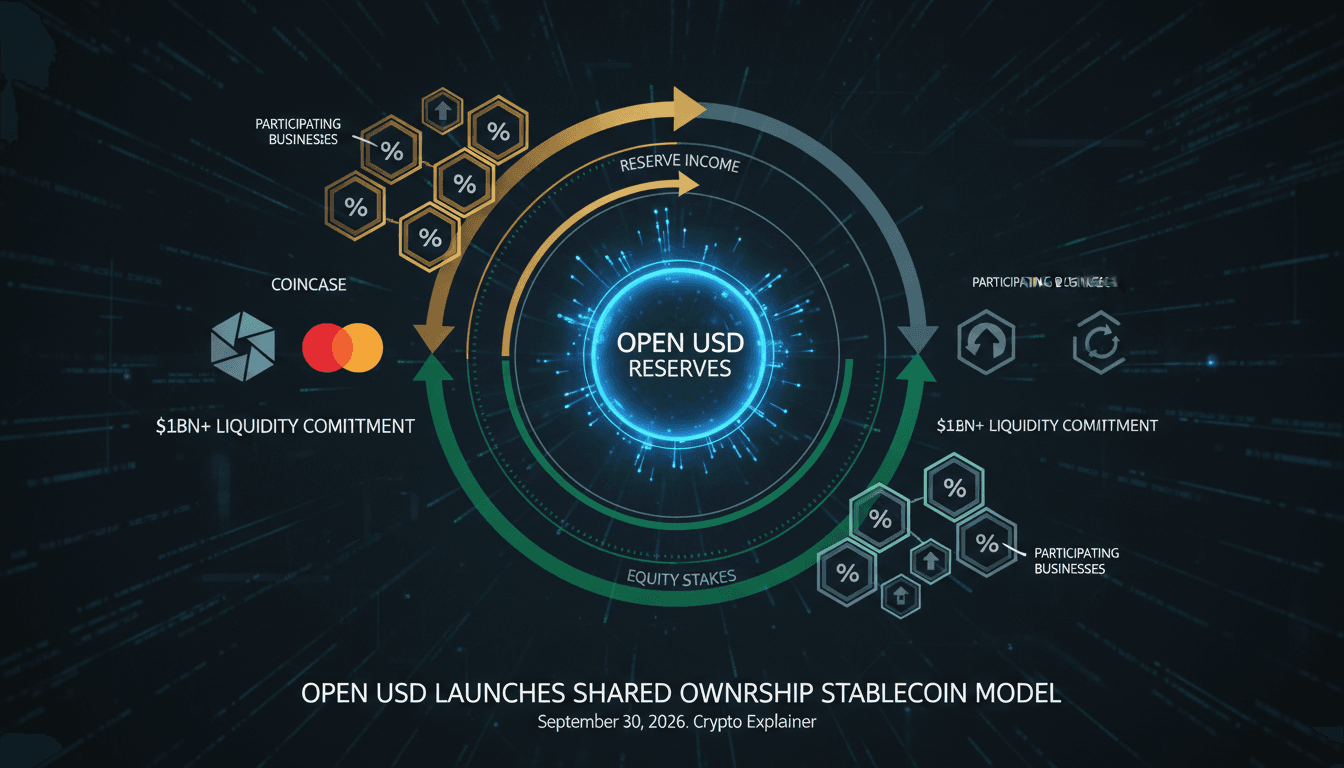
- The model allows businesses to earn equity stakes and reserve income based on their contributions, diverging from traditional issuer-retained earnings.
The context you actually need
- The stablecoin market has surpassed $300 billion, with Tether's USDT and Circle's USDC controlling over 80% of it.
- Traditional stablecoins concentrate reserve earnings with single issuers, limiting economic benefits to a few.
- Open USD's model aims to create shared infrastructure, promoting a more equitable distribution of resources among participants.
What's really happening
Open USD (OUSD) represents a significant shift in the stablecoin landscape, driven by a consortium of major financial players. Launched by Open Standard, OUSD is designed to operate on Ethereum, Solana, Base, and Tempo blockchains, marking a departure from the conventional stablecoin model that typically centralizes reserve earnings with a single issuer.
The founding partners—Coinbase, Mastercard, Shopify, Stripe, and Visa—have collectively committed over $1 billion to ensure robust initial liquidity. This substantial backing not only legitimizes OUSD but also positions it as a formidable competitor to established stablecoins like USDT and USDC.
What sets OUSD apart is its shared ownership model, which allows participating businesses to earn equity stakes and a share of reserve income based on their contributions to supply and transaction activity. This contrasts sharply with the traditional model, where issuers retain most of the earnings. By distributing nearly all reserve revenues to participants after a small management fee, OUSD incentivizes businesses to engage actively in the ecosystem, fostering a collaborative environment.
The model also features fee-free minting and redemption for qualifying businesses, further lowering barriers to entry and encouraging adoption. As OUSD expands its partner network—now exceeding 200 companies, including UBS and SBI Holdings—it aims to create a more inclusive financial infrastructure that benefits a broader range of stakeholders.
CEO Zach Abrams, who previously co-founded Bridge, emphasizes that this initiative is not just about creating a new stablecoin but about building a shared economic framework that can adapt to the evolving needs of the digital economy. The project is still in its early stages, with no significant governmental responses or market shifts reported as of October 1, 2026. However, its focus on utility and shared economics could redefine how stablecoins operate, potentially leading to a more equitable financial landscape.
Who feels it first (and how)
- Businesses in payments: Companies involved in payment processing may benefit from lower fees and shared revenue opportunities.
- Cross-border transaction firms: Entities facilitating international transfers could see enhanced efficiency and reduced costs.
- Institutional investors: Financial institutions may find new avenues for investment and liquidity management through OUSD's model.
- Developers on supported blockchains: Those building applications on Ethereum, Solana, Base, and Tempo may leverage OUSD for innovative financial solutions.
What to watch next
- Adoption rates: Monitor how quickly businesses integrate OUSD into their operations, as this will indicate market acceptance.
- Regulatory responses: Keep an eye on how governments react to OUSD's model, which could influence its viability and expansion.
- Market competition: Watch for responses from established stablecoin issuers, as they may adapt their models in reaction to OUSD's shared ownership approach.
Open USD launched on September 30, 2026, with significant liquidity backing.
Increased competition in the stablecoin market as traditional issuers respond to OUSD's model.
The long-term regulatory landscape and its impact on OUSD's operations and growth.
Frequently Asked Questions
- Why it matters?
- The introduction of Open USD challenges the traditional stablecoin model, potentially redistributing economic power within the digital currency ecosystem.
- What happened (in 30 seconds)?
- Open USD (OUSD) launched on September 30, 2026, with a shared ownership model across multiple blockchains. Founding partners including Coinbase, Mastercard, and Visa committed over $1 billion to establish initial liquidity. The model allows businesses to earn equity stakes and reserve income based on their contributions, diverging from traditional issuer-retained earnings.
- What's really happening?
- Open USD (OUSD) represents a significant shift in the stablecoin landscape, driven by a consortium of major financial players. Launched by Open Standard, OUSD is designed to operate on Ethereum, Solana, Base, and Tempo blockchains, marking a departure from the conventional stablecoin model that typically centralizes reserve earnings with a single issuer. The founding partners—Coinbase, Mastercard, Shopify, Stripe, and Visa—have collectively committed over $1 billion to ensure robust initial li
- Who feels it first (and how)?
- Businesses in payments: Companies involved in payment processing may benefit from lower fees and shared revenue opportunities. Cross-border transaction firms: Entities facilitating international transfers could see enhanced efficiency and reduced costs. Institutional investors: Financial institutions may find new avenues for investment and liquidity management through OUSD's model. Developers on supported blockchains: Those building applications on Ethereum, Solana, Base, and Tempo may lev
- What to watch next?
- Adoption rates: Monitor how quickly businesses integrate OUSD into their operations, as this will indicate market acceptance. Regulatory responses: Keep an eye on how governments react to OUSD's model, which could influence its viability and expansion. Market competition: Watch for responses from established stablecoin issuers, as they may adapt their models in reaction to OUSD's shared ownership approach.
English-language digital publication covering business, politics, technology, and current affairs.
"The Arabian Post mixes original and syndicated-style coverage with a broad regional and global business-news orientation."
— A47 Editor
Open USD enters market with shared ownership model
Open USD, a new dollar-backed stablecoin, has launched with a shared ownership model that allows businesses to benefit from reserve income and ownership as it expands its use across Ethereum, Solana, Base, and Tempo. Major companies like Coinbase, Ma...
Real-time updates, analysis, and reports on the blockchain and cryptocurrency sectors.
"Crypto News delivers real-time updates, analysis, and reports on the blockchain and cryptocurrency sectors."
— A47 Editor
Open USD launches with over $1B in liquidity commitments
Open USD has officially launched across four blockchains, backed by over $1 billion in liquidity commitments from five founding partners, marking a significant entry into the stablecoin market. This initiative introduces a model that links company re...
Covers blockchain, cryptocurrency news, project analysis, and market insights.
"CoinDesk is a well-established cryptocurrency and blockchain news provider, offering comprehensive insights, market data, and industry research."
— A47 Editor
Open USD takes on Tether, Circle with a different stablecoin model that's 'building money'
Open Standard has introduced Open USD, a new stablecoin model aimed at competing with established players like Tether and Circle. The initiative is backed by over 140 partners, including major financial institutions such as Visa and Mastercard, indic...