
UK High Court Rules Chinese Law Governs Claims to Seized Bitcoin Assets
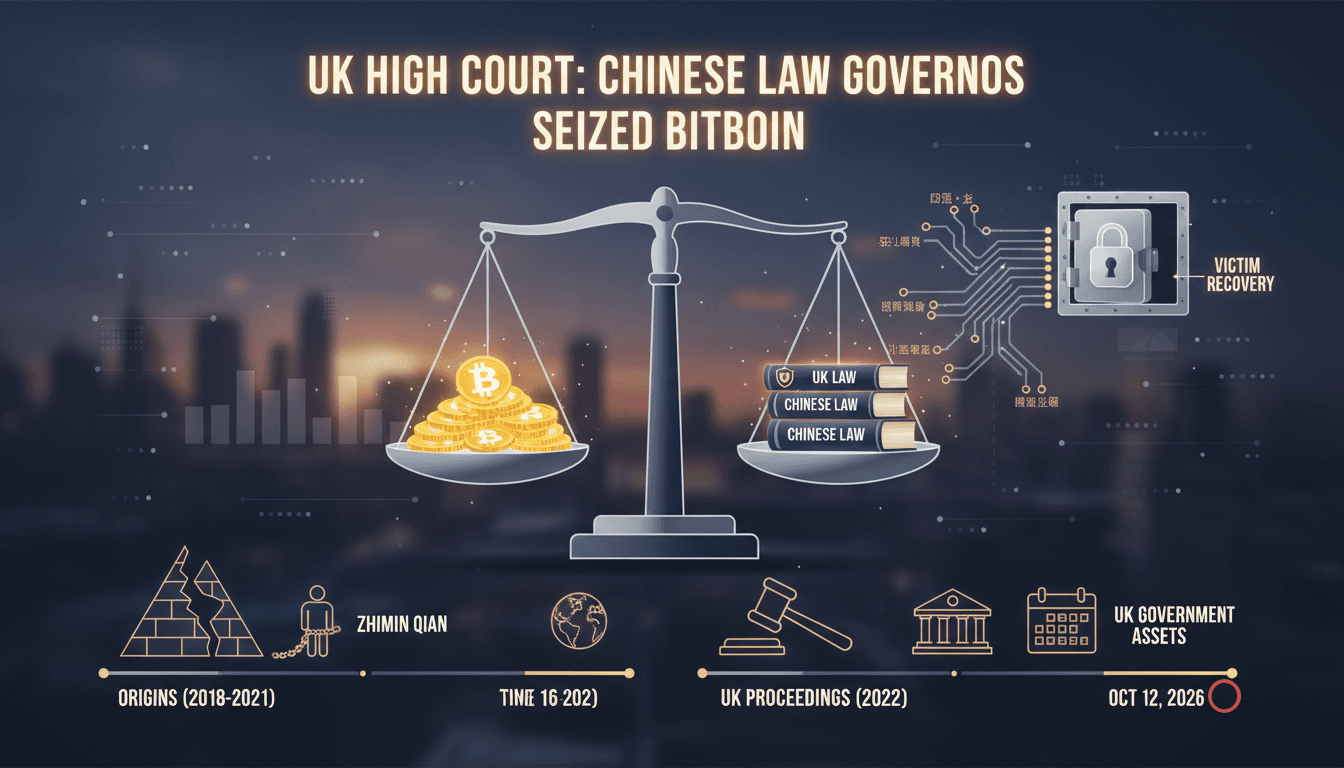
If you're involved in cryptocurrency investments or asset recovery, this ruling could reshape your legal strategies.
Why it matters
This ruling sets a precedent for how international fraud cases involving cryptocurrency are adjudicated, impacting victims' recovery efforts globally.
What happened (in 30 seconds)
- On October 13, 2026, the UK High Court ruled that Chinese law governs claims to 61,000 BTC seized from fraudster Zhimin Qian.
- This decision narrows the legal avenues for victims under UK law, which was previously seen as more favorable for asset recovery.
- Victims plan to appeal, as the ruling defers final ownership determinations and strengthens the UK government's position in retaining the assets.
The context you actually need
- Zhimin Qian, a Chinese national, operated a Ponzi scheme that defrauded over 128,000 investors of approximately £4.1 billion.
- The UK authorities seized the Bitcoin in 2018 during a money-laundering investigation after Qian fled to the UK.
- Victims sought recovery under UK civil laws, leading to a complex choice-of-law dispute regarding the applicable legal framework.
What's really happening
The UK High Court's ruling on October 13, 2026, marks a significant shift in the legal landscape surrounding cryptocurrency asset recovery. The court determined that Chinese law applies to the claims of victims defrauded by Zhimin Qian, a decision that complicates the recovery process for those seeking restitution for their losses. This ruling is particularly impactful given that the seized Bitcoin, approximately 61,000 BTC valued at around £3.8 billion ($5 billion), represents a substantial financial interest for the claimants.
The choice-of-law debate arose during hearings in July 2026, where victims' counsel argued for the application of English law, which would have allowed for more straightforward claims of ownership. In contrast, prosecutors advocated for Chinese law, emphasizing that the fraud's origins, including contracts and payments, were rooted in China. Mr. Justice Mark Turner ultimately sided with the prosecution, asserting that the relevant damage and contractual relationships occurred in China, thus necessitating the application of Chinese law.
This ruling does not resolve the ultimate ownership of the Bitcoin but requires claimants to establish their rights under Chinese law in subsequent legal proceedings. The implications are profound: victims now face a more complex legal landscape that may hinder their ability to recover losses. The ruling also strengthens the UK government's position in retaining the assets, as the application of Chinese law could limit the victims' claims under the Proceeds of Crime Act.
The decision has sparked plans for an appeal by the victims' legal team, which includes Fieldfisher. They aim to challenge the choice-of-law ruling, indicating that the legal battle is far from over. As the case progresses, it will likely involve expert evidence on Chinese law, further complicating the recovery process.
This ruling highlights the growing intersection of cryptocurrency and international law, raising questions about how jurisdictions handle fraud cases involving digital assets. As more individuals and entities engage with cryptocurrencies, the legal frameworks governing these assets will need to evolve, potentially leading to more complex international disputes.
Who feels it first (and how)
- Fraud victims: Individuals who invested in Qian's Ponzi scheme will face challenges in recovering their losses.
- Legal professionals: Lawyers specializing in asset recovery and cryptocurrency law will need to navigate new complexities in international law.
- Regulatory bodies: UK authorities may see increased scrutiny and pressure regarding their handling of cryptocurrency-related fraud cases.
What to watch next
- Victims' appeal: The outcome of the appeal will determine if English law can be applied, potentially altering the recovery landscape.
- Market reactions: Monitor Bitcoin prices and investor sentiment, as legal developments could influence market stability.
- International legal precedents: Watch for similar cases that may arise globally, as this ruling could set a benchmark for future asset recovery efforts.
The UK High Court ruled that Chinese law governs the claims to the seized Bitcoin.
Victims will appeal the ruling, leading to further legal proceedings.
The long-term implications for cryptocurrency regulation and asset recovery in the UK and beyond.
Frequently Asked Questions
- Why it matters?
- This ruling sets a precedent for how international fraud cases involving cryptocurrency are adjudicated, impacting victims' recovery efforts globally.
- What happened (in 30 seconds)?
- On October 13, 2026, the UK High Court ruled that Chinese law governs claims to 61,000 BTC seized from fraudster Zhimin Qian. This decision narrows the legal avenues for victims under UK law, which was previously seen as more favorable for asset recovery. Victims plan to appeal, as the ruling defers final ownership determinations and strengthens the UK government's position in retaining the assets.
- What's really happening?
- The UK High Court's ruling on October 13, 2026, marks a significant shift in the legal landscape surrounding cryptocurrency asset recovery. The court determined that Chinese law applies to the claims of victims defrauded by Zhimin Qian, a decision that complicates the recovery process for those seeking restitution for their losses. This ruling is particularly impactful given that the seized Bitcoin, approximately 61,000 BTC valued at around £3.8 billion ($5 billion), represents a substantial fin
- Who feels it first (and how)?
- Fraud victims: Individuals who invested in Qian's Ponzi scheme will face challenges in recovering their losses. Legal professionals: Lawyers specializing in asset recovery and cryptocurrency law will need to navigate new complexities in international law. Regulatory bodies: UK authorities may see increased scrutiny and pressure regarding their handling of cryptocurrency-related fraud cases.
- What to watch next?
- Victims' appeal: The outcome of the appeal will determine if English law can be applied, potentially altering the recovery landscape. Market reactions: Monitor Bitcoin prices and investor sentiment, as legal developments could influence market stability. International legal precedents: Watch for similar cases that may arise globally, as this ruling could set a benchmark for future asset recovery efforts.
Covers blockchain, cryptocurrency news, project analysis, and market insights.
"CoinDesk is a well-established cryptocurrency and blockchain news provider, offering comprehensive insights, market data, and industry research."
— A47 Editor
UK court ruling boosts government’s chances of keeping $5 billion in seized bitcoin
A UK court ruling has strengthened the government's position regarding the retention of 61,000 Bitcoin, valued at approximately $5 billion, which were seized by the Metropolitan Police during an investigation into Zhimin Qian, who has pleaded guilty ...
Covers blockchain, cryptocurrency news, project analysis, and market insights.
"Cointelegraph is a leading crypto-focused media outlet known for timely news, analysis, and educational content related to blockchain and digital assets."
— A47 Editor
Chinese fraud victims lose key court battle over 61,000 Bitcoin
Chinese fraud victims have encountered a significant legal setback as a UK court has ruled that their claims regarding the recovery of 61,000 seized Bitcoin are governed by Chinese law. This decision complicates their efforts to reclaim the cryptocur...
Real-time updates, analysis, and reports on the blockchain and cryptocurrency sectors.
"Crypto News delivers real-time updates, analysis, and reports on the blockchain and cryptocurrency sectors."
— A47 Editor
Bitcoin fraud victims may lose gains under UK court ruling
A recent ruling by the UK High Court has determined that claims over more than 61,000 Bitcoin will be governed by Chinese law, jeopardizing potential gains for approximately 16,000 victims of fraud, as reported by Caixin. This judgment, issued on Oct...