
Intel, IBM, Oracle and IonQ Object to OKX-ICE Tokenized Stock Listings, Bringing Total Opposing Issuers to 26
Why it matters
The formal pushback from 41% of targeted issuers demonstrates that bridging legacy equities to public decentralized finance protocols faces immediate structural friction over investor protections and brand control.
What happened (in 30 seconds)
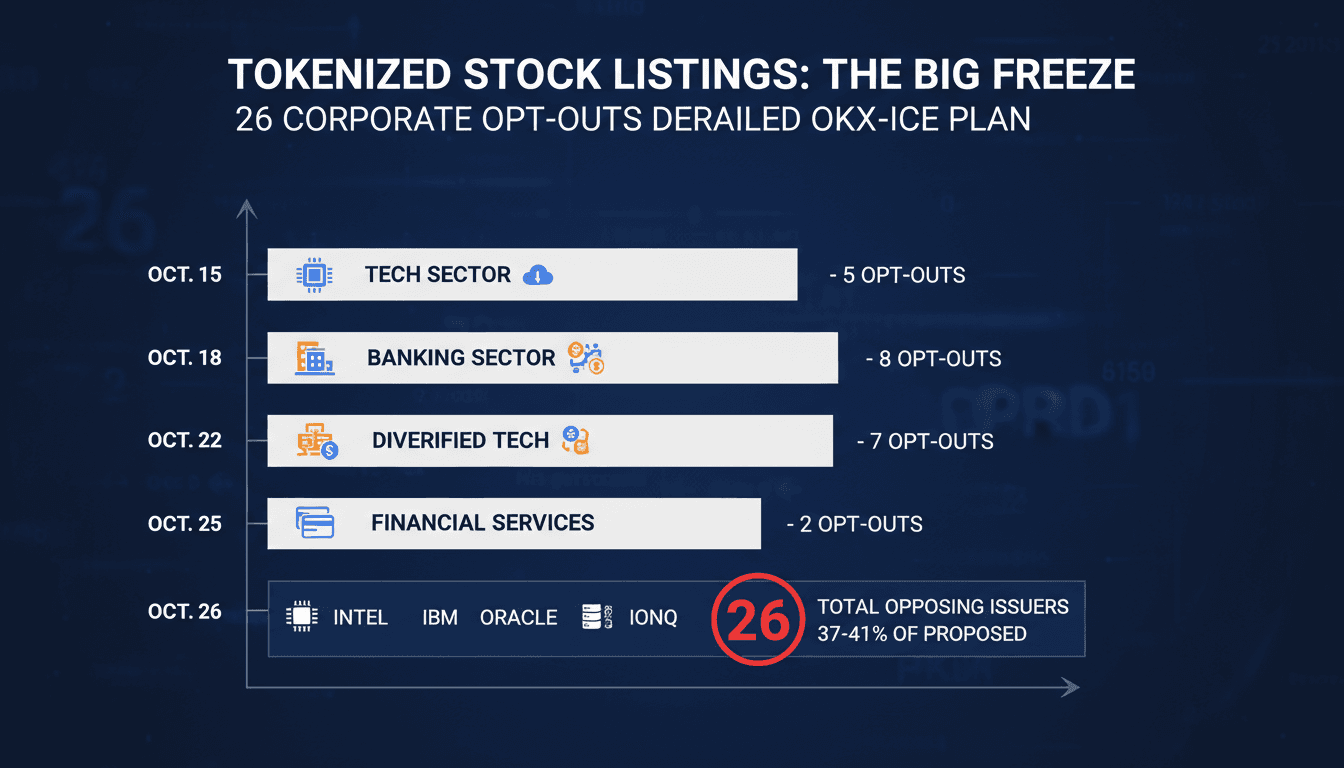
* Corporate resistance hit 26 issuers: Intel, IBM, Oracle, and IonQ joined Alphabet, Microsoft, Goldman Sachs, Wells Fargo, and Cisco in formally opting out of the proposed OKX-ICE tokenized stock platform as of October 26, 2026. * The initiative targets 62 equities: Proposed by OKXICE—a 50-50 joint venture between crypto exchange OKX and Intercontinental Exchange (ICE)—the platform aimed to trade tokenized National Market System (NMS) stocks using Uniswap v4 pools on OKX’s XLayer network. * Objections climbed rapidly: After filing with the SEC on October 4, 2026, the venue recorded nine objections by October 15, rising to 16 by October 19, 22 by October 23, and reaching 26 by October 26 without public explanation of specific issuer rationales.
The context you actually need
* The SEC opened a testing window: In September 2026, the U.S. Securities and Exchange Commission approved temporary innovation exemptions allowing Tokenized Securities Venues (TSVs) to facilitate limited trading of tokenized NMS stocks. * Market structure remains divided: While ICE partnered directly with OKX to leverage decentralized automated market makers and stablecoin settlement, rival exchange operator Nasdaq issued formal guidance urging corporate issuers to exercise caution while developing its own tokenized asset frameworks. * Custody protections carry unresolved gaps: Public notices from the venue highlighted operational risks, confirming that self-custodied stock tokens lack clear coverage under the Securities Investor Protection Corporation (SIPC) framework.
What's really happening
The friction around OKXICE highlights an incentive mismatch between public market issuers and infrastructure builders testing experimental regulatory rules. When the SEC introduced temporary innovation exemptions for Tokenized Securities Venues in September 2026, the agency created a sandbox to test secondary trading of NMS equities on blockchain rails. OKXICE responded by filing a plan on October 4 to list tokenized representations of 62 leading public companies, relying on Uniswap v4 liquidity pools deployed on OKX’s XLayer and settling in stablecoins.
Within three weeks, 41% of that initial basket refused to participate. The opt-out rate escalated in distinct waves: nine issuers protested around October 15, 16 by October 19, 22 by October 23, and 26 by October 26. The roster of dissenting firms includes key tech heavyweights such as Intel, IBM, Oracle, IonQ, Microsoft, Cisco, and Alphabet, alongside systemically important financial institutions like Goldman Sachs and Wells Fargo.
This corporate pushback stems from clear operational and regulatory incentives. For an issuer managing a multi-billion-dollar market capitalization, having common stock mirrored on external blockchain pools without bilateral agreements introduces brand and legal exposures. Under conventional NMS rules, corporate equities trade through clearinghouses, registered broker-dealers, and transfer agents governed by established statutory rules. Transferring these assets to automated market makers on Layer-2 blockchains alters settlement dynamics, introduces smart contract failure points, and fragments order flow.
Custodial safeguards present another structural barrier. The venue’s disclosures explicitly noted uncertainty regarding whether SIPC coverage extends to tokenized shares held in self-custodied digital wallets. For compliance officers and corporate treasurers, exposure to retail investors losing capital in uninsured, self-custodied environments represents an uncompensated reputational liability.
Furthermore, traditional market infrastructure operators are competing for standard-setting power. As ICE advanced its joint venture with OKX to capture tokenized volume, Nasdaq actively issued guidance advising corporate issuers to proceed carefully with external tokenization platforms while advancing its own proprietary digital asset projects. Issuer resistance is therefore not an outright rejection of tokenization; it is an active refusal to cede equity distribution to third-party crypto venues operating under temporary regulatory exemptions.
Who feels it first (and how)
* Digital asset infrastructure executives: Product teams at tokenization platforms must reconsider unsolicited issuer listing strategies, as institutional blue chips demand direct governance over their equity representations. * Corporate investor relations and legal teams: Public company counsels at technology and financial firms face increased administrative workloads evaluating opt-out notices and tracking third-party secondary market listings under SEC exemptions. * DeFi liquidity providers: Market makers deploying capital into Uniswap v4 pools face reduced trading volumes and a narrowing pool of eligible tier-one equities as large-cap issuers opt out. * Traditional institutional brokerages: Incumbent brokers maintain their standard equities distribution advantage as long as regulatory uncertainty and SIPC limitations keep tokenized trading venues restricted.
What to watch next
* The remaining 36 target issuers: Monitor whether other firms among the original 62 planned equities file opt-out notices before OKXICE concludes its onboarding window, which will indicate if the platform can maintain a viable baseline of listings. * Nasdaq’s proprietary tokenization pipeline: Track formal product announcements from Nasdaq following its issuer cautionary notes to see if traditional exchanges offer tokenization frameworks with issuer-controlled distribution models. * SEC guidance on self-custodied securities: Watch for official statements or revisions from U.S. securities regulators clarifying SIPC coverage and investor protection rules for tokenized equities held outside registered broker-dealers.
Twenty-six corporate issuers—comprising 37% to 41% of the original 62-company proposal—formally objected to their inclusion on the OKXICE tokenized trading platform between October 15 and October 26, 2026.
The rapid succession of corporate opt-outs will force Tokenized Securities Venues to transition from open listing frameworks to permissioned models requiring bilateral corporate agreements.
It remains undetermined whether the SEC will modify its temporary innovation exemption requirements or if other TSVs can legally trade tokenized securities without express corporate authorization.
Frequently Asked Questions
- Why it matters?
- The formal pushback from 41% of targeted issuers demonstrates that bridging legacy equities to public decentralized finance protocols faces immediate structural friction over investor protections and brand control.
- What happened (in 30 seconds)?
- Corporate resistance hit 26 issuers: Intel, IBM, Oracle, and IonQ joined Alphabet, Microsoft, Goldman Sachs, Wells Fargo, and Cisco in formally opting out of the proposed OKX-ICE tokenized stock platform as of October 26, 2026. The initiative targets 62 equities: Proposed by OKXICE—a 50-50 joint venture between crypto exchange OKX and Intercontinental Exchange (ICE)—the platform aimed to trade tokenized National Market System (NMS) stocks using Uniswap v4 pools on OKX’s XLayer network. Objection
- What's really happening?
- The friction around OKXICE highlights an incentive mismatch between public market issuers and infrastructure builders testing experimental regulatory rules. When the SEC introduced temporary innovation exemptions for Tokenized Securities Venues in September 2026, the agency created a sandbox to test secondary trading of NMS equities on blockchain rails. OKXICE responded by filing a plan on October 4 to list tokenized representations of 62 leading public companies, relying on Uniswap v4 liquidity
- Who feels it first (and how)?
- Digital asset infrastructure executives: Product teams at tokenization platforms must reconsider unsolicited issuer listing strategies, as institutional blue chips demand direct governance over their equity representations. Corporate investor relations and legal teams: Public company counsels at technology and financial firms face increased administrative workloads evaluating opt-out notices and tracking third-party secondary market listings under SEC exemptions. DeFi liquidity providers: Market
- What to watch next?
- The remaining 36 target issuers: Monitor whether other firms among the original 62 planned equities file opt-out notices before OKXICE concludes its onboarding window, which will indicate if the platform can maintain a viable baseline of listings. Nasdaq’s proprietary tokenization pipeline: Track formal product announcements from Nasdaq following its issuer cautionary notes to see if traditional exchanges offer tokenization frameworks with issuer-controlled distribution models. SEC guidance on s
Covers blockchain, cryptocurrency news, project analysis, and market insights.
"Cointelegraph is a leading crypto-focused media outlet known for timely news, analysis, and educational content related to blockchain and digital assets."
— A47 Editor
Intel, IBM, Oracle and IonQ latest to object to OKX-ICE tokenized stocks
Intel, IBM, Oracle and IonQ have formally objected to the proposed OKX-ICE platform for offering tokenized shares of U.S.-listed companies, according to Cointelegraph, with the reported number of objecting companies rising to 26 as the SEC's innovati...
Covers Bitcoin plus altcoin news, market updates, and educational resources.
"Bitcoin.com provides news, market data, and guides focused on Bitcoin and the wider crypto industry."
— A47 Editor
Intel, Oracle, IBM and IonQ Join Growing Opposition to OKXICE Tokenized Stock Plan
Intel, Oracle, IBM and IonQ have joined a growing list of objectors to OKXICE's proposed plan to offer tokenized shares of U.S.-listed companies, with reports putting the total number of objecting firms at 26 as the SEC's innovation exemption and iss...
Real-time updates, analysis, and reports on the blockchain and cryptocurrency sectors.
"Crypto News delivers real-time updates, analysis, and reports on the blockchain and cryptocurrency sectors."
— A47 Editor
IBM, Oracle, Intel join OKX-ICE tokenized stock objections as total hits 26
IBM, Oracle, Intel and IonQ have joined objections to the OKXICE plan to offer tokenized shares of U.S.-listed companies, bringing the reported total to 26 as the SEC's issuer-consent rules for the new innovation exemption come under scrutiny.
English-language digital publication covering business, politics, technology, and current affairs.
"The Arabian Post mixes original and syndicated-style coverage with a broad regional and global business-news orientation."
— A47 Editor
Microsoft and Alphabet oppose proposed tokenised share trading
Microsoft, Alphabet, McDonald's and 19 other publicly traded companies have objected to plans by cryptocurrency exchange OKX and New York Stock Exchange owner Intercontinental Exchange to offer blockchain-based versions of their shares on a proposed ...