
Janus Henderson and Centrifuge Launch Nasdaq-Licensed Blockchain-Native Nasdaq-100 Fund JQQQ on Stellar
Why it matters
Major traditional asset managers are transitioning from experimental pilot testing to licensed, primary-issuance equity products on public blockchains, formalizing the infrastructure channel between institutional liquidity and decentralized ledgers.
What happened (in 30 seconds)
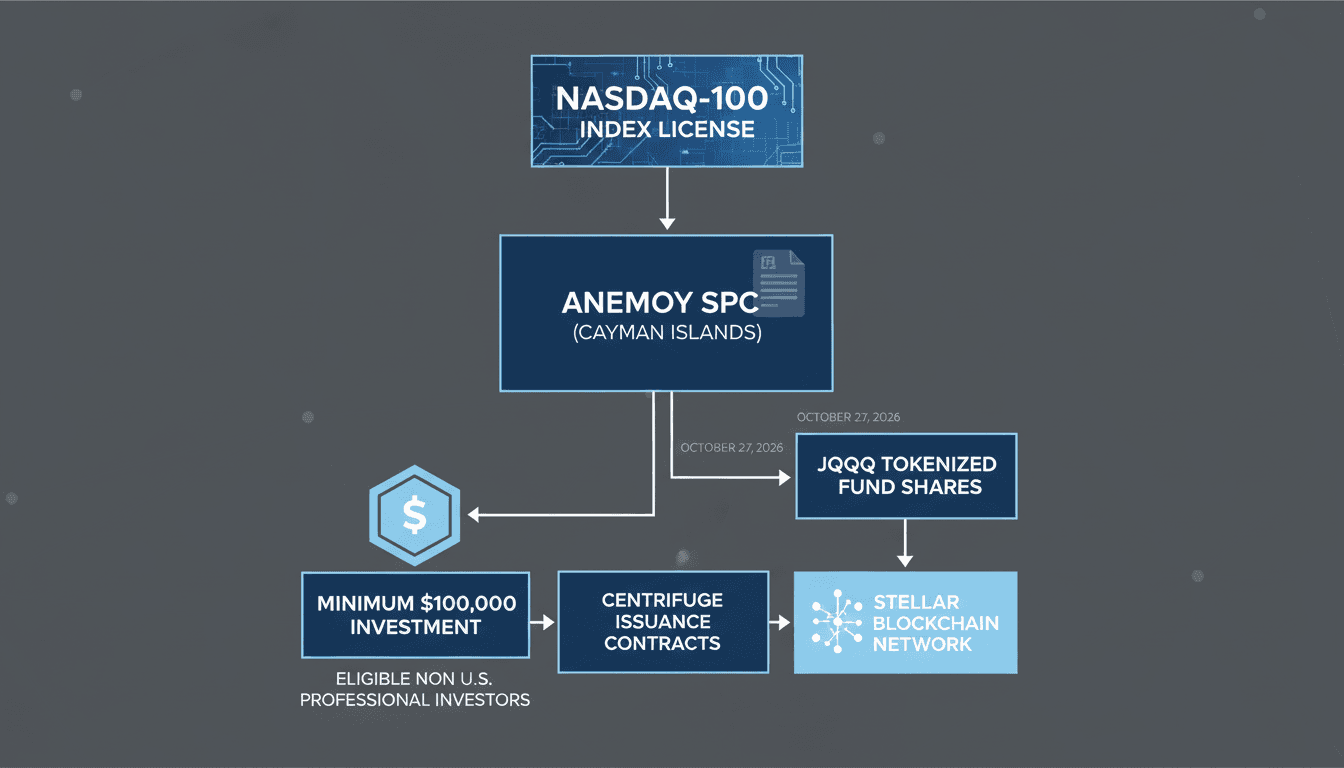
- Direct equity licensing onchain: Janus Henderson and Centrifuge launched JQQQ on October 27, 2026, marking the first issuer-sponsored, blockchain-native fund tracking the Nasdaq-100 Index under an official Nasdaq license.
- Dedicated infrastructure deployment: The product operates as a segregated portfolio of Anemoy Capital SPC Limited in the British Virgin Islands, minting shares exclusively on the Stellar blockchain via Centrifuge's institutional tooling.
- Restricted qualified participation: Access is reserved for eligible non-U.S. professional investors with a minimum commitment threshold of $100,000, explicitly excluding domestic U.S. capital.
The context you actually need
- Evolution beyond fixed-income pilots: Institutional real-world asset (RWA) tokenization previously centered almost entirely on short-duration sovereign debt and credit, but issuer-backed index equity marks an expansion into benchmark public equities.
- Scaling institutional volume: The launch pushes Janus Henderson’s active tokenized institutional footprint past $1 billion, building on its previous deployment of the S&P 500-tracking SPXA fund.
- Stellar's growing RWA footprint: Total tokenized real-world assets deployed on the Stellar blockchain exceeded $4 billion in 2026, providing an established settlement network for enterprise token issuances.
What's really happening
The launch of JQQQ illustrates a strategic shift in how global asset management combines established brand equity with decentralized network infrastructure. For years, digital asset markets interacted with benchmark equities almost entirely through third-party synthetic wrappers, offshore mirror tokens, or over-collateralized derivative protocols. These instruments historically introduced systemic counterparty friction, tracking divergence, and regulatory vulnerability.
Janus Henderson, an asset manager overseeing roughly $500 billion in total assets under management, is deploying capital through a setup that changes this risk profile. JQQQ is not a synthetic derivative; it is an issuer-sponsored fund with Janus Henderson Investors US LLC acting as sub-investment manager under a direct index license from Nasdaq.
The institutional incentives behind this deployment reflect changing commercial balance sheets:
First, it solves distribution efficiency. By housing the fund inside Anemoy Capital SPC Limited in the British Virgin Islands, Janus Henderson achieves regulatory segmentation that allows non-U.S. qualified participants to interact with core Western benchmark indices via onchain verification. The $100,000 minimum investment deliberately restricts the registry to sophisticated capital, avoiding consumer-protection friction while testing low-friction digital share creation.
Second, it establishes primary-issuance programmability. Centrifuge’s tokenization rail on Stellar transforms fund shares from static entries within a legacy transfer agent's ledger into composable digital representations. According to Centrifuge, this architecture targets the use of licensed fund shares as functional building blocks in automated financial workflows, such as collateral management, direct onchain treasury allocation, and instantaneous cross-border settlement.
Third, it marks a defensible operational bridge for legacy asset allocators. Asset managers face fee compression on traditional mutual fund and ETF wrappers. By expanding onchain strategies beyond $1 billion, Janus Henderson establishes early operational dominance in tokenized real-world assets, proving that legacy fund architectures can be translated natively onto public blockchains without sacrificing legal recourse, index integrity, or jurisdictional compliance.
Who feels it first (and how)
- Non-U.S. family offices and institutional allocators: Eligible professional funds in wealth hubs like Dubai and Singapore can hold high-beta tech exposure directly in digital wallets, reducing settlement latency and custodian overhead.
- DeFi and institutional liquidity venues: Infrastructure protocols gain access to a fully collateralized, officially licensed equity foundation asset to build cross-margining and institutional lending products.
- Legacy fund administration firms: Traditional transfer agents face competitive pressure from smart-contract issuance engines that automate cap-table tracking and fund-registry accounting at significantly lower transaction costs.
- U.S.-based individual and institutional capital: Entirely excluded from participation due to jurisdictional firewalls, widening the operational gap between onshore compliance requirements and international onchain capital markets.
What to watch next
- Secondary market composability: Watch whether JQQQ achieves clearance for use as qualified collateral within permissioned automated lending markets on Stellar or connected protocols.
- AUM accumulation speed: Track the timeline for JQQQ's initial seeding phase to hit its first $100 million in verified onchain balances, signaling organic demand beyond seed commitments.
- Competitive response from Tier-1 rivals: Observe whether index providers license additional flagship intellectual property directly to other multi-hundred-billion-dollar fund managers on public rails.
The fund is live on the Stellar network, requires a $100,000 minimum investment, tracks the Nasdaq-100 under an authentic index license, and is legally ring-fenced via Anemoy Capital SPC Limited for non-U.S. professional investors.
Total assets under management across Janus Henderson’s tokenized product shelf will scale further as institutional non-U.S. asset managers seek regulated equity instruments to diversify corporate treasuries.
Whether regulatory frameworks in key non-U.S. jurisdictions will permit secondary market trading across external automated liquidity pools, or restrict transferability strictly to whitelisted peer-to-peer wallets.
Frequently Asked Questions
- Why it matters?
- Major traditional asset managers are transitioning from experimental pilot testing to licensed, primary-issuance equity products on public blockchains, formalizing the infrastructure channel between institutional liquidity and decentralized ledgers.
- What happened (in 30 seconds)?
- Direct equity licensing onchain: Janus Henderson and Centrifuge launched JQQQ on October 27, 2026, marking the first issuer-sponsored, blockchain-native fund tracking the Nasdaq-100 Index under an official Nasdaq license. Dedicated infrastructure deployment: The product operates as a segregated portfolio of Anemoy Capital SPC Limited in the British Virgin Islands, minting shares exclusively on the Stellar blockchain via Centrifuge's institutional tooling. Restricted qualified participation: Acce
- What's really happening?
- The launch of JQQQ illustrates a strategic shift in how global asset management combines established brand equity with decentralized network infrastructure. For years, digital asset markets interacted with benchmark equities almost entirely through third-party synthetic wrappers, offshore mirror tokens, or over-collateralized derivative protocols. These instruments historically introduced systemic counterparty friction, tracking divergence, and regulatory vulnerability. Janus Henderson, an ass
- Who feels it first (and how)?
- Non-U.S. family offices and institutional allocators: Eligible professional funds in wealth hubs like Dubai and Singapore can hold high-beta tech exposure directly in digital wallets, reducing settlement latency and custodian overhead. DeFi and institutional liquidity venues: Infrastructure protocols gain access to a fully collateralized, officially licensed equity foundation asset to build cross-margining and institutional lending products. Legacy fund administration firms: Traditional transfer
- What to watch next?
- Secondary market composability: Watch whether JQQQ achieves clearance for use as qualified collateral within permissioned automated lending markets on Stellar or connected protocols. AUM accumulation speed: Track the timeline for JQQQ's initial seeding phase to hit its first $100 million in verified onchain balances, signaling organic demand beyond seed commitments. Competitive response from Tier-1 rivals: Observe whether index providers license additional flagship intellectual property directly
Covers Bitcoin plus altcoin news, market updates, and educational resources.
"Bitcoin.com provides news, market data, and guides focused on Bitcoin and the wider crypto industry."
— A47 Editor
Nasdaq-100 Enters Tokenized Fund Era With Janus Henderson JQQQ
Janus Henderson's JQQQ, a fund tracking the Nasdaq-100, has entered the tokenized fund space, with the Bitcoin.com report describing the product as the latest example of traditional index exposure moving onto blockchain rails. The base report, publis...
Covers blockchain, cryptocurrency news, project analysis, and market insights.
"Cointelegraph is a leading crypto-focused media outlet known for timely news, analysis, and educational content related to blockchain and digital assets."
— A47 Editor
Janus Henderson, Centrifuge launch tokenized Nasdaq-100 fund on Stellar
Janus Henderson and Centrifuge have launched a tokenized fund tracking the Nasdaq-100 on the Stellar blockchain, offering eligible non-US investors exposure to the index as Janus Henderson expands its institutional tokenization business.
Markets desk coverage, trading insights, and investor updates.
"WSJ’s markets reporting provides in-depth analysis and context for investors."
— A47 Editor
Janus Launches First Tokenized Fund Licensing the Nasdaq-100 Index
Janus has launched what is described as its first tokenized fund licensing the Nasdaq-100 Index, following Nasdaq's earlier decision to open licensing deals on its Big Tech benchmark to other money managers. The development was reported by The Wall S...