
Zcash Co-Founders Clash Over Proposal to Redirect $125M Community Grants Funding Stream
Why it matters
The debate tests whether programmatic block subsidies can be safely retired once protocol reserves accumulate enough capital to fund a decade of core development.
What happened (in 30 seconds)
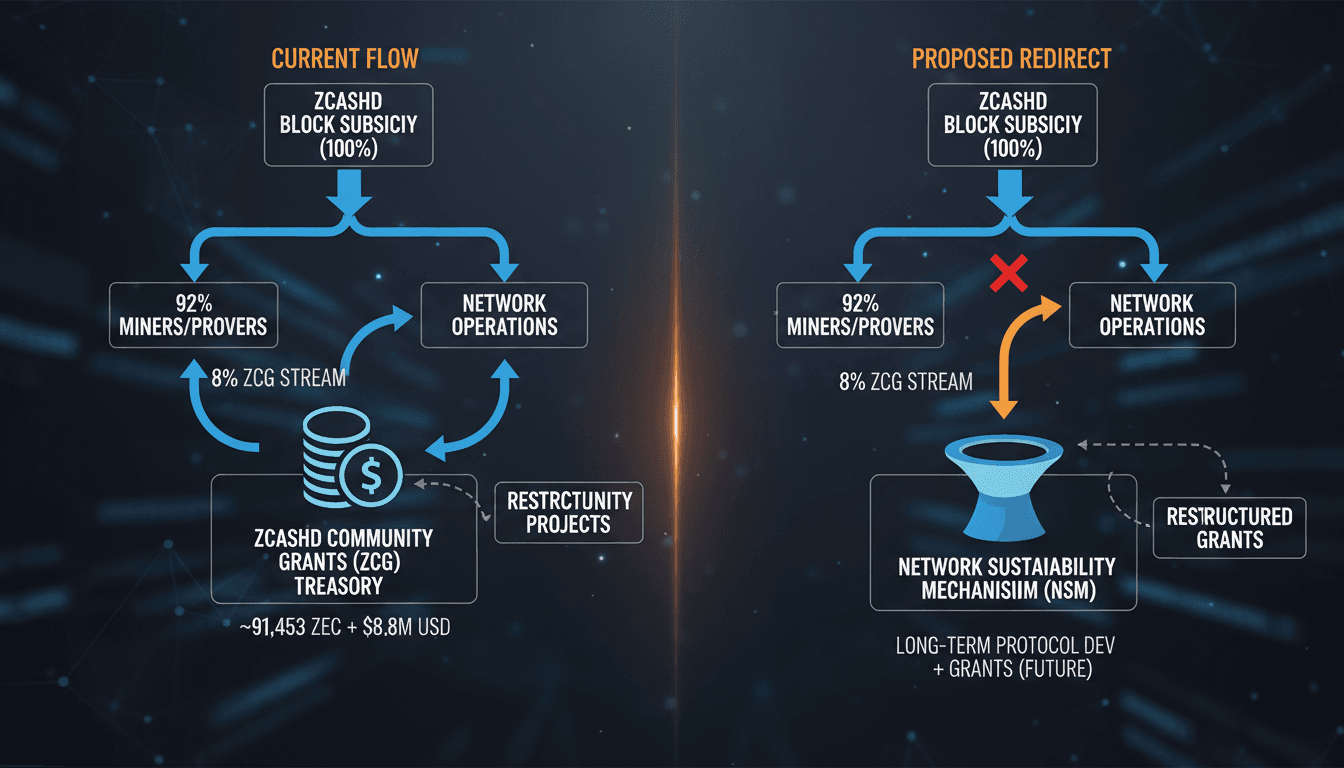
- Sean Bowe proposed disabling the automatic grant stream, filing a draft Zcash Improvement Proposal (ZIP) to redirect the 8% block subsidy from Zcash Community Grants (ZCG) to the Network Sustainability Mechanism (NSM).
- Josh Swihart called the proposal a half measure, arguing instead for the immediate dissolution of both the ZCG and coinholder funding streams into the NSM to provide absolute market clarity ahead of the halving.
- Key participants split over capital routing, with cryptographer Ian Miers questioning the destination of the redirected capital and Gemini co-founder Tyler Winklevoss backing a broader termination of the legacy grant structures.
The context you actually need
- ZCG was funded via an automatic 8% block subsidy, created to finance third-party developer grants, tooling, and privacy initiatives alongside a separate coinholder-controlled pool.
- The treasury accumulated an estimated $125 million net, currently holding 91,453 ZEC alongside $8.8 million in cash against roughly $2.4 million in existing liabilities (calculated using an illustrative $1,300 per ZEC price baseline).
- The draft proposal carries no immediate protocol activation, as it is formally excluded from the upcoming Network Upgrade 7 (NU7) schedule and remains open for community review.
What's really happening
The tension between Sean Bowe and Josh Swihart exposes a structural problem facing proof-of-work protocols with mandatory development taxes: automated treasury issuance works well to seed an early ecosystem, but it can create significant capital allocation distortions once asset prices climb.
Under the current architecture, 8% of every mined Zcash block subsidy continuously flows to ZCG. When the program was conceived, this distribution ensured persistent funding for community-led initiatives outside the primary core development teams. However, the combination of multi-year asset appreciation and disciplined expenditure created an unexpected balance sheet. With ZCG’s assets standing at 91,453 ZEC and $8.8 million in fiat-denominated reserves, Bowe’s analysis demonstrates that the entity possesses more than 10 years of runway under current operational budgets. Continuing to pump 8% of total block issuance into an already over-capitalized entity risks capital inefficiency.
To address this, Bowe’s draft ZIP diverts the 8% slice into the Network Sustainability Mechanism (NSM). The NSM functions as an internal sink: funds routed there are effectively held out of active circulation under current governance rules, reducing the pace of circulating supply expansion without requiring an outright structural rewrite of consensus subsidy calculations.
Swihart’s counter-proposal reveals the fundamental disagreement over institutional governance. As founder of the Zcash Open Development Lab (ZODL), Swihart argues that redirecting only the ZCG allocation while leaving the coinholder-controlled distribution channel intact creates operational ambiguity. In his view, leaving one stream active while redirecting another perpetuates administrative overhead and leaves the market guessing about future governance interventions. Swihart advocates terminating both streams entirely and locking those allocations into the NSM until the next halving event, establishing a hard structural deadline for development subsidies.
This dynamic exposes the incentive divide between protocol architects and ecosystem recipients. For miners and token holders, automatic dilution via protocol-level block subsidies is justifiable only when the network faces existential development deficits. When a grant program accumulates reserves sufficient to sustain a decade of grant-making, the economic rationale for ongoing programmatic dilution weakens. The dispute is not about whether community development should be funded, but whether perpetual protocol-level inflation should continue feeding an entity that already holds balance-sheet surplus.
Who feels it first (and how)
- Grant applicants and independent developers face long-term shifts in funding mechanisms if ZCG transitions from an ongoing cash-flow model to a finite spending plan drawn from existing reserves.
- Node operators and network miners monitor the fate of the 8% block slice, as redirecting subsidies into the NSM withholds tokens from circulation rather than distributing them directly into market-accessible developer wallets.
- Treasury and DAO administrators observe whether a top-tier privacy network can execute a controlled wind-down of automated subsidies without triggering administrative gridlock.
What to watch next
- Community feedback on the draft ZIP on GitHub, which will clarify whether developers favor Bowe’s single-stream redirect or Swihart’s total retirement of both funding channels.
- Network upgrade scheduling beyond NU7, as any implementation will require formal inclusion in a future hard fork or consensus specification.
- Governance deliberations regarding the NSM, specifically clarifying how withheld assets within the mechanism will be handled long-term.
Sean Bowe filed a draft ZIP to divert ZCG’s 8% block subsidy to the NSM; Josh Swihart opposed the partial scope and requested full retirement of both ZCG and coinholder funding streams; the ZCG balance sheet holds net assets of roughly $125 million.
The proposal will not impact short-term protocol operations, as it is explicitly excluded from the imminent Network Upgrade 7 (NU7) deployment timeline.
Whether core developers and coinholders will accept routing capital to the NSM or push to return that block share directly to proof-of-work miners or an alternate burn model.
Frequently Asked Questions
- Why it matters?
- The debate tests whether programmatic block subsidies can be safely retired once protocol reserves accumulate enough capital to fund a decade of core development.
- What happened (in 30 seconds)?
- Sean Bowe proposed disabling the automatic grant stream, filing a draft Zcash Improvement Proposal (ZIP) to redirect the 8% block subsidy from Zcash Community Grants (ZCG) to the Network Sustainability Mechanism (NSM). Josh Swihart called the proposal a half measure, arguing instead for the immediate dissolution of both the ZCG and coinholder funding streams into the NSM to provide absolute market clarity ahead of the halving. Key participants split over capital routing, with cryptographer Ian M
- What's really happening?
- The tension between Sean Bowe and Josh Swihart exposes a structural problem facing proof-of-work protocols with mandatory development taxes: automated treasury issuance works well to seed an early ecosystem, but it can create significant capital allocation distortions once asset prices climb. Under the current architecture, 8% of every mined Zcash block subsidy continuously flows to ZCG. When the program was conceived, this distribution ensured persistent funding for community-led initiatives o
- Who feels it first (and how)?
- Grant applicants and independent developers face long-term shifts in funding mechanisms if ZCG transitions from an ongoing cash-flow model to a finite spending plan drawn from existing reserves. Node operators and network miners monitor the fate of the 8% block slice, as redirecting subsidies into the NSM withholds tokens from circulation rather than distributing them directly into market-accessible developer wallets. Treasury and DAO administrators observe whether a top-tier privacy network can
- What to watch next?
- Community feedback on the draft ZIP on GitHub, which will clarify whether developers favor Bowe’s single-stream redirect or Swihart’s total retirement of both funding channels. Network upgrade scheduling beyond NU7, as any implementation will require formal inclusion in a future hard fork or consensus specification. Governance deliberations regarding the NSM, specifically clarifying how withheld assets within the mechanism will be handled long-term.
Covers Bitcoin plus altcoin news, market updates, and educational resources.
"Bitcoin.com provides news, market data, and guides focused on Bitcoin and the wider crypto industry."
— A47 Editor
Zcash Co-Founders Clash Over Future of $125M Grant Fund
Zcash co-founders Sean Bowe and Josh Swihart are publicly at odds over the future of the Zcash Community Grants (ZCG) fund, roughly $125 million, as the network's privacy-focused development model faces scrutiny; the dispute centers on how block subs...
Covers blockchain, cryptocurrency news, project analysis, and market insights.
"Cointelegraph is a leading crypto-focused media outlet known for timely news, analysis, and educational content related to blockchain and digital assets."
— A47 Editor
Zcash co-founder calls to stop funding ‘over $125M’ grants program
Zcash co-founder Sean Bowe has called for the Zcash Community Grants (ZCG) program, which has funded projects with over $125 million, to stop receiving its share of new ZEC, arguing ZCG already has enough money to keep funding projects and proposing ...
Real-time updates, analysis, and reports on the blockchain and cryptocurrency sectors.
"Crypto News delivers real-time updates, analysis, and reports on the blockchain and cryptocurrency sectors."
— A47 Editor
Zcash co-founder proposes redirecting 8% of block rewards to network reserve
Zcash co-founder Sean Bowe has proposed redirecting 8% of the network's block subsidies away from Zcash Community Grants into a reserve designed to support future mining rewards, a move that could effectively end the grant program's regular funding. ...
Real-time updates, analysis, and reports on the blockchain and cryptocurrency sectors.
"Crypto News delivers real-time updates, analysis, and reports on the blockchain and cryptocurrency sectors."
— A47 Editor
Zcash community divided over $550,000 adult industry outreach grant
Zcash has faced criticism from some cryptocurrency traders over a $550,000 community grant supporting outreach at adult industry events, with organizers defending the program as a way to bring private payments to people who struggle with traditional ...