
Bitcoin Falls in Month After Fed Holds Rates at 3.75%-4.00% With December Hike Probability at 79%
Why it matters
Monetary tightening shifts capital incentives toward risk-free yields, directly undermining digital asset price momentum over 30-day post-meeting windows.
What happened (in 30 seconds)
- The policy decision: On October 28, 2026, the Federal Reserve held interest rates steady at 3.75%-4.00% via a 10-2 vote, with two members dissenting in favor of a 25-basis-point increase.
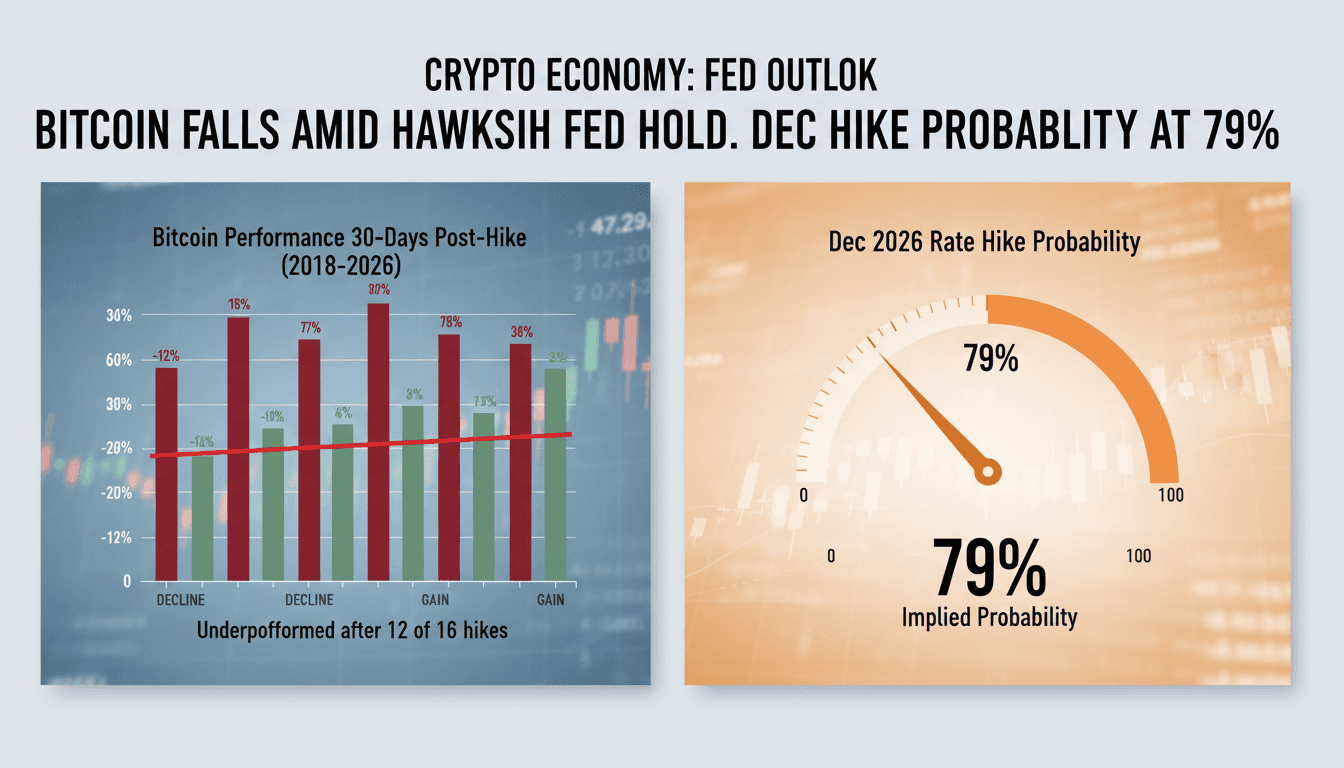
- The market pricing: Market participants rapidly re-evaluated the policy path, pricing in a 79% probability of a rate hike at the upcoming December 9 meeting.
- The asset reaction: Bitcoin dropped 1.4% over 24 hours to trade near $79,800, bringing its 30-day retreat to 5% as broader risk sentiment weakened across global markets.
The context you actually need
- Historical tightening patterns: Across 71 Federal Reserve decisions evaluated since January 2018, Bitcoin dropped in the 30 days following 12 of the 16 recorded rate increases, registering a median decline of 3.5%.
- Divergence from September: While Bitcoin defied historical tightening trends following the September 2026 rate hike, its October pullback aligns with the prevailing multi-year pattern of post-hike consolidation.
- Baseline macroeconomic strength: The Federal Open Market Committee characterized broader economic activity as "strong," leaving interest-rate policymakers focused on forthcoming price and employment metrics rather than easing liquidity.
What's really happening
The primary driver of Bitcoin’s price compression is not an isolated shift in cryptocurrency sentiment, but the structural mechanics of global liquidity. When the Federal Reserve maintains a hawkish posture—evidenced by two explicit dissents demanding higher borrowing costs—it shifts the opportunity cost of capital for institutional allocators.
A benchmark rate bracketed between 3.75% and 4.00% maintains elevated yields on short-dated sovereign paper. For asset managers, deploying capital into non-yielding risk assets requires an anticipated return that comfortably exceeds this baseline hurdle rate. When the central bank signals that the terminal rate may increase rather than plateau, balance sheet managers reallocate liquidity out of volatile beta assets to capture risk-free returns.
The historical data across 71 Fed meetings since 2018 demonstrates this friction. In 75% of rate-hiking events over that span—specifically 12 out of 16 occurrences—Bitcoin traded lower over the ensuing 30-day window, delivering a median drawdown of 3.5%. While external market conditions, including the 2020 liquidity shock and the 2022 market deleveraging, influenced individual cycles, the persistent directionality highlights how tightening financial conditions deplete liquidity buffers.
Furthermore, the foreign exchange dynamic reinforces this contraction. Elevated policy rates bolster the relative strength of the U.S. dollar, tightening dollar-denominated financial conditions worldwide. Because digital assets trade primarily against the dollar and dollar-pegged stablecoins, tighter greenback liquidity compresses margin balances, increases financing rates on derivatives desks, and discourages leveraged long exposure.
The shift to a 79% priced probability for a December 9 rate hike signals that institutional traders expect liquidity conditions to deteriorate before they improve. As tech equities in Asian trading sessions also experienced concurrent selloffs, Bitcoin’s intraday slide to $79,800 represents a systemic risk-off repricing. Rather than an idiosyncratic breakdown, the price action reflects capital allocators actively recalibrating risk profiles to match a Federal Reserve that prioritizes demand dampening over asset valuation support.
Who feels it first (and how)
- Digital asset treasury desks: Balance sheets holding non-yielding token reserves encounter immediate mark-to-market depreciation and higher opportunity costs compared to short-dated sovereign paper.
- Derivatives and high-frequency traders: Speculative trading desks face rising funding costs and technical pressure near the 50-week exponential moving average as leverage unwinds.
- Cross-border capital allocators: Fund managers balancing multi-asset portfolios must rebalance out of emerging, high-volatility sectors and into higher-yielding dollar cash equivalents.
What to watch next
- The Personal Consumption Expenditures (PCE) price index: Measures baseline price pressures; an elevated reading will reinforce the 79% pricing for a December policy hike.
- The upcoming U.S. employment report: Tracks labor market resilience, where sustained job additions provide the central bank room to implement further policy firming.
- Technical support at the 50-week EMA: Serves as the critical price threshold for Bitcoin around the $79,800 level to determine if technical selling broadens.
The Federal Reserve maintained rates at 3.75%-4.00% on October 28, 2026, in a 10-2 split decision, with historical data confirming Bitcoin declined 30 days after 12 of the last 16 rate hikes.
Persistent hawkish signaling will keep digital asset trading volumes constrained and limit near-term valuation multiple expansion into the December meeting.
Whether forthcoming inflation reports (CPI and PCE) will accelerate sufficiently to transform the 79% market probability of a December rate hike into an actionable committee majority.
Frequently Asked Questions
- Why it matters?
- Monetary tightening shifts capital incentives toward risk-free yields, directly undermining digital asset price momentum over 30-day post-meeting windows.
- What happened (in 30 seconds)?
- The policy decision: On October 28, 2026, the Federal Reserve held interest rates steady at 3.75%-4.00% via a 10-2 vote, with two members dissenting in favor of a 25-basis-point increase. The market pricing: Market participants rapidly re-evaluated the policy path, pricing in a 79% probability of a rate hike at the upcoming December 9 meeting. The asset reaction: Bitcoin dropped 1.4% over 24 hours to trade near $79,800, bringing its 30-day retreat to 5% as broader risk sentiment weakened across
- What's really happening?
- The primary driver of Bitcoin’s price compression is not an isolated shift in cryptocurrency sentiment, but the structural mechanics of global liquidity. When the Federal Reserve maintains a hawkish posture—evidenced by two explicit dissents demanding higher borrowing costs—it shifts the opportunity cost of capital for institutional allocators. A benchmark rate bracketed between 3.75% and 4.00% maintains elevated yields on short-dated sovereign paper. For asset managers, deploying capital into
- Who feels it first (and how)?
- Digital asset treasury desks: Balance sheets holding non-yielding token reserves encounter immediate mark-to-market depreciation and higher opportunity costs compared to short-dated sovereign paper. Derivatives and high-frequency traders: Speculative trading desks face rising funding costs and technical pressure near the 50-week exponential moving average as leverage unwinds. Cross-border capital allocators: Fund managers balancing multi-asset portfolios must rebalance out of emerging, high-vola
- What to watch next?
- The Personal Consumption Expenditures (PCE) price index: Measures baseline price pressures; an elevated reading will reinforce the 79% pricing for a December policy hike. The upcoming U.S. employment report: Tracks labor market resilience, where sustained job additions provide the central bank room to implement further policy firming. Technical support at the 50-week EMA: Serves as the critical price threshold for Bitcoin around the $79,800 level to determine if technical selling broadens.
Beginner-friendly crypto tutorials, guides, and news.
"99Bitcoins is a crypto education and news site known for easy-to-understand content and comprehensive guides."
— A47 Editor
BTC USD Fell in the Month After 12 of the Fed’s 16 Rate Hikes Since 2018: What Could a December Hike Mean for Bitcoin?
Bitcoin has traded lower in the 30 days following 12 of the Federal Reserve's 16 rate hikes since 2018, according to a 99Bitcoins review of all 71 Fed decisions, and traders are pricing a 79% chance of another hike at the December 9 meeting. The Fed'...
Real-time updates, analysis, and reports on the blockchain and cryptocurrency sectors.
"Crypto News delivers real-time updates, analysis, and reports on the blockchain and cryptocurrency sectors."
— A47 Editor
Bitcoin near $80.8K as Fed holds rates, two officials seek hike
The Federal Reserve held its benchmark interest rate steady at 3.75%–4.00% on October 28, with two officials favoring another quarter-point hike, and the decision passed 10–2. Bitcoin traded near $80,800 around the announcement, after recovering from...
Bitcoin news, technical analysis, and forecasts across crypto markets.
"NewsBTC covers Bitcoin news, technical analysis, and forecasts across crypto markets and major blockchain projects."
— A47 Editor
Bitcoin Hovers Around $80,000 as Fed Decision Draws Closer
Bitcoin traded near the $80,000 level as market participants entered October 27, 2026, focused on the upcoming Federal Reserve policy decision. The base report frames the cryptocurrency as holding steady while investors weigh the central bank's next ...