
Suspected Binance Hot Wallet Compromise Moves Up to $5.8 Billion in Crypto Assets Across Multiple Blockchains
Why it matters
The diversion of up to $5.8 billion across multiple blockchains represents the largest capital displacement event in digital asset history, triggering $1.4 billion in market liquidations and testing the boundaries of post-upgrade protocol vulnerabilities.
What happened (in 30 seconds)
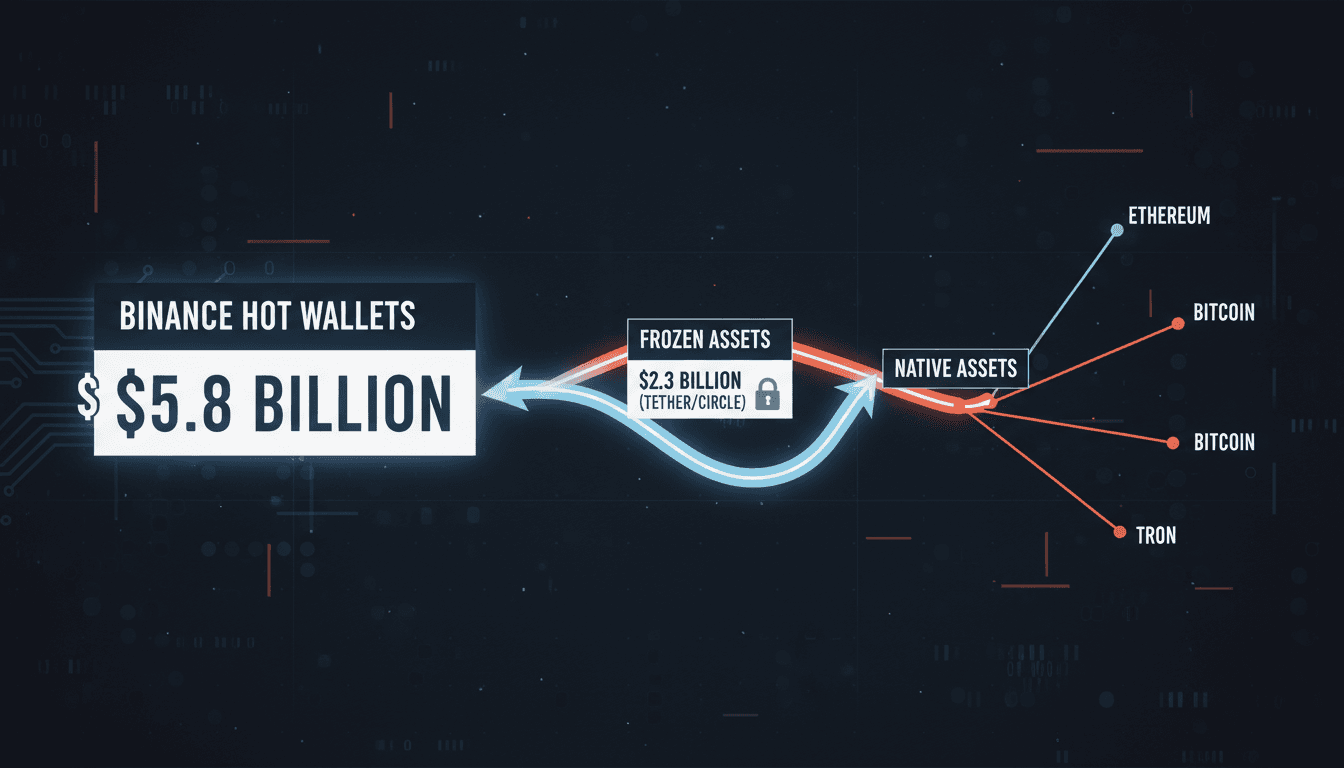
- The capital flight: Around 4:20 p.m. Eastern Time on October 29, 2026, an unauthorized delegation transaction targeted Binance’s hot wallets, draining approximately 167,464 ETH, 1.615 billion USDT, and related assets totaling an estimated $5.3 billion to $5.8 billion across Ethereum, Bitcoin, and Tron.
- The infrastructure response: Binance halted global withdrawals to initiate security verifications, while stablecoin issuers Tether and Circle coordinated to freeze more than $2.3 billion in asset balances on-chain.
- The official position: Binance announced that customer deposits remain safe and committed enterprise resources to cover any net deficit, while founder Changpeng Zhao noted that the anomalous activity mirrored an exploit.
The context you actually need
- The protocol precedent: In May 2025, Ethereum deployed the Pectra upgrade featuring EIP-7702, a standard allowing standard externally owned accounts to temporarily delegate transaction logic to smart contracts.
- The historical baseline: This incident surpasses the February 2025 Bybit security breach, which resulted in $1.5 billion in losses, validating warnings issued by analytical firms regarding complex multi-chain execution paths.
- The market shockwave: Market prices retreated rapidly following the transactions, with Bitcoin sliding toward $76,000, Ethereum dropping 4.6%, and leveraged traders sustaining $1.4 billion in automated liquidations.
What's really happening
The mechanics of the incident point to a structural vulnerability at the intersection of private key custody, automated hot-wallet infrastructure, and newly adopted transaction standards.
Binance operates high-velocity "hot wallets"—addresses connected directly to internet interfaces to service continuous user withdrawals and deposits. These automated custody nodes maintain large balances of fungible tokens to preserve liquidity depth. Forensic data shows the attack leveraged an EIP-7702 delegation transaction for the address labeled Binance 14. EIP-7702, activated during the May 2025 Ethereum Pectra hard fork, was developed to enhance user experience by allowing conventional wallets to act as smart contract accounts during execution. In this scenario, that exact feature appears to have granted the attacker an automated execution pipeline.
By deploying pre-signed authorizations, the actor converted the designated hot wallet into an execution contract that swept 167,464 ETH and 1.615 billion USDT to external holding addresses within minutes. Parallel drain activity unfolded across the Bitcoin and Tron blockchains, indicating that the compromise was not limited to an isolated smart contract logic error. Instead, the incident implies that administrative signing infrastructure or internal credential management systems were compromised beforehand, granting the actor multi-chain key authorization.
The financial fallout split the moved capital into two categories: censorable smart contract tokens and censorship-resistant base assets. Because USDT and USDC possess administrative contract controls, issuers Tether and Circle rapidly locked over $2.3 billion of the routed funds, essentially neutralizing those balances. Conversely, native assets—such as raw ETH and Bitcoin—lack issuer-side blacklisting functions. These unencumbered funds continue moving through decentralized mixers, bridges, and cross-chain routers outside the purview of traditional asset recovery.
Binance’s balance sheet now faces a severe containment test. While the exchange states customer funds are secure and pledges to absorb losses via operational reserves, covering several billion dollars of unrecoverable native tokens forces massive enterprise capital reallocation. The incident proves that architectural efficiency—keeping billions of dollars in programmatic, automated signing hot wallets to sustain instant transactions—creates an acute systemic risk point.
Who feels it first (and how)
- Active retail and institutional exchange clients: Experience interrupted operational liquidity due to absolute withdrawal freezes across Binance platform accounts.
- Leveraged derivatives traders: Suffer abrupt position closures, as reflected by the $1.4 billion wiped out across global order books when spot prices corrected.
- Treasury managers at Web3 firms: Face mandatory operational reassessments regarding centralized hot-wallet custody versus segregated cold storage solutions.
- Stablecoin issuers and infrastructure providers: Endure heightened governance and technical demands to process billions of dollars in emergency blacklist and compliance actions.
What to watch next
- Forensic validation of key exposure: Clarification on whether signing infrastructure, API access, or an insider compromised Binance's administrative keys will establish the true vulnerability vector.
- On-chain movement of native assets: The tracing of non-freezable Bitcoin and Ethereum balances will determine how much capital exits into decentralized mixing networks permanently.
- Timeline for withdrawal normalization: The speed and tiering with which Binance safely resumes outgoing user transfers will signal the stability of its underlying liquidity.
An anomalous event directed up to $5.8 billion out of Binance-linked hot wallets on October 29, 2026; stablecoin issuers froze over $2.3 billion; Binance suspended asset withdrawals while promising to cover shortfalls.
The attacker maintained advance access to internal signing credentials or hot wallet operational systems, enabling the exploitation of EIP-7702 delegation functions across chains simultaneously.
The final quantified loss balance after asset freezes, the legal origin of the intrusion, and whether platform cold-storage reserves remain entirely insulated from the underlying key compromise.
Frequently Asked Questions
- Why it matters?
- The diversion of up to $5.8 billion across multiple blockchains represents the largest capital displacement event in digital asset history, triggering $1.4 billion in market liquidations and testing the boundaries of post-upgrade protocol vulnerabilities.
- What happened (in 30 seconds)?
- The capital flight: Around 4:20 p.m. Eastern Time on October 29, 2026, an unauthorized delegation transaction targeted Binance’s hot wallets, draining approximately 167,464 ETH, 1.615 billion USDT, and related assets totaling an estimated $5.3 billion to $5.8 billion across Ethereum, Bitcoin, and Tron. The infrastructure response: Binance halted global withdrawals to initiate security verifications, while stablecoin issuers Tether and Circle coordinated to freeze more than $2.3 billion in asset
- What's really happening?
- The mechanics of the incident point to a structural vulnerability at the intersection of private key custody, automated hot-wallet infrastructure, and newly adopted transaction standards. Binance operates high-velocity "hot wallets"—addresses connected directly to internet interfaces to service continuous user withdrawals and deposits. These automated custody nodes maintain large balances of fungible tokens to preserve liquidity depth. Forensic data shows the attack leveraged an EIP-7702 deleg
- Who feels it first (and how)?
- Active retail and institutional exchange clients: Experience interrupted operational liquidity due to absolute withdrawal freezes across Binance platform accounts. Leveraged derivatives traders: Suffer abrupt position closures, as reflected by the $1.4 billion wiped out across global order books when spot prices corrected. Treasury managers at Web3 firms: Face mandatory operational reassessments regarding centralized hot-wallet custody versus segregated cold storage solutions. Stablecoin issuers
- What to watch next?
- Forensic validation of key exposure: Clarification on whether signing infrastructure, API access, or an insider compromised Binance's administrative keys will establish the true vulnerability vector. On-chain movement of native assets: The tracing of non-freezable Bitcoin and Ethereum balances will determine how much capital exits into decentralized mixing networks permanently. Timeline for withdrawal normalization: The speed and tiering with which Binance safely resumes outgoing user transfers
Covers Bitcoin plus altcoin news, market updates, and educational resources.
"Bitcoin.com provides news, market data, and guides focused on Bitcoin and the wider crypto industry."
— A47 Editor
Inside the $5.8B Binance Hack: What’s Confirmed and What Isn’t
Binance has become the center of a reported multibillion-dollar hack, with the base report examining what has been confirmed and what remains unverified in the $5.8B figure. Live coverage indicates Binance said $2.54 billion in assets had been frozen...
Covers blockchain, cryptocurrency news, project analysis, and market insights.
"Cointelegraph is a leading crypto-focused media outlet known for timely news, analysis, and educational content related to blockchain and digital assets."
— A47 Editor
Binance hack rattles crypto markets as BNB falls 7%, Bitcoin slides
Bitcoin and Ether fell as the broader crypto market dropped 3.3%, after reports of suspicious multibillion-dollar transfers from Binance-linked wallets stoked uncertainty. BNB fell about 7% in the same sell-off, with the base report framing the episo...
RT is a Russian state-funded network covering global events from a Russian perspective.
"RT is widely criticized for promoting pro-Kremlin narratives and is considered by many to be a state propaganda outlet."
— A47 Editor
World’s largest crypto exchange investigates suspected multibillion-dollar hack
Binance, the world's largest cryptocurrency exchange, is investigating a suspected multibillion-dollar security breach after researchers flagged billions of dollars in suspicious transfers, according to a report from RT (Russia Today).