
S&P Retains Weakest USDT Stability Rating as Higher-Risk Reserves Reach 28 Percent
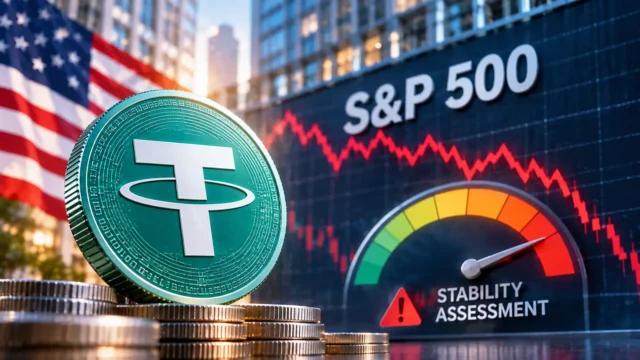
Why it matters
The world’s dominant digital dollar settlement layer is increasingly backed by volatile assets rather than cash equivalents, testing whether alternative reserve frameworks can withstand sudden macro liquidity shocks.
What happened (in 30 seconds)
- S&P maintained its score of 5 (weak): On November 18, 2026, S&P Global Ratings reaffirmed its lowest stability grade for Tether's USDT, repeating the evaluation first established in November 2025.
- Higher-risk reserve exposure expanded: The credit rating agency cited that higher-risk assets—including Bitcoin, gold, corporate bonds, public equities, and secured loans—climbed to 28% of USDT circulation as of September 30, up from 24% a year prior.
- Tether disputed the methodology: Paolo Ardoino and Tether pushed back against the assessment, pointing to a 104.3% collateralization ratio, an attestation from BDO confirming a $7.95 billion surplus, an audit from KPMG, and citing historical rating agency misjudgments.
The context you actually need
- The regulatory pivot to El Salvador: In January 2025, Tether transitioned operations to El Salvador under the National Commission of Digital Assets (CNAD) regulatory framework, a jurisdiction that allows issuers wider discretion over eligible reserve asset classes.
- The mechanical ceiling on downgrades: S&P’s scale runs from 1 to 5, meaning USDT sat at the lowest available rank throughout the past year; the agency explicitly noted no further numerical downgrade was possible despite the reserve shift.
- Operational track record versus rating criteria: Tether has processed redemptions at parity throughout multiple market stress cycles, but traditional rating agency frameworks penalize non-segregated reserves and non-cash equivalent paper when modeling stress scenarios.
What's really happening
The friction between Tether and S&P Global Ratings reveals a structural disagreement over what constitutes stability in digital currency balance sheets. Traditional credit rating agencies measure stablecoins against orthodox money-market fund standards: cash, overnight repos, and short-dated sovereign paper. S&P’s analytical framework presumes that any asset subject to market volatility—such as precious metals, corporate debt instruments, or digital tokens—poses an intrinsic risk of undercollateralization should redemptions accelerate during a broad asset sell-off.
Tether’s actual balance sheet composition reflects an alternative economic incentive model. Under the CNAD regulatory umbrella in El Salvador, the issuer is not restricted to standard fiat-substitute assets. Tether's September 30 reporting verified by BDO shows $191.5 billion in total reserve assets against $183.5 billion in liabilities. That structure leaves an equity surplus of $7.95 billion, generating a 104.3% collateralization ratio.
However, the composition of that backing has actively tilted. With higher-risk assets rising from 24% to 28% of circulation within 12 months, roughly $51 billion of USDT’s aggregate float is tied to assets that trade with standard market fluctuation. In normal or bull market cycles, these yield-bearing and appreciating holdings generate substantial operating revenue for the issuer. S&P's modeling, conversely, stresses the downside: if a sharp correction hits Bitcoin, public equities, and corporate debt simultaneously, the current $7.95 billion equity cushion could face rapid erosion before loans can be recalled or volatile assets liquidated.
Compounding S&P’s assessment is governance architecture. The agency pointed out that the current supervisory environment in El Salvador does not mandate explicit legal asset segregation, while public disclosures regarding specific custodian counterparties remain limited. While Tether points to verified attestations by BDO and its audit through KPMG as sufficient proof of solvency, credit assessors demand transparent, daily operational ring-fencing. Because USDT maintained continuous parity and redemptions remained orderly throughout 2025 and 2026, the marketplace continues to treat USDT as an effective dollar equivalent, effectively discounting institutional rating methodologies in favor of historical redemption liquidity.
Who feels it first (and how)
- Institutional cross-border desks: Corporate treasuries moving balances through OTC settlement conduits must evaluate whether enterprise risk policies permit working capital exposure to an asset bearing an external 'weak' assessment.
- Dubai-based digital asset exchanges: Regional platforms that rely heavily on USDT trading pairs face indirect liquidity exposure if institutional banking counterparties restrict off-ramps based on formal rating classifications.
- High-frequency market makers: Arbitrageurs and liquidity providers holding seven- to eight-figure USDT balances bear the direct exposure of reserve volatility if a simultaneous liquidation across gold and equity holdings stresses the redemption queue.
What to watch next
- The 30% risk-asset inflection: Track upcoming quarterly attestations to observe whether alternative holdings expand past 30% of total circulation, a threshold that would require larger equity surpluses to offset downside variance.
- Collateralization buffer size: Monitor Tether's reported excess equity beyond its current $7.95 billion cushion, which serves as the primary absorption shock absorber against asset-class drawdowns.
- Secondary market peg deviation: Watch whether institutional borrowing rates or stablecoin swap pools reflect any widening basis spread against alternative fiat-backed tokens in response to the rating update.
S&P affirmed its score of 5 (weak) on November 18, 2026, based on higher-risk assets increasing from 24% to 28% of USDT circulation as of September 30, 2026. BDO attestations confirm $191.5 billion in assets against $183.5 billion in liabilities, yielding a 104.3% collateralization ratio.
Tether will continue to operate under its El Salvador CNAD framework rather than alter its treasury asset allocation specifically to satisfy traditional credit agency scoring criteria.
Whether institutional institutional desks and corporate entities with rigid risk parameters will curtail USDT volume or if execution liquidity will continue to supersede third-party stability ratings.
Frequently Asked Questions
- Why it matters?
- The world’s dominant digital dollar settlement layer is increasingly backed by volatile assets rather than cash equivalents, testing whether alternative reserve frameworks can withstand sudden macro liquidity shocks.
- What happened (in 30 seconds)?
- S&P maintained its score of 5 (weak): On November 18, 2026, S&P Global Ratings reaffirmed its lowest stability grade for Tether's USDT, repeating the evaluation first established in November 2025. Higher-risk reserve exposure expanded: The credit rating agency cited that higher-risk assets—including Bitcoin, gold, corporate bonds, public equities, and secured loans—climbed to 28% of USDT circulation as of September 30, up from 24% a year prior. Tether disputed the methodology: Paolo Ardoino and
- What's really happening?
- The friction between Tether and S&P Global Ratings reveals a structural disagreement over what constitutes stability in digital currency balance sheets. Traditional credit rating agencies measure stablecoins against orthodox money-market fund standards: cash, overnight repos, and short-dated sovereign paper. S&P’s analytical framework presumes that any asset subject to market volatility—such as precious metals, corporate debt instruments, or digital tokens—poses an intrinsic risk of undercollate
- Who feels it first (and how)?
- Institutional cross-border desks: Corporate treasuries moving balances through OTC settlement conduits must evaluate whether enterprise risk policies permit working capital exposure to an asset bearing an external 'weak' assessment. Dubai-based digital asset exchanges: Regional platforms that rely heavily on USDT trading pairs face indirect liquidity exposure if institutional banking counterparties restrict off-ramps based on formal rating classifications. High-frequency market makers: Arbitrage
- What to watch next?
- The 30% risk-asset inflection: Track upcoming quarterly attestations to observe whether alternative holdings expand past 30% of total circulation, a threshold that would require larger equity surpluses to offset downside variance. Collateralization buffer size: Monitor Tether's reported excess equity beyond its current $7.95 billion cushion, which serves as the primary absorption shock absorber against asset-class drawdowns. Secondary market peg deviation: Watch whether institutional borrowing r
News and analysis on Bitcoin, altcoins, and blockchain innovation.
"Bitcoinist delivers news and analysis on Bitcoin, altcoins, and blockchain innovation with a focus on market trends and industry updates."
— A47 Editor
Tether Pushes Back Against S&P as USDT Reserve Maintains Lowest Stability Assessment
S&P Global Ratings kept Tether's USDT at 5 (weak), its lowest stability score, in a Stablecoin Stability Assessment published November 18, citing a growing share of higher-risk assets in USDT's reserves and continuing transparency concerns, and Tethe...
Covers Bitcoin plus altcoin news, market updates, and educational resources.
"Bitcoin.com provides news, market data, and guides focused on Bitcoin and the wider crypto industry."
— A47 Editor
S&P Global Maintains Lowest Stability Score for Tether’s USDT
S&P Global Ratings kept Tether's USDT stablecoin at its lowest available Stablecoin Stability Assessment score of 5 (weak), in a Stablecoin Stability Assessment published November 18, 2026. The rating agency cited a growing share of higher-risk asset...
Real-time updates, analysis, and reports on the blockchain and cryptocurrency sectors.
"Crypto News delivers real-time updates, analysis, and reports on the blockchain and cryptocurrency sectors."
— A47 Editor
S&P keeps Tether’s USDT at weakest stability score as riskier asset exposure rises to 28%
S&P has kept Tether's USDT at the weakest available stability score in its latest Stablecoin Stability Assessment, as higher-risk assets reportedly reach 28% of circulating supply and concerns about reserve transparency persist.
Covers blockchain, cryptocurrency news, project analysis, and market insights.
"Cointelegraph is a leading crypto-focused media outlet known for timely news, analysis, and educational content related to blockchain and digital assets."
— A47 Editor
Tether invokes The Big Short in swipe at S&P over USDT reserve risks
S&P Global left Tether's USDT stablecoin unchanged in its latest Stablecoin Stability Assessment, keeping the lowest available score of 5, while Tether publicly responded by invoking The Big Short to criticize the rating agency's view of USDT reserve...
Research, news, and analysis on blockchain startups, DeFi, and regulations.
"Crypto Briefing provides research, news, and analysis on blockchain startups, DeFi, and crypto regulations with investor-focused coverage."
— A47 Editor
S&P Global Ratings downgrades Tether’s USDT peg assessment to weak
S&P Global Ratings has downgraded its assessment of Tether's USDT peg to "weak," according to a Crypto Briefing report, signaling concern about the stablecoin's ability to maintain its dollar peg and the transparency of its reserves.