
MARA and Riot Liquidate 60845 Bitcoin for Approximately 4.5 Billion in 2026 to Fund Debt Repayment and Infrastructure
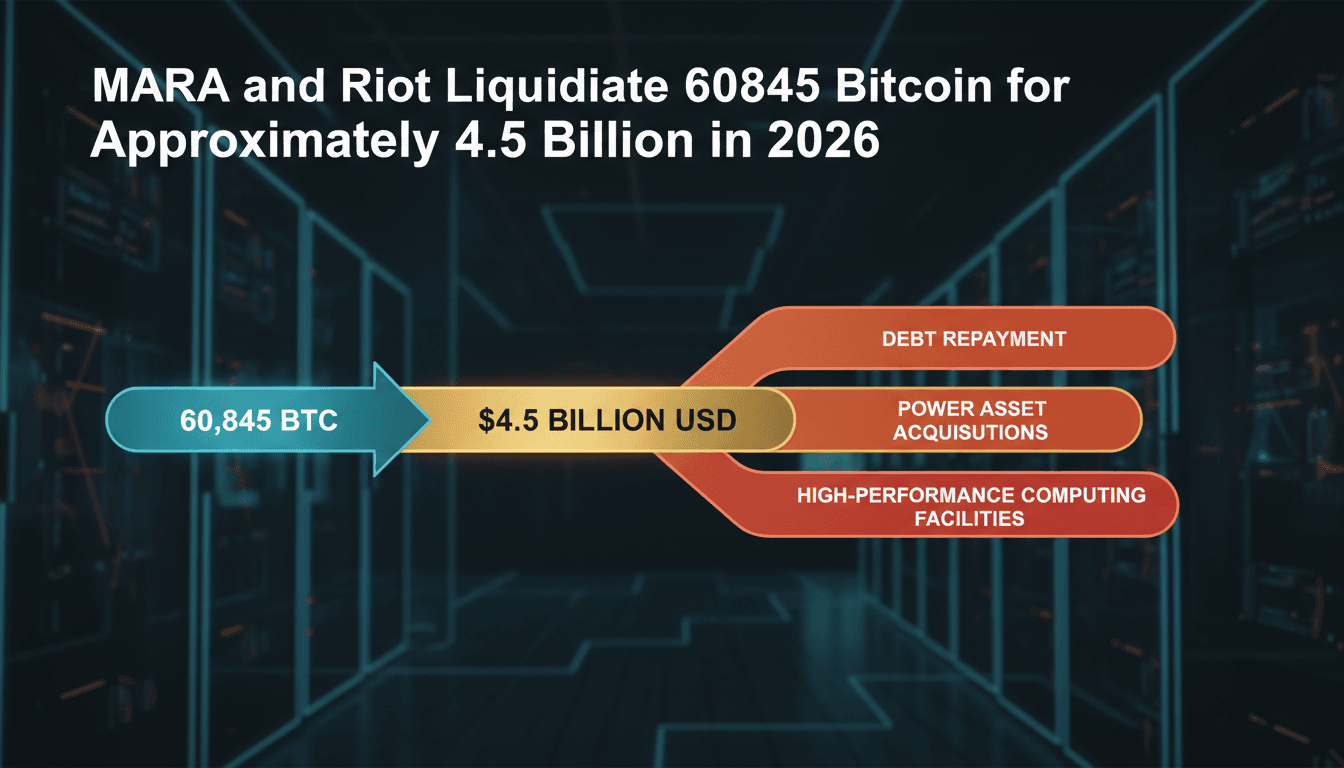
Corporate digital asset reserves are subordinating to physical energy capacity, requiring operators to monitor enterprise liquidity reallocation rather than pure treasury accumulation.
Why it matters
The transition of public mining balance sheets from sovereign-style asset accumulation to active capital expenditure signals that access to power infrastructure and debt service now outranks long-term token retention in enterprise viability.
What happened (in 30 seconds)
- Corporate liquidations crossed $4.5 billion: MARA Holdings and Riot Platforms collectively sold 60,845 Bitcoin in 2026, accounting for roughly 56% of total sales across 14 tracked publicly listed firms.
- Proceeds met near-term capital needs: MARA deployed $750 million from post-September proceeds averaging $81,039 per Bitcoin to retire debt tied to its Long Ridge Energy acquisition, while Riot addressed a $200 million credit facility.
- Treasuries transitioned to fund compute infrastructure: Both operators abandoned strict asset-retention frameworks to finance data center construction, including Riot’s high-performance compute integration with Anthropic at its Corsicana site.
The context you actually need
- Mining economics compressed under higher production costs: Declining gross mining margins throughout 2025 and 2026 reduced structural cash generation from block validation, forcing operators to monetize baseline balance sheet holdings.
- Outflows drastically outstripped fresh network production: Riot’s liquidation of 20,264 BTC through the first nine months exceeded its actual production run rate of 4,697 BTC mined over the exact same operating window.
- Enterprise debt structures limited balance-sheet optionality: High-interest credit facilities and acquisition loans collateralized by volatile digital balances required explicit fiat redemption to eliminate liquidation triggers.
What's really happening
The operational model that defined public crypto infrastructure between 2020 and 2024—retaining 100% of mined tokens to inflate enterprise net asset values—has concluded. MARA Holdings and Riot Platforms are adjusting to clear economic realities: capital expenditure demands in energy and compute have escalated beyond what equity dilution and low operational cash flows can sustain.
Across 2026, corporate disposals exceeded 108,000 BTC across 14 public corporations. MARA and Riot alone generated roughly $4.5 billion from their combined sale of 60,845 BTC. In the first nine months of the year, MARA raised $1.9 billion by clearing 26,984 BTC, followed by an additional 13,597 BTC sold for approximately $1.1 billion at an average executed clearing price of $81,039. The immediate use of funds was non-discretionary: $750 million went toward extinguishing loan obligations tied to its Long Ridge Energy infrastructure transaction.
Riot pursued an identical treasury mechanic. It liquidated 20,264 BTC for $1.48 billion through September, despite mining only 4,697 BTC in that timeframe. By parting with over four times its production volume, Riot satisfied a $200 million credit facility and redirected baseline capital into its Corsicana campus to build physical data centers hosting tenant infrastructure, notably for Anthropic.
The incentive structure here is purely structural. Grid access, interconnection capacity, and contracted power assets offer verifiable recurring revenue when converted to high-performance computing (HPC) and artificial intelligence infrastructure. In contrast, unencumbered Bitcoin holdings do not yield cash to service short-term liabilities.
When operational margins thin, the cost of servicing leveraged obligations with volatile collateral becomes unacceptable to public debt markets. Consequently, public miners are acting as persistent market sellers. Rather than using capital markets to protect their tokens, management teams are now liquidating those tokens to purchase real-world thermal power and compute assets.
Who feels it first (and how)
- Digital asset market-structure desks: Market participants absorb steady structural sell-side order flow as institutional liquidations outpace monthly miner block rewards.
- High-performance computing developers: Infrastructure planners face direct real estate and power competition from capitalized miners actively funding multi-megawatt campuses.
- Corporate treasury officers: Allocators lose public company precedents for balance-sheet tokenization as former benchmark holders treat digital reserves as working capital.
What to watch next
- Corporate debt maturity profiles: Ongoing monitor of short-term notes and revolving credit lines among mid-cap miners, because upcoming maturities dictate future liquidation volume.
- Grid interconnection milestones: Progress indicators on Corsicana and Long Ridge energy capacity developments, which verify whether diverted funds generate projected non-mining returns.
- Public company production-to-sale ratios: The spread between monthly aggregate coins mined versus total coins sold across publicly reporting operators to determine structural selling pressure.
MARA and Riot sold 60,845 BTC in 2026 to generate roughly $4.5 billion, specifically repaying $950 million in combined credit lines and acquisition facilities while acquiring compute infrastructure.
Miner sales will continue to track power infrastructure capex schedules rather than spot market price cycles, establishing an ongoing source of spot liquidity supply.
Whether transitioning power assets from digital currency validation to AI and cloud compute leases will yield margins large enough to justify the permanent reduction in company treasury reserves.
Frequently Asked Questions
- Why it matters?
- The transition of public mining balance sheets from sovereign-style asset accumulation to active capital expenditure signals that access to power infrastructure and debt service now outranks long-term token retention in enterprise viability.
- What happened (in 30 seconds)?
- Corporate liquidations crossed $4.5 billion: MARA Holdings and Riot Platforms collectively sold 60,845 Bitcoin in 2026, accounting for roughly 56% of total sales across 14 tracked publicly listed firms. Proceeds met near-term capital needs: MARA deployed $750 million from post-September proceeds averaging $81,039 per Bitcoin to retire debt tied to its Long Ridge Energy acquisition, while Riot addressed a $200 million credit facility. Treasuries transitioned to fund compute infrastructure: Both o
- What's really happening?
- The operational model that defined public crypto infrastructure between 2020 and 2024—retaining 100% of mined tokens to inflate enterprise net asset values—has concluded. MARA Holdings and Riot Platforms are adjusting to clear economic realities: capital expenditure demands in energy and compute have escalated beyond what equity dilution and low operational cash flows can sustain. Across 2026, corporate disposals exceeded 108,000 BTC across 14 public corporations. MARA and Riot alone generated
- Who feels it first (and how)?
- Digital asset market-structure desks: Market participants absorb steady structural sell-side order flow as institutional liquidations outpace monthly miner block rewards. High-performance computing developers: Infrastructure planners face direct real estate and power competition from capitalized miners actively funding multi-megawatt campuses. Corporate treasury officers: Allocators lose public company precedents for balance-sheet tokenization as former benchmark holders treat digital reserves a
- What to watch next?
- Corporate debt maturity profiles: Ongoing monitor of short-term notes and revolving credit lines among mid-cap miners, because upcoming maturities dictate future liquidation volume. Grid interconnection milestones: Progress indicators on Corsicana and Long Ridge energy capacity developments, which verify whether diverted funds generate projected non-mining returns. Public company production-to-sale ratios: The spread between monthly aggregate coins mined versus total coins sold across publicly r
Real-time updates, analysis, and reports on the blockchain and cryptocurrency sectors.
"Crypto News delivers real-time updates, analysis, and reports on the blockchain and cryptocurrency sectors."
— A47 Editor
MARA and Riot sold 60,845 Bitcoin. Where did the cash go?
MARA Holdings and Riot Platforms have reported roughly $4.5 billion in proceeds from selling 60,845 Bitcoin in 2026, with the miners using the funds to help pay down debt and finance power and data center projects, according to the base report.
Covers Bitcoin plus altcoin news, market updates, and educational resources.
"Bitcoin.com provides news, market data, and guides focused on Bitcoin and the wider crypto industry."
— A47 Editor
MARA Raises $185M as $1.5B Energy Acquisition Nears Completion
MARA Holdings raised $185 million as it nears completion of a $1.5 billion energy acquisition, the base Bitcoin.com report states, with the Long Ridge Energy and Power transaction described as close to finalization. The article presents the financing...
Covers blockchain, cryptocurrency news, project analysis, and market insights.
"Cointelegraph is a leading crypto-focused media outlet known for timely news, analysis, and educational content related to blockchain and digital assets."
— A47 Editor
MARA prices $185M debt offering after $1.1B Bitcoin sale
MARA has priced a $185 million debt offering to finance its AI infrastructure expansion, following a $1.1 billion Bitcoin sale; the Long Ridge acquisition is adding nearly $69 million in annual interest costs, according to Cointelegraph.
Covers Bitcoin plus altcoin news, market updates, and educational resources.
"Bitcoin.com provides news, market data, and guides focused on Bitcoin and the wider crypto industry."
— A47 Editor
MARA Has Dumped $3 Billion in Bitcoin This Year, and It Isn’t Done Selling
MARA Holdings, a major listed bitcoin miner, has sold 40,581 BTC worth roughly $3.03 billion this year and has not signaled an end to its selling, according to Bitcoin.com. The disposals come during a broad crypto sell-off that followed a hotter-than...