
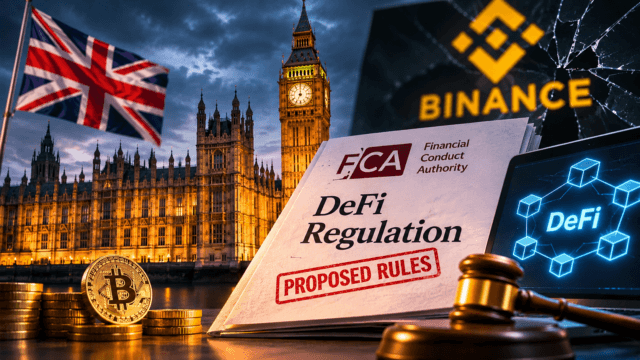
UK FCA Moves to Require DeFi Authorization and Bar Regulated Retail Routing After Binance Hack
Why it matters
The UK Financial Conduct Authority (FCA) is establishing a structural barrier between regulated crypto firms and permissionless protocols, departing from emerging US and EU approaches to prioritize anti-money-laundering controls over DeFi interoperability.
What happened (in 30 seconds)
- Mandatory platform authorization: The FCA signaled plans on November 26, 2026, to require decentralized finance platforms serving UK residents to secure formal regulatory authorization.
- Retail routing prohibition: Regulated exchanges and brokerages will be prohibited from routing retail orders to decentralized venues that lack FCA authorization.
- The catalyst: Regulators tied the decision directly to the October 29, 2026, Binance exploit, in which attackers laundered an estimated $6.3–6.4 billion using cross-chain protocols such as THORChain that operate without centralized asset-freeze capabilities.
The context you actually need
- The regulatory timeline: Consultations on DeFi guidance (GC26/7) and the regulatory perimeter (CP26/36) closed on November 18, 2026, setting up final guidance in January 2027 ahead of full regime implementation on October 25, 2027.
- The international divergence: While the European Union’s framework and emerging US approaches explore compliance rails to maintain access to decentralized venues, the UK model effectively treats unauthorized protocols as non-compliant counterparty risks for domestic intermediaries.
- The enforcement gap: Jane Moore, FCA head of payments and digital assets, highlighted that the settlement speed of permissionless liquidity pools structurally impedes court-ordered asset freezes and forensic recovery.
What's really happening
The mechanism driving the FCA’s proposal is a classic perimeter defense strategy. In traditional finance, regulators maintain compliance by holding intermediaries accountable for the counterparties they touch. In decentralized finance, where smart contracts execute autonomously and pseudonymous liquidity pools lack corporate boards, this intermediary hook vanishes. When North Korea-linked actors routed proceeds from the $6.3–6.4 billion Binance breach through cross-chain protocols, the transaction speed outpaced legal intervention, leaving authorities with no entity to serve with freezing injunctions.
To solve this, the FCA is not attempting to rewrite global open-source code; it is controlling the domestic pipeline. By prohibiting regulated centralized exchanges from routing retail trades into unauthorized DeFi protocols, the regulator creates a walled garden. Regulated firms face clear incentives: comply with domestic conduct and anti-money laundering standards or forfeit their permissions to operate in the UK market. For decentralized protocols, obtaining authorization would necessitate establishing identifiable legal entities, implementing customer due diligence, and embedding compliance mechanisms capable of executing asset halts.
This approach sets up a structural market divergence. Protocol architects intentionally design decentralized autonomous organizations (DAOs) and automated market makers to eliminate single points of failure and central gatekeepers. Asking a decentralized protocol to register creates an operational paradox. If a protocol alters its governance to meet FCA standards, it ceases to be decentralized. If it refuses, UK-regulated platforms must sever execution links.
Industry bodies such as Coinbase and Aave Labs argue this approach creates a de facto market prohibition. Rather than cultivating institutional pathways into decentralized liquidity—as competing financial hubs in Europe and North America are attempting—the UK regime forces capital to choose between domestic regulatory compliance and access to global liquidity pools. The trade-off is stark: the FCA reduces sovereign financial crime exposure at the expense of UK market connectivity to decentralized financial infrastructure.
Who feels it first (and how)
- UK Retail Crypto Traders: Lose direct on-ramp access from domestic regulated exchanges to high-yield or specialized liquidity pools hosted on permissionless networks.
- Decentralized Protocol Developers: Face an immediate choice to either construct geoblocked compliance wrappers for UK addresses or pull interfaces from the UK market altogether.
- UK-Regulated Intermediaries & Exchanges: Must reconfigure execution routers, update compliance monitoring systems, and bear the technical cost of screening order flow against an unauthorized venue list.
- Institutional Digital Asset Funds: Face bifurcated order books, where UK-compliant liquidity operates at a spread compared to deeper, non-compliant global protocols.
What to watch next
- January 2027 FCA Final Guidance: This release will define the exact technical and legal thresholds for what constitutes an "unauthorized DeFi platform" under UK law.
- Intermediary Routing Architecture: How major exchanges like Coinbase modify their UK order-routing engines to isolate retail users from external DeFi smart contracts.
- Jurisdictional Arbitrage Shifts: Whether protocol development teams and capital migrate registration to EU or US jurisdictions that offer structured compliance routes rather than retail prohibitions.
The FCA will implement its cryptoasset regulatory framework on October 25, 2027, following final guidance scheduled for January 2027, with public consultations having officially closed on November 18, 2026.
UK-facing digital asset firms will discontinue automated DeFi order-routing products for domestic retail clients well ahead of the October 2027 deadline to mitigate regulatory scrutiny.
Whether decentralized platforms with no corporate presence can be compelled to comply, or if the burden of enforcement will rest solely on centralized domestic intermediaries.
Frequently Asked Questions
- Why it matters?
- The UK Financial Conduct Authority (FCA) is establishing a structural barrier between regulated crypto firms and permissionless protocols, departing from emerging US and EU approaches to prioritize anti-money-laundering controls over DeFi interoperability.
- What happened (in 30 seconds)?
- Mandatory platform authorization: The FCA signaled plans on November 26, 2026, to require decentralized finance platforms serving UK residents to secure formal regulatory authorization. Retail routing prohibition: Regulated exchanges and brokerages will be prohibited from routing retail orders to decentralized venues that lack FCA authorization. The catalyst: Regulators tied the decision directly to the October 29, 2026, Binance exploit, in which attackers laundered an estimated $6.3–6.4 billion
- What's really happening?
- The mechanism driving the FCA’s proposal is a classic perimeter defense strategy. In traditional finance, regulators maintain compliance by holding intermediaries accountable for the counterparties they touch. In decentralized finance, where smart contracts execute autonomously and pseudonymous liquidity pools lack corporate boards, this intermediary hook vanishes. When North Korea-linked actors routed proceeds from the $6.3–6.4 billion Binance breach through cross-chain protocols, the transacti
- Who feels it first (and how)?
- UK Retail Crypto Traders: Lose direct on-ramp access from domestic regulated exchanges to high-yield or specialized liquidity pools hosted on permissionless networks. Decentralized Protocol Developers: Face an immediate choice to either construct geoblocked compliance wrappers for UK addresses or pull interfaces from the UK market altogether. UK-Regulated Intermediaries & Exchanges: Must reconfigure execution routers, update compliance monitoring systems, and bear the technical cost of screening
- What to watch next?
- January 2027 FCA Final Guidance: This release will define the exact technical and legal thresholds for what constitutes an "unauthorized DeFi platform" under UK law. Intermediary Routing Architecture: How major exchanges like Coinbase modify their UK order-routing engines to isolate retail users from external DeFi smart contracts. Jurisdictional Arbitrage Shifts: Whether protocol development teams and capital migrate registration to EU or US jurisdictions that offer structured compliance routes
Covers Bitcoin plus altcoin news, market updates, and educational resources.
"Bitcoin.com provides news, market data, and guides focused on Bitcoin and the wider crypto industry."
— A47 Editor
UK FCA Plans Strict DeFi Rules as Coinbase and Aave Push Back
The UK Financial Conduct Authority is preparing stricter restrictions on decentralised finance (DeFi), according to the base report from Bitcoin.com, which says the moves have drawn pushback from firms including Coinbase and Aave. The FCA's plans fol...
Covers blockchain, cryptocurrency news, project analysis, and market insights.
"Cointelegraph is a leading crypto-focused media outlet known for timely news, analysis, and educational content related to blockchain and digital assets."
— A47 Editor
UK is ‘getting it wrong’ on DeFi regulation, says Coinbase
The UK Financial Conduct Authority's proposed DeFi rules have drawn criticism from Coinbase and advocacy group Stand With Crypto, who argue the framework could leave UK users without regulated access to decentralized finance. The base report, publish...
Curated tech headlines including AI stories.
"Influential aggregator surfacing the day’s top tech/AI links."
— A47 Editor
The UK FCA says it plans to require DeFi platforms to obtain authorization, adopting a stricter stance than the US and the EU after the $6.3B Binance hack (Financial Times)
The UK Financial Conduct Authority says it plans to require decentralised finance (DeFi) platforms to obtain authorisation, citing the $6.3 billion Binance hack and a lack of consumer protections, according to a Financial Times report carried by Tech...
Real-time updates, analysis, and reports on the blockchain and cryptocurrency sectors.
"Crypto News delivers real-time updates, analysis, and reports on the blockchain and cryptocurrency sectors."
— A47 Editor
UK FCA pushes for tighter DeFi rules following $6.3 billion Binance hack
The UK Financial Conduct Authority has confirmed plans to pursue strict authorization requirements for decentralized finance platforms, citing concerns over money laundering, fraud, and inadequate consumer protections, according to a November 26 Fina...
News and analysis on Bitcoin, altcoins, and blockchain innovation.
"Bitcoinist delivers news and analysis on Bitcoin, altcoins, and blockchain innovation with a focus on market trends and industry updates."
— A47 Editor
UK DeFi Rules Could Punish an Entire Industry for Binance’s Mistake
UK financial regulators have reportedly cited Binance's roughly $6.3 billion hot-wallet breach as justification for tighter rules on decentralised finance access, according to the Financial Times, while Coinbase argues the approach amounts to creatin...
Covers blockchain, cryptocurrency news, project analysis, and market insights.
"Cointelegraph is a leading crypto-focused media outlet known for timely news, analysis, and educational content related to blockchain and digital assets."
— A47 Editor
UK regulator plans tighter DeFi rules, citing $6.3B Binance hack: Report
UK regulator plans tighter DeFi rules, citing the $6.3B Binance hack, according to a Cointelegraph report. North Korea-linked hackers allegedly used DeFi protocols to launder stolen Binance funds, while US prosecutors moved to recover more than $1.1 ...