
BGP Route Hijacking Diverts Up to 1.9 EH/s of Bitcoin Hashrate from Over 1,000 Mining Sites via Unencrypted Stratum V1
Why it matters
The incidents prove that internet routing protocols can divert commercial computing revenue at scale without breaching local servers, firewalls, or facilities.
What happened (in 30 seconds)
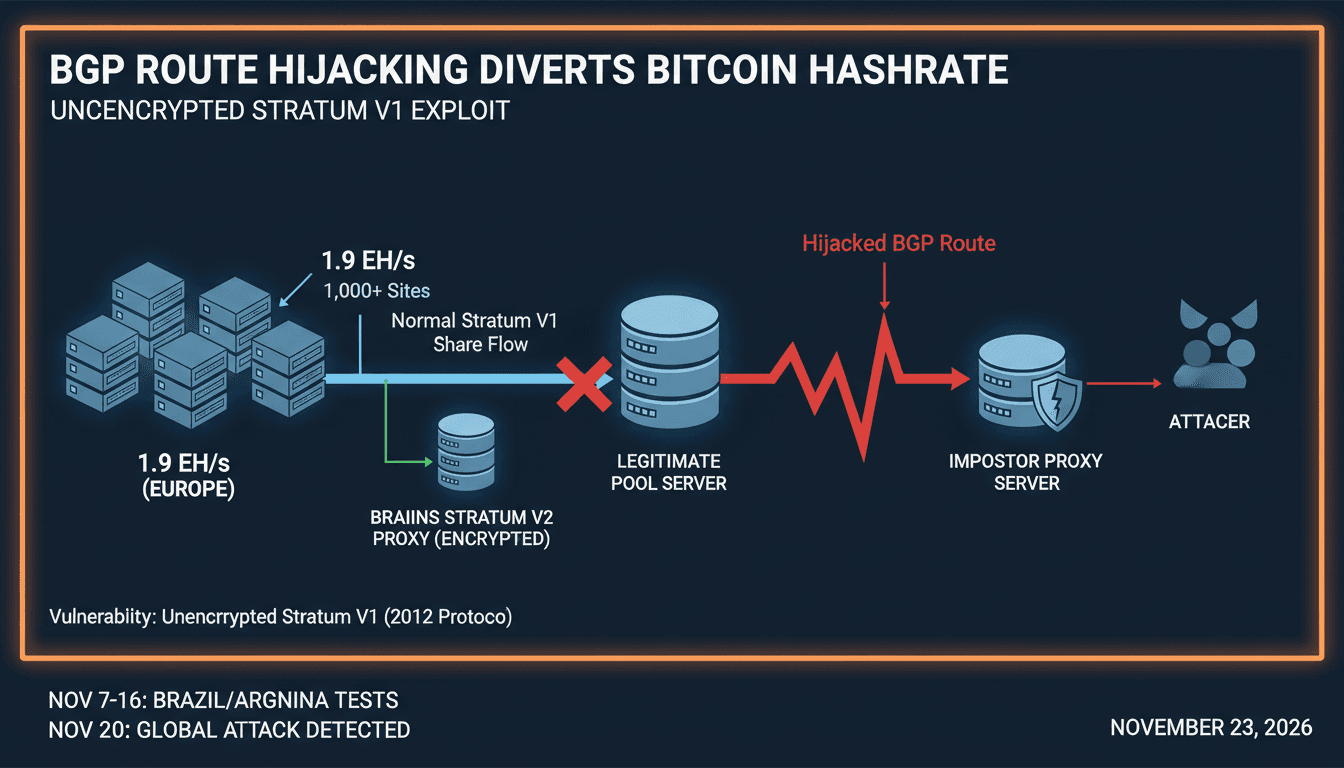
- Attackers used Border Gateway Protocol (BGP) routing manipulation to intercept Bitcoin mining data across more than 1,000 facilities simultaneously, redirecting computational output to an impostor destination.
- The November 20 incidents diverted between 0.6 and 1.9 EH/s of compute capacity across four distinct windows lasting from 6 to 49 minutes, primarily targeting European mining facilities.
- Hardware rigs operated without local errors or downtime, while legitimate pool dashboards registered zero hashrate as compute shares were credited directly to an attacker-controlled account at an alternate mining pool.
The context you actually need
- The Stratum V1 communication protocol has operated without integrated authentication or cryptographic encryption since 2012, leaving data packets susceptible to interception whenever network transit routes are modified.
- Precursor attacks tested the vulnerability earlier in November, executing 19 separate runs between November 7 and 12 across Brazil and Argentina that redirected 36 to 174 PH/s from 120 to 400 sites for periods lasting up to three hours.
- Industry actors previously documented similar routing risks, with mining firm Luxor identifying hashrate redirection patterns prior to the European incidents detailed by Braiins.
What's really happening
The mechanics of this exploit highlight a systemic gap between cryptographic blockchain security and legacy internet routing architecture. The core issue lies at the intersection of Border Gateway Protocol (BGP) fragility and the unencrypted Stratum V1 standard.
BGP governs how packets traverse autonomous systems across the internet. It was designed to prioritize routing efficiency over absolute path verification. When an autonomous system advertises a more specific routing prefix, upstream internet service providers naturally direct traffic along that path. In these incidents, the attacker broadcast forged BGP routes for the IP addresses of legitimate mining pools.
Once traffic routed through the attacker's server, the vulnerability inherent to Stratum V1 completed the hijack. Stratum V1 does not employ Transport Layer Security (TLS) or cryptographic server verification. Mining machines initiate plain-text connections. When the miner connects to the intercepted IP address, it cannot verify the server's identity.
The attacker's intermediate server functioned as a high-speed proxy. It delivered valid cryptographic work templates to the hijacked machines, keeping the hardware fully saturated. The local machines reported normal operating metrics: power draw remained constant, temperature profiles showed no anomalies, and machine logs indicated active share submission. However, the proxy swapped the payout address embedded within the share submissions, forwarding the aggregated computational proof-of-work to an alternate pool under the attacker's account.
The economic model of this attack relies on short-duration execution. Mining pool dashboards do not instantly register hashrate drops due to the statistical nature of share submission windows. By cycling reroutes in bursts lasting from 6 to 49 minutes, attackers monetize large bursts of computing power before automated alerts prompt facility operators to inspect connection paths. The November 20 attack captured up to 1.9 EH/s, which represented approximately 0.19% of the entire Bitcoin network's total computing capacity at that time.
Because the underlying hardware, ASIC firmware, and pool core infrastructure were never breached, zero cryptographic keys were compromised. The failure point was entirely transit-layer authentication. This structural vulnerability leaves facilities running unencrypted Stratum V1 exposed to revenue diversion whenever network routing anomalies occur.
Who feels it first (and how)
- Industrial facility operators in Europe and Latin America: Face immediate operational losses from diverted compute payouts while bearing full power and cooling expenses during the hijack windows.
- Mining pool engineering teams: Forced to rapidly engineer and support Stratum V2 or TLS-wrapped endpoints to prevent customer attrition caused by routing-level diversion.
- Enterprise network architects in high-throughput compute: Required to audit BGP route monitoring, Resource Public Key Infrastructure (RPKI) enforcement, and plain-text telemetry channels.
What to watch next
- Pool-level Stratum V2 implementation rates: As of November 23, most major pools offered only legacy Stratum V1; widespread deployment of authenticated Stratum V2 proxies is required to close the structural vector.
- Firmware-level TLS enforcement: Tracking whether hardware operators adopt updated Braiins firmware or third-party implementations that enforce strict certificate validation on all outbound mining packets.
- Duration patterns in routing anomalies: Monitoring whether subsequent redirection events contract below 5-minute durations to evade baseline alert triggers established by commercial pool monitoring software.
Attackers diverted up to 1.9 EH/s across four episodes affecting 1,050 to 1,600 sites on November 20, 2026, by exploiting unencrypted Stratum V1 channels through BGP route redirection.
The threat will persist against facilities using default Stratum V1 connections until pools and firmware enforce mutual authentication.
The legal identity, physical location, and ultimate revenue realization of the entity managing the recipient pool accounts.
Frequently Asked Questions
- Why it matters?
- The incidents prove that internet routing protocols can divert commercial computing revenue at scale without breaching local servers, firewalls, or facilities.
- What happened (in 30 seconds)?
- Attackers used Border Gateway Protocol (BGP) routing manipulation to intercept Bitcoin mining data across more than 1,000 facilities simultaneously, redirecting computational output to an impostor destination. The November 20 incidents diverted between 0.6 and 1.9 EH/s of compute capacity across four distinct windows lasting from 6 to 49 minutes, primarily targeting European mining facilities. Hardware rigs operated without local errors or downtime, while legitimate pool dashboards registered ze
- What's really happening?
- The mechanics of this exploit highlight a systemic gap between cryptographic blockchain security and legacy internet routing architecture. The core issue lies at the intersection of Border Gateway Protocol (BGP) fragility and the unencrypted Stratum V1 standard. BGP governs how packets traverse autonomous systems across the internet. It was designed to prioritize routing efficiency over absolute path verification. When an autonomous system advertises a more specific routing prefix, upstream int
- Who feels it first (and how)?
- Industrial facility operators in Europe and Latin America: Face immediate operational losses from diverted compute payouts while bearing full power and cooling expenses during the hijack windows. Mining pool engineering teams: Forced to rapidly engineer and support Stratum V2 or TLS-wrapped endpoints to prevent customer attrition caused by routing-level diversion. Enterprise network architects in high-throughput compute: Required to audit BGP route monitoring, Resource Public Key Infrastructure
- What to watch next?
- Pool-level Stratum V2 implementation rates: As of November 23, most major pools offered only legacy Stratum V1; widespread deployment of authenticated Stratum V2 proxies is required to close the structural vector. Firmware-level TLS enforcement: Tracking whether hardware operators adopt updated Braiins firmware or third-party implementations that enforce strict certificate validation on all outbound mining packets. Duration patterns in routing anomalies: Monitoring whether subsequent redirection
Real-time updates, analysis, and reports on the blockchain and cryptocurrency sectors.
"Crypto News delivers real-time updates, analysis, and reports on the blockchain and cryptocurrency sectors."
— A47 Editor
Bitcoin hashrate hijack hit more than 1,000 mining sites
Braiins has disclosed that forged internet routes diverted up to 1.9 exahashes per second of Bitcoin mining power on November 20, affecting more than 1,000 sites at a time. The firm's report, published November 25, lists four episodes that day, with ...
Covers blockchain, cryptocurrency news, project analysis, and market insights.
"Cointelegraph is a leading crypto-focused media outlet known for timely news, analysis, and educational content related to blockchain and digital assets."
— A47 Editor
Braiins warns of Bitcoin mining attacks affecting over 1,000 sites
Braiins, a Bitcoin mining pool operator, warned that attackers are exploiting unsecured connections to hijack miners' computing power and potentially steal their rewards, with more than 1,000 sites reported as affected.
Covers Bitcoin plus altcoin news, market updates, and educational resources.
"Bitcoin.com provides news, market data, and guides focused on Bitcoin and the wider crypto industry."
— A47 Editor
Braiins Warns of Widespread Bitcoin Hashrate Hijacking Attacks
Braiins has warned of widespread bitcoin hashrate hijacking attacks, reporting that attackers are exploiting unsecured connections to take over miners' computing power and potentially steal their mining rewards, with more than 1,000 sites reported as...