
Bank of Korea raises interest rate to 2.75% amid inflationary pressures
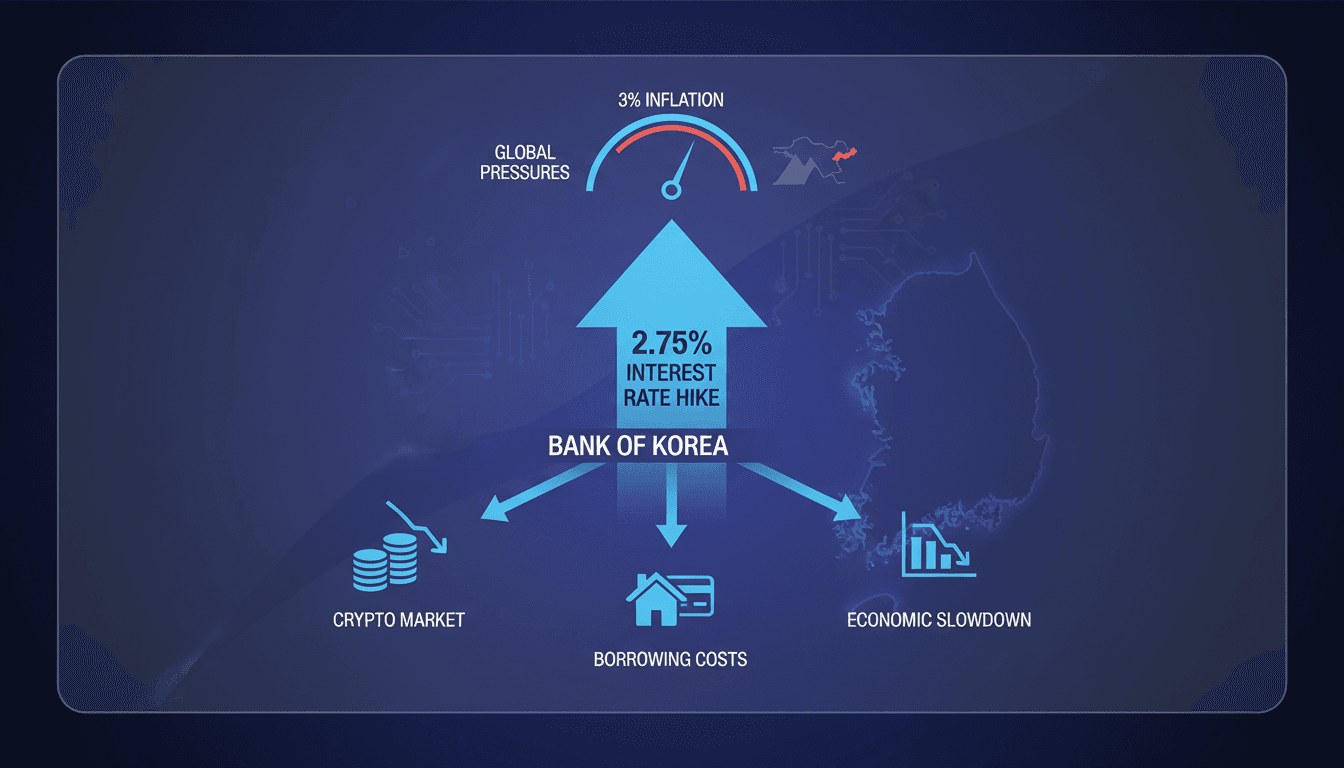
Here's what it means for you.
The Bank of Korea's decision to raise the base interest rate to 2.75% signals a significant shift in monetary policy aimed at curbing rising inflation. This increase, the first since 2023, may lead to higher borrowing costs for consumers and could cool the active cryptocurrency market. Stakeholders in various sectors, particularly real estate and technology, should prepare for potential market adjustments as the economy responds to these changes. As inflation continues to exceed 3%, the implications of this rate hike will be felt across multiple facets of the economy. Investors and consumers alike will need to navigate a landscape shaped by these new financial conditions.
What happened
The Bank of Korea has raised its interest rate to 2.75%, marking the end of a three-year pause in rate adjustments. This decision is a direct response to inflationary pressures that have recently escalated, driven in part by global economic factors. The rate hike aims to stabilize the economy amid rising costs and external geopolitical tensions.
Following the announcement, South Korea's Kospi index experienced a notable drop of 6.6%, reflecting investor concerns about the implications of the new rate. Technology stocks, including major players like SK Hynix and Samsung Electronics, faced significant losses as the market reacted to the news.
The Context
The decision to raise interest rates comes at a time when inflation has surpassed 3%, prompting the Bank of Korea to take action. Global economic pressures, particularly military tensions in the Middle East, have further complicated the financial landscape. The rise in AI semiconductor exports has also played a role in shaping the current economic environment.
This rate hike is particularly significant as it marks the first increase since 2023, indicating a shift in the Bank of Korea's approach to managing economic stability. The move is expected to have wide-ranging implications for various sectors, especially those sensitive to interest rates, such as real estate and cryptocurrency.
Takeaway
Looking ahead, the Bank of Korea's interest rate hike may lead to further adjustments as inflationary pressures persist. Stakeholders should closely monitor the impact on South Korea's cryptocurrency market, which could experience a cooling effect due to higher borrowing costs. Additionally, the ongoing global economic conditions, particularly the U.S.-Iran conflict, will likely influence future monetary policy decisions.
As the situation evolves, it will be crucial for investors and consumers to stay informed about how these changes may affect their financial strategies and market dynamics.
Global business headlines with AI angles.
"General business outlet that frequently covers AI."
— A47 Editor
Why the AI Chip Boom Just Forced South Korea to Raise Interest Rates
The Bank of Korea has raised interest rates to 2.75% as a response to inflation surpassing 3%, driven by a surge in AI semiconductor exports. This decision reflects the central bank's efforts to manage economic pressures stemming from the booming AI ...
Real-time updates, analysis, and reports on the blockchain and cryptocurrency sectors.
"Crypto News delivers real-time updates, analysis, and reports on the blockchain and cryptocurrency sectors."
— A47 Editor
South Korea rate hike puts fresh pressure on crypto risk appetite
South Korea has raised its base interest rate to 2.75%, marking the end of a three-year pause in monetary policy. This decision is expected to exert additional pressure on the country's active cryptocurrency market, which has been characterized by si...
Business, markets, economy, and corporate news with strong UAE and regional relevance.
"Emirates 24|7 business coverage tends to center UAE markets, property, regulation, and regional economic developments."
— A47 Editor
Asian stocks slide as South Korea's Kospi tumbles 6.6%; oil eases despite US-Iran tensions
Asian stock markets experienced a downturn on Thursday, primarily driven by a significant 6.6% drop in South Korea's Kospi index, following the Bank of Korea's first interest rate hike since 2023 amid inflationary concerns linked to the ongoing confl...
Social/economic commentary and analysis relevant to business and markets.
"WSJ blends data-driven economic insight with commentary on policy and society."
— A47 Editor
Bank of Korea Raises Rate for First Time Since 2023
The Bank of Korea has raised its interest rates for the first time since 2023, responding to persistent inflation driven by geopolitical tensions, particularly the U.S.-Iran conflict. This decision marks a significant shift in the central bank's mone...
Pan-Arab news coverage spanning politics, business, sports, and regional affairs.
"Asharq Al-Awsat reflects a broad Arab editorial perspective with strong attention to regional geopolitics."
— A47 Editor
البنك المركزي الكوري الجنوبي يرفع الفائدة لأول مرة منذ 2023 لكبح التضخم والديون
The Bank of Korea raised its key interest rate for the first time since 2023 on Thursday, marking a significant shift in monetary policy aimed at curbing inflation and managing debt levels. This decision comes after more than three years of maintaini...