
US GDP growth slows to 1.5% in Q2 2026 amid persistent inflation
What happened
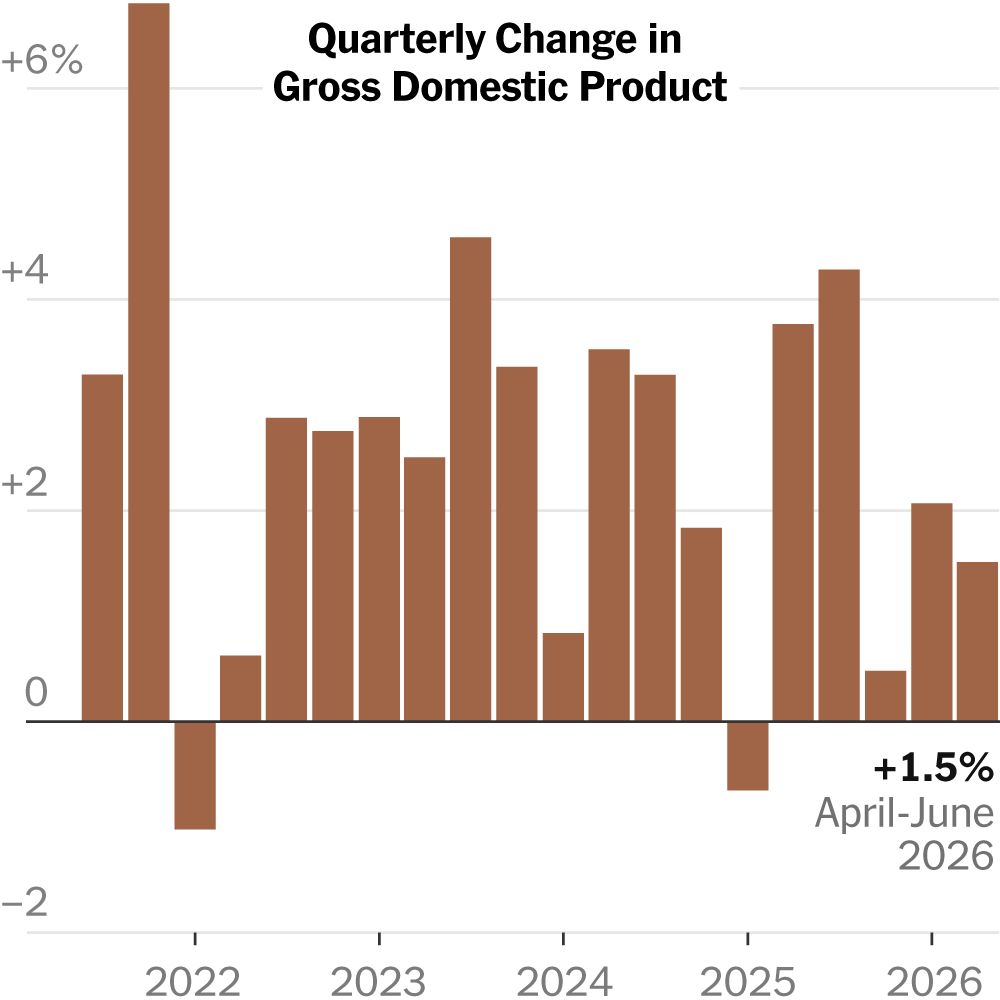
The U.S. economy grew at an annual rate of 1.5% in the second quarter of 2026, a notable decline from the 2.1% growth recorded in the first quarter. This slowdown has raised concerns among economists, as it falls short of expectations for a more robust economic performance. Despite the overall deceleration, consumer spending has shown resilience, providing a glimmer of hope amid the economic uncertainty.
Inflation continues to pose a significant challenge, recorded at 3.3%, well above the Federal Reserve's target of 2%. This persistent inflation could necessitate policy adjustments to ensure sustainable economic recovery. The Federal Reserve has maintained interest rates unchanged for five consecutive meetings, indicating a cautious approach to managing these economic pressures.
The Context
The slowdown in GDP growth is occurring against a backdrop of ongoing inflationary pressures that have persisted for several quarters. The Federal Reserve's current stance on interest rates reflects a balancing act between fostering economic growth and controlling inflation. Stakeholders, including policymakers and investors, are closely monitoring these developments as they could have far-reaching implications for the economy.
The economic landscape has shifted significantly since the beginning of 2026, with growth rates fluctuating and inflation remaining stubbornly high. The Federal Reserve's decisions in the coming months will be critical in shaping the economic outlook. As the situation evolves, understanding the interplay between consumer behavior and inflation will be essential for forecasting future trends.
Takeaway
Looking ahead, the Federal Reserve's upcoming meetings will be pivotal in determining potential interest rate changes. Analysts will be watching closely to see how the central bank responds to the dual challenges of slow growth and persistent inflation. Consumer spending trends will also be a key indicator of economic health, influencing both policy decisions and market dynamics.
As the economy navigates these challenges, stakeholders should remain alert to shifts in consumer confidence and spending patterns. The interplay between inflation and growth will be crucial in shaping the future trajectory of the U.S. economy.
Markets, economy, and company analysis from NYT’s business desk.
"The New York Times is a globally recognized newspaper offering authoritative reporting with a center-left editorial stance."
— A47 Editor
U.S. GDP Growth Slowed in Second Quarter of 2026
U.S. gross domestic product (GDP) growth slowed in the second quarter of 2026, indicating a deceleration in economic activity. Persistent price pressures are contributing to instability in financial markets, raising concerns among investors and analy...
Social/economic commentary and analysis relevant to business and markets.
"WSJ blends data-driven economic insight with commentary on policy and society."
— A47 Editor
U.S. economic growth slowed to 1.5% in second quarter
The U.S. economy experienced a slowdown in growth, with the gross domestic product (GDP) rising at an annual rate of 1.5% in the second quarter of 2026, falling short of economists' expectations. This deceleration in economic activity raises concerns...
Corporate news, economic trends, and markets with UK and global scope.
"BBC News is widely regarded as reputable and impartial, with a public service mandate."
— A47 Editor
US economic growth sees surprise slowdown in second quarter
The US economy experienced a surprise slowdown in growth during the second quarter of 2026, with an annual growth rate of 1.5%, down from 2.1% in the previous quarter. This decline reflects a complex economic landscape where consumer confidence has e...
Coverage of national news and events from across the United States.
"HuffPost is known for its progressive editorial stance, offering opinionated yet comprehensive coverage on social, political, and cultural topics."
— A47 Editor
U.S. Economy Grows At A Sluggish 1.5% In Second-Quarter With Inflation Remaining Stubbornly High
The U.S. economy experienced a sluggish growth rate of 1.5% in the second quarter, with inflation remaining persistently high. In response to these economic conditions, the Federal Reserve opted to keep its benchmark interest rate unchanged for the f...
News from the United States including domestic politics, society, and culture.
"The Guardian is known for its progressive editorial stance and in-depth analysis, often advocating for social justice, environmental issues, and liberal values."
— A47 Editor
US economy grows sluggish 1.5% in second quarter as inflation tops Fed target
The US economy grew at a sluggish pace of 1.5% in the second quarter of 2026, a decline from 2.1% in the previous quarter, as rising imports negatively impacted growth. Despite this, consumer spending showed resilience, and inflation remained above t...
Global business headlines with AI angles.
"General business outlet that frequently covers AI."
— A47 Editor
The Economy Grew Less Than Expected In Q2. Core Inflation Also Remained Above The Key 2% Target
The U.S. economy grew by 1.5% in the second quarter of 2026, falling short of expectations, while inflation remained at 3.3%, consistent with forecasts. This growth rate indicates a slowdown in economic momentum, raising concerns among analysts.