
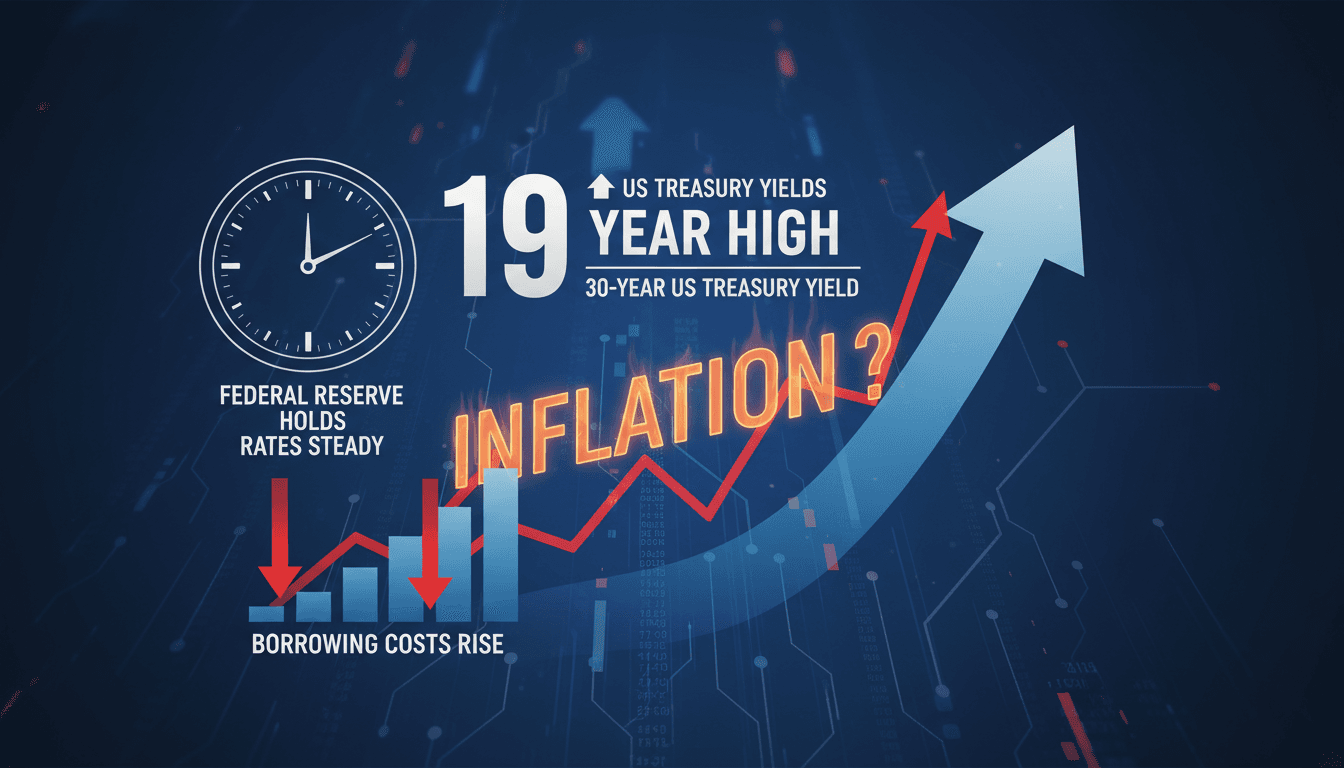
US Treasury yields reach 19-year high as Federal Reserve holds interest rates steady
Here's what it means for you.
The Federal Reserve's decision to maintain interest rates has significant implications for the economy and investment strategies. With the 30-year US Treasury yield climbing to its highest level in nearly two decades, borrowing costs are set to rise, impacting both consumers and businesses. Investors are now faced with increased uncertainty regarding inflation and future rate hikes, which could shape their financial decisions in the coming months. As the Fed grapples with persistent inflation pressures, its ability to manage economic stability is under scrutiny. This situation may lead to a reevaluation of investment portfolios and borrowing strategies as market participants adjust to the new landscape.
What happened
The Federal Reserve recently decided to hold its key interest rate steady, resulting in a notable spike in the 30-year US Treasury yield. This yield surged to 5.24%, marking a 19-year high and reflecting market reactions to the Fed's policy stance. The increase in borrowing costs has raised concerns about the Fed's effectiveness in combating inflation.
This decision follows five consecutive meetings where the Fed maintained its main interest rate between 3.5% and 3.75%. The rise in the Treasury yield by 14 basis points indicates a significant shift in market sentiment regarding future economic conditions.
The Context
The Federal Reserve's current policy environment is characterized by ongoing inflationary pressures, which have prompted market analysts to question the central bank's future direction. The decision to keep interest rates steady has led to heightened uncertainty among investors, who are now weighing the implications of upcoming inflation data and potential rate hikes.
The 30-year Treasury yield's rise to its highest level since 2007 underscores the challenges the Fed faces in balancing economic growth with inflation control. As borrowing costs increase, the ramifications for economic activity and investment strategies become increasingly critical.
Takeaway
Looking ahead, market participants should closely monitor upcoming inflation data and its potential impact on Federal Reserve policy. Any signals regarding future rate hikes could significantly influence borrowing costs and economic growth. The persistence of high borrowing costs may lead to a reevaluation of investment strategies as stakeholders navigate this evolving landscape.
As the Fed's next moves are scrutinized, the implications for both consumers and businesses will be profound. Understanding these dynamics will be essential for making informed financial decisions in the near future.
Global business headlines with AI angles.
"General business outlet that frequently covers AI."
— A47 Editor
Treasury Yields Stay Near Decades-High After Fed Pause. Long-Term Borrowing Costs Still Under Pressure
The benchmark 30-year Treasury yield has remained near its highest level in nearly two decades, hovering around 5.19%, as markets react to the Federal Reserve's recent policy decisions and ongoing inflation data. This situation reflects investor conc...
Social/economic commentary and analysis relevant to business and markets.
"WSJ blends data-driven economic insight with commentary on policy and society."
— A47 Editor
U.S. Treasury Yields Soar as Market Struggles to Interpret Fed
The 30-year U.S. Treasury yield has surged to a 19-year high following the Federal Reserve's decision to maintain interest rates, leaving the market uncertain about future monetary policy directions. This rise reflects investor reactions to the Fed's...
News from the United States including domestic politics, society, and culture.
"The Guardian is known for its progressive editorial stance and in-depth analysis, often advocating for social justice, environmental issues, and liberal values."
— A47 Editor
US borrowing costs hit 19-year high as Fed holds interest rates
US government borrowing costs have reached their highest level since 2007, as the Federal Reserve decided to maintain its key interest rate between 3.5% and 3.75% for the fifth consecutive meeting. This decision has raised concerns about the Fed's ab...
Top international stories selected by The Guardian editors.
"The Guardian is known for its progressive editorial stance and in-depth analysis."
— A47 Editor
US borrowing costs hit 19-year high as Fed holds interest rates
US government borrowing costs have reached their highest level since 2007, as the Federal Reserve decided to maintain its key interest rate between 3.5% and 3.75% for the fifth consecutive meeting. This decision has raised concerns about the Fed's ab...
Business and economy coverage focused on Dubai, the UAE, Saudi Arabia, and the wider Middle East.
"Arabian Business is a well-known regional business outlet with strong focus on Gulf markets, leadership, and investment stories."
— A47 Editor
High borrowing costs here to stay: What the Fed’s latest move means for the GCC
The Federal Reserve's recent decision to maintain interest rates signals that high borrowing costs are likely to persist, impacting the Gulf Cooperation Council (GCC) economies. This move reflects ongoing economic uncertainties and inflationary press...