
U.S. Treasury Yields Fully Rebound Following Debt Buyback Expansion Announcement
Here's what it means for you.
If you’re invested in U.S. bonds or tied to global interest rates, this rebound could impact your returns and borrowing costs.
Why it matters
This event underscores ongoing fiscal pressures that could influence global financial markets and borrowing conditions.
What happened (in 30 seconds)
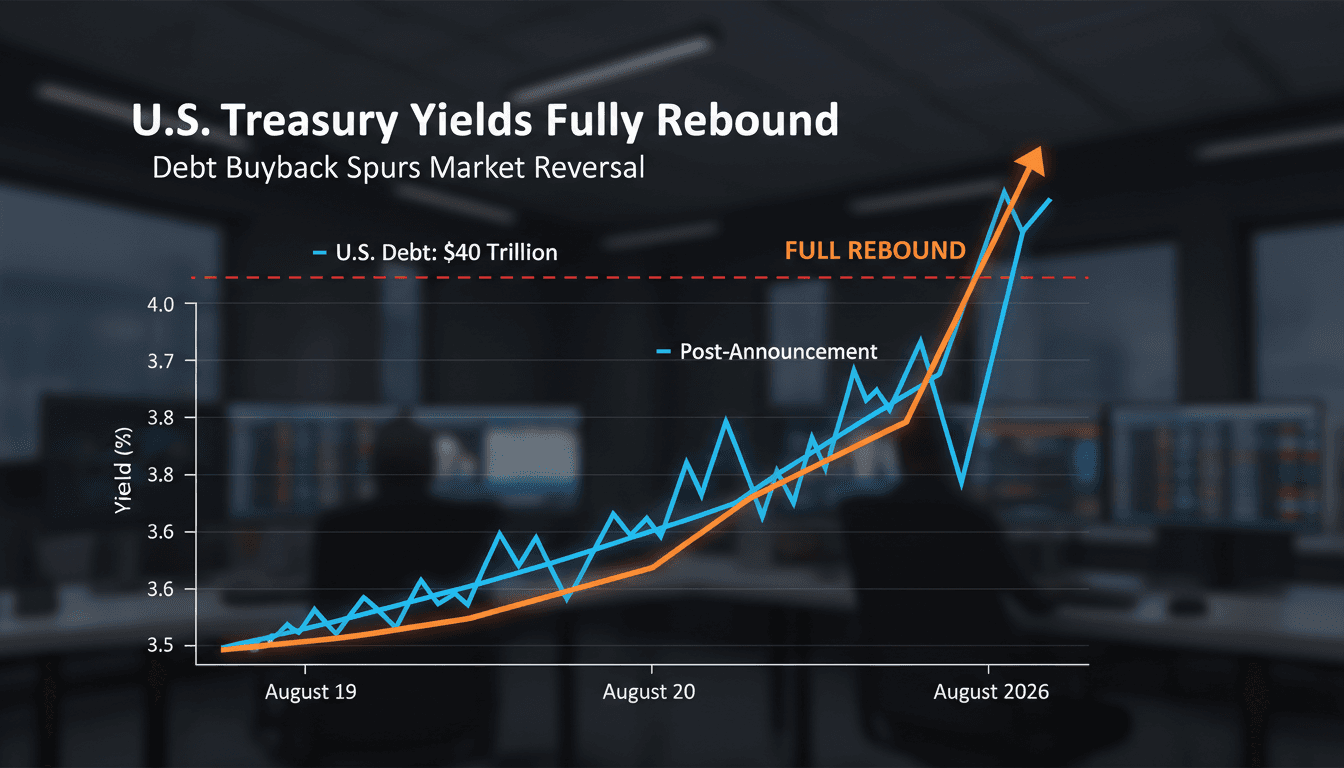
- Yields rebounded sharply on August 20, 2026, erasing declines from the previous day after the Treasury announced a debt repurchase expansion.
- The 30-year yield climbed 5.7 basis points to 5.251%, while the 10-year yield rose over 5.1 basis points to 4.704%.
- The U.S. national debt surpassed $40 trillion, raising concerns about fiscal sustainability and future borrowing costs.
The context you actually need
- Debt repurchase expansion: The U.S. Treasury announced it would more than double its buyback program to at least $4 billion, targeting longer-dated securities.
- Market reaction: Initial declines in yields were quickly reversed, indicating persistent concerns about structural fiscal challenges rather than a resolution.
- Liquidity support: The intervention aimed to enhance liquidity in segments of the bond market that have been struggling to attract buyers.
What's really happening
On August 19, 2026, the U.S. Treasury Department announced a significant expansion of its debt repurchase program, more than doubling the buyback size to at least $4 billion. This move was specifically aimed at longer-dated nominal securities, which have seen a lack of buyers since late June. Initially, this announcement led to a sharp decline in yields, with the 30-year Treasury yield dropping approximately 10 basis points. However, just one day later, yields rebounded fully, with the 30-year climbing 5.7 basis points to 5.251% and the 10-year up over 5.1 basis points to 4.704%.
This rapid reversal highlights the ongoing structural pressures within the U.S. economy, particularly as the national debt has now surpassed $40 trillion. The intervention was intended to provide liquidity support in illiquid segments of the bond market, but it also reflects deeper issues related to elevated deficits and rising borrowing costs. Analysts suggest that while the buyback program may temporarily stabilize yields, it does not address the underlying fiscal challenges that the U.S. faces, including projected interest costs exceeding $1 trillion annually.
The rebound in yields occurred against a backdrop of increasing concerns about fiscal sustainability, particularly as political attention shifts toward impending debt ceiling debates projected for 2027. The market's quick response to the Treasury's intervention indicates that investors remain skeptical about the long-term effectiveness of such measures. Instead of alleviating concerns, the buyback program may merely defer the inevitable discussions about fiscal responsibility and the management of national debt.
As the Treasury continues to navigate these challenges, the implications for global markets are significant. Investors worldwide are closely monitoring U.S. Treasury yields, as they often serve as a benchmark for other interest rates. The structural issues within the U.S. economy could lead to increased volatility in global financial markets, affecting everything from mortgage rates to corporate borrowing costs.
Who feels it first (and how)
- Bond investors: Those holding U.S. Treasuries may see fluctuations in their investment returns.
- Expatriates in Dubai: Changes in U.S. interest rates can affect expatriate investments tied to the dollar.
- Real estate developers: Higher borrowing costs could impact financing for projects linked to international capital markets.
What to watch next
- Debt ceiling discussions: Watch for developments in the upcoming debates projected for 2027, as they could significantly impact fiscal policy.
- Interest rate trends: Monitor how U.S. Treasury yields influence global interest rates, particularly in emerging markets.
- Market liquidity: Keep an eye on liquidity conditions in the bond market, as ongoing interventions may signal deeper issues.
The U.S. national debt has surpassed $40 trillion.
Continued volatility in Treasury yields as markets react to fiscal policies.
The long-term effectiveness of the Treasury's buyback program in stabilizing yields.
Frequently Asked Questions
- Why it matters?
- This event underscores ongoing fiscal pressures that could influence global financial markets and borrowing conditions.
- What happened (in 30 seconds)?
- Yields rebounded sharply on August 20, 2026, erasing declines from the previous day after the Treasury announced a debt repurchase expansion. The 30-year yield climbed 5.7 basis points to 5.251%, while the 10-year yield rose over 5.1 basis points to 4.704%. The U.S. national debt surpassed $40 trillion, raising concerns about fiscal sustainability and future borrowing costs.
- What's really happening?
- On August 19, 2026, the U.S. Treasury Department announced a significant expansion of its debt repurchase program, more than doubling the buyback size to at least $4 billion. This move was specifically aimed at longer-dated nominal securities, which have seen a lack of buyers since late June. Initially, this announcement led to a sharp decline in yields, with the 30-year Treasury yield dropping approximately 10 basis points. However, just one day later, yields rebounded fully, with the 30-year c
- Who feels it first (and how)?
- Bond investors: Those holding U.S. Treasuries may see fluctuations in their investment returns. Expatriates in Dubai: Changes in U.S. interest rates can affect expatriate investments tied to the dollar. Real estate developers: Higher borrowing costs could impact financing for projects linked to international capital markets.
- What to watch next?
- Debt ceiling discussions: Watch for developments in the upcoming debates projected for 2027, as they could significantly impact fiscal policy. Interest rate trends: Monitor how U.S. Treasury yields influence global interest rates, particularly in emerging markets. Market liquidity: Keep an eye on liquidity conditions in the bond market, as ongoing interventions may signal deeper issues.
Global business headlines with AI angles.
"General business outlet that frequently covers AI."
— A47 Editor
Bond Yields Rebound Quickly And Erase The Drop From The Treasury's Intervention In Just a Day
The Treasury Department announced on Wednesday that it will more than double the size of government debt repurchases, leading to a rapid rebound in bond yields that erased the previous day's decline caused by the intervention.
Pan-Arab news coverage spanning politics, business, sports, and regional affairs.
"Asharq Al-Awsat reflects a broad Arab editorial perspective with strong attention to regional geopolitics."
— A47 Editor
هل تزاحم «الخزانة» الأميركية «الفيدرالي» على النفوذ في سوق السندات؟
The U.S. Treasury Department has decided to double its long-term bond repurchase operations, raising questions about the extent of its intervention in the markets. This move indicates a strategic shift in how the Treasury engages with the bond market...
Market-moving headlines impacting equities, bonds, and related risk assets.
"Real-time catalysts and volatility drivers across indices and sectors."
— A47 Editor
Treasury Secretary Bessent doubles US long-bond buybacks in the face of surging yields
Treasury Secretary Bessent has announced a doubling of US long-bond buybacks to a minimum of $4 billion, a strategic response to surging yields that have raised concerns about government borrowing costs. This decision reflects the Treasury's proactiv...
Global business headlines with AI angles.
"General business outlet that frequently covers AI."
— A47 Editor
The Treasury Will More Than Double Its Government Debt Repurchases. Stocks Edged Up.
The U.S. Treasury has announced plans to more than double its government debt repurchases, focusing on the 10-to-20-year and 20-to-30-year segments of the market, coinciding with a notable decline in bond yields. This strategic move aims to stabilize...
Capitol Hill news, legislation, and policy insight.
"The Hill specializes in U.S. politics and policy, with a focus on Capitol Hill developments and a reputation for insider reporting."
— A47 Editor
Treasury Department to double debt buybacks after bond yield spike
The Treasury Department announced plans to double the maximum amount of U.S. debt it can buy back, specifically targeting longer-dated securities in the 10-to-20-year and 20-to-30-year sectors. This decision comes in response to a recent spike in bon...
Pan-Arab news coverage spanning politics, business, sports, and regional affairs.
"Asharq Al-Awsat reflects a broad Arab editorial perspective with strong attention to regional geopolitics."
— A47 Editor
هل تختبر الخزانة الأميركية حدود التدخل في سوق السندات؟
The U.S. Treasury Department is set to double its long-term Treasury bond repurchase operations, a move aimed at enhancing liquidity in the debt market and alleviating the pressures it has faced.
Macro commentary, policy analysis, growth/inflation themes, and global outlooks.
"Contextual macro coverage that complements day-to-day market headlines."
— A47 Editor
Instant View: US Treasury will double some bond buy backs
The US Treasury has announced plans to double the sizes of certain debt buyback operations to a minimum of $4 billion, a strategic move aimed at managing fiscal responsibilities amid rising economic pressures. This decision reflects an ongoing adjust...
Global business headlines with AI angles.
"General business outlet that frequently covers AI."
— A47 Editor
The Treasury Will More Than Double Its Government Debt Repurchases. Yields Are Sharply Lower.
The U.S. Treasury has announced plans to more than double its government debt repurchases, specifically targeting the 10-to-20-year and 20-to-30-year segments of the market. This move comes as yields are sharply lower, indicating a shift in the gover...