
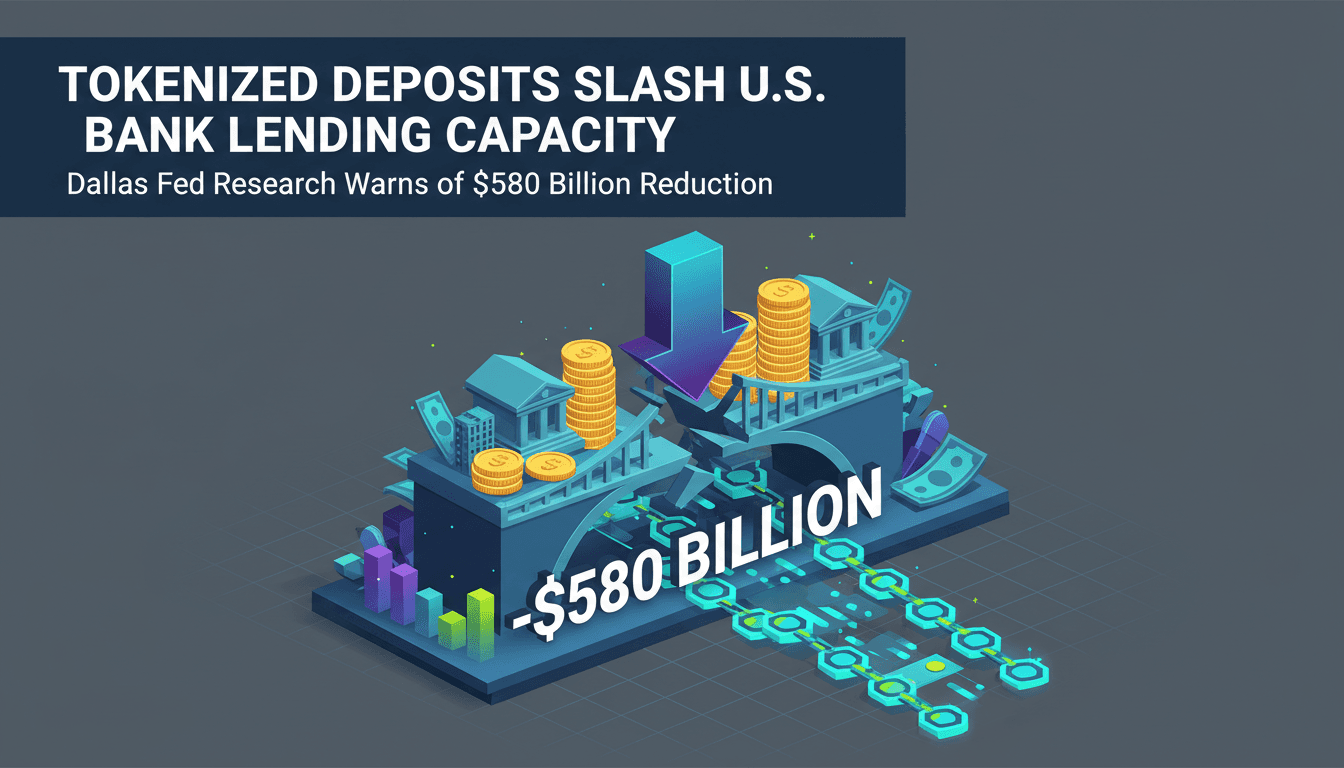
Dallas Fed Research Warns Tokenized Deposits May Slash U.S. Bank Lending Capacity by $580 Billion
Here's what it means for you.
If you're involved in finance or banking, the shift towards tokenized deposits could reshape lending dynamics and borrowing costs.
Why it matters
The potential reduction in U.S. banks' maturity transformation capacity could significantly impact credit availability and interest rates across the economy.
What happened (in 30 seconds)
- Dallas Fed economists published a paper estimating that tokenized deposits could reduce U.S. banks' maturity transformation capacity by $580 billion.
- Tokenized deposits enable instant transfers and programmable features, potentially shortening deposit lives and increasing interest rate sensitivity.
- Major banks are collaborating on a shared tokenized deposit network, with a launch targeted for the first half of 2027.
The context you actually need
- Tokenization of deposits is emerging as a regulated alternative to stablecoins, allowing bank liabilities to be represented on blockchain while remaining claims on the issuing institution.
- U.S. banks are exploring shared infrastructure to compete with non-bank payment systems and real-time settlement technologies, driven by the need for liquidity.
- Previous developments in instant payment networks, like Brazil's Pix, have shown a correlation with increased demand for liquid assets and reduced credit intermediation.
What's really happening
The Dallas Fed's research paper by economists Rosie Levy and Srini Ramaswamy outlines two primary channels through which tokenized deposits could impact U.S. banks. First, the ability to transfer funds nearly instantaneously may lead to a significant reduction in the weighted average lives of deposits. This means that customers, driven by yield-seeking behavior or AI agents, could move their funds rapidly across institutions, effectively shortening the time banks can rely on those deposits. The paper models a scenario where a 10% reduction in average deposit life could result in a staggering $580 billion decrease in banks' maturity transformation capacity, measured in 10-year equivalents.
Second, the paper discusses how increased interest rate sensitivity—referred to as higher deposit beta—could further constrain banks' willingness to hold interest-rate risk. In a hypothetical scenario where interest rates rise by 10%, banks might face an estimated reduction of $700 billion in their capacity to lend, assuming a four-year weighted average life for deposits. This could lead banks to adjust their strategies by increasing their holdings of reserves and Treasuries, issuing more term debt, or altering pricing structures, which could ultimately raise borrowing costs for consumers and businesses.
The analysis emphasizes that these findings are hypothetical and do not predict the actual adoption levels of tokenized deposits. However, the implications are significant, as banks may need to recalibrate their risk management strategies and lending practices in response to the evolving landscape of digital finance. The ongoing development of a shared tokenized deposit network by major banks, including JPMorgan Chase, Bank of America, Citigroup, and Wells Fargo, through The Clearing House, indicates a serious commitment to exploring this new frontier. The targeted launch in the first half of 2027 will be a critical moment to watch, as it could set the stage for broader adoption and impact on the banking sector.
Who feels it first (and how)
- Commercial banks: They may face reduced lending capacity and increased costs.
- Borrowers: Individuals and businesses could see higher interest rates and tighter credit conditions.
- Financial regulators: They will need to monitor the implications for systemic risk and market stability.
- Tech firms: Companies developing blockchain solutions may experience increased demand for their services.
What to watch next
- Launch of the tokenized deposit network: The first half of 2027 will reveal how banks adapt to this new infrastructure and its immediate effects on lending.
- Interest rate movements: Changes in interest rates could further influence banks' risk appetite and lending strategies.
- Regulatory responses: Watch for any regulatory actions or guidelines that may emerge as banks navigate the implications of tokenized deposits.
The Dallas Fed estimates a $580 billion reduction in maturity transformation capacity due to tokenized deposits.
Major banks will continue to develop shared tokenized deposit networks, impacting lending practices.
The actual adoption levels of tokenized deposits and their long-term effects on the banking sector remain uncertain.
Frequently Asked Questions
- Why it matters?
- The potential reduction in U.S. banks' maturity transformation capacity could significantly impact credit availability and interest rates across the economy.
- What happened (in 30 seconds)?
- Dallas Fed economists published a paper estimating that tokenized deposits could reduce U.S. banks' maturity transformation capacity by $580 billion. Tokenized deposits enable instant transfers and programmable features, potentially shortening deposit lives and increasing interest rate sensitivity. Major banks are collaborating on a shared tokenized deposit network, with a launch targeted for the first half of 2027.
- What's really happening?
- The Dallas Fed's research paper by economists Rosie Levy and Srini Ramaswamy outlines two primary channels through which tokenized deposits could impact U.S. banks. First, the ability to transfer funds nearly instantaneously may lead to a significant reduction in the weighted average lives of deposits. This means that customers, driven by yield-seeking behavior or AI agents, could move their funds rapidly across institutions, effectively shortening the time banks can rely on those deposits. The
- Who feels it first (and how)?
- Commercial banks: They may face reduced lending capacity and increased costs. Borrowers: Individuals and businesses could see higher interest rates and tighter credit conditions. Financial regulators: They will need to monitor the implications for systemic risk and market stability. Tech firms: Companies developing blockchain solutions may experience increased demand for their services.
- What to watch next?
- Launch of the tokenized deposit network: The first half of 2027 will reveal how banks adapt to this new infrastructure and its immediate effects on lending. Interest rate movements: Changes in interest rates could further influence banks' risk appetite and lending strategies. Regulatory responses: Watch for any regulatory actions or guidelines that may emerge as banks navigate the implications of tokenized deposits.
Real-time updates, analysis, and reports on the blockchain and cryptocurrency sectors.
"Crypto News delivers real-time updates, analysis, and reports on the blockchain and cryptocurrency sectors."
— A47 Editor
Tokenized deposits could cut U.S. bank lending capacity by $580 billion: report
A recent report indicates that the adoption of tokenized deposits could significantly reduce the lending capacity of U.S. banks by as much as $580 billion. This concern arises from the potential for these digital assets to facilitate quicker transfer...
Covers blockchain, cryptocurrency news, project analysis, and market insights.
"Cointelegraph is a leading crypto-focused media outlet known for timely news, analysis, and educational content related to blockchain and digital assets."
— A47 Editor
Tokenized deposits could raise US credit costs: Dallas Fed economists
Economists from the Dallas Federal Reserve have raised concerns that the emergence of tokenized deposits could destabilize bank funding, potentially increasing credit costs for borrowers. They suggest that these programmable deposits may lead to rapi...
Covers blockchain, cryptocurrency news, project analysis, and market insights.
"CoinDesk is a well-established cryptocurrency and blockchain news provider, offering comprehensive insights, market data, and industry research."
— A47 Editor
Dallas Fed warns tokenized deposits could strip $700 billion from U.S. banks' lending capacity
The Dallas Federal Reserve has issued a warning that the rise of tokenized deposits could potentially reduce U.S. banks' lending capacity by $700 billion, as these programmable deposits may facilitate rapid and automated bank switching for better yie...