
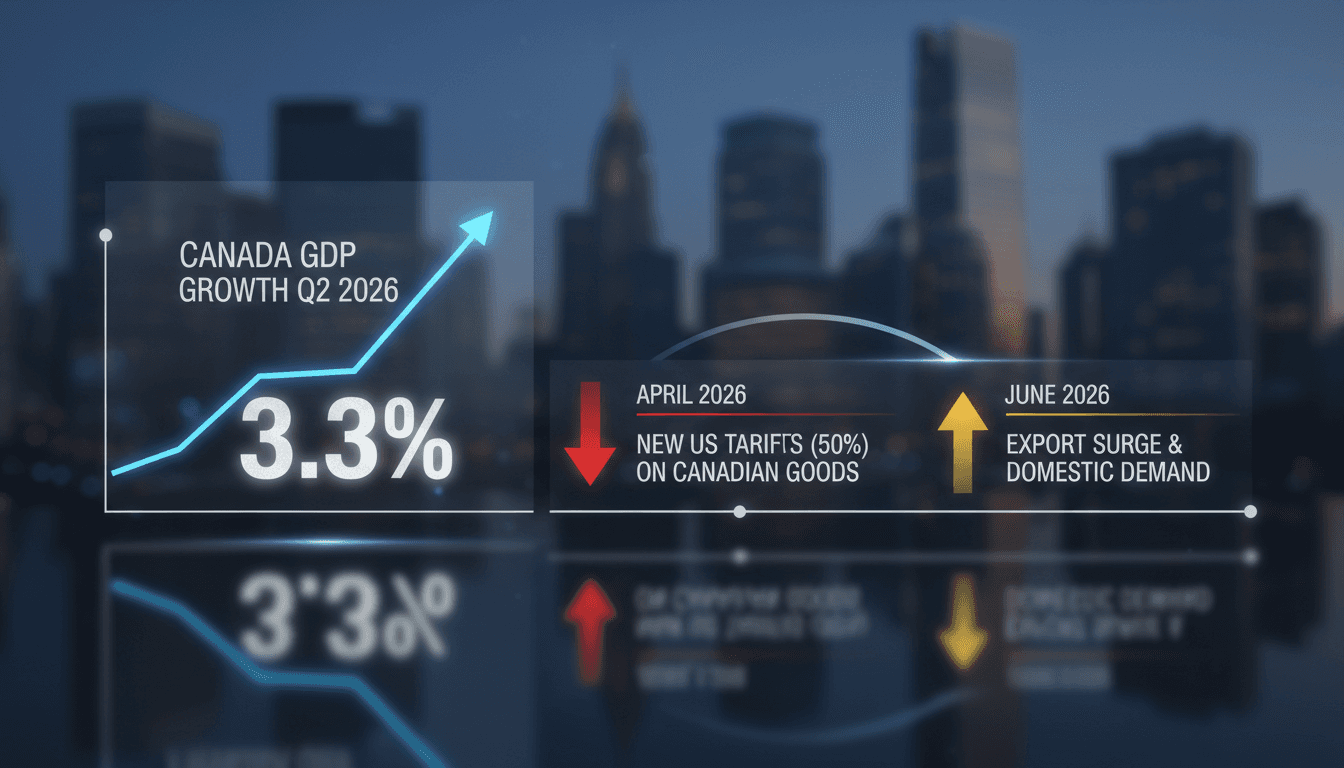
Canada's economy grows 3.3% in Q2 2026 despite US tariff pressures
Here's what it means for you.
If you’re involved in international trade or investment, the shifting dynamics in Canada’s economy could impact your strategies.
Why it matters
Canada's economic performance is a bellwether for North American trade relations and can influence global market stability.
What happened (in 30 seconds)
- Canada's GDP grew by 3.3% in Q2 2026, marking a significant rebound after a period of stagnation.
- Renewed US tariffs of 50% on $20 billion of Canadian exports were imposed, prompting retaliatory measures from Canada.
- Consumer spending and business investment surged, driving domestic demand and exports despite ongoing trade tensions.
The context you actually need
- Trade tensions have escalated over the past 18 months, disrupting supply chains and increasing costs across North America.
- The USMCA/CUSMA framework has been strained, with previous tariffs affecting key Canadian sectors, leading to a fragile economic environment.
- Negotiations between Canada and the US have faltered, resulting in new tariffs that threaten to undermine recent economic gains.
What's really happening
Canada's economy has shown resilience in the face of renewed trade pressures, with a reported GDP growth of 3.3% in Q2 2026. This growth follows a period of stagnation, where the economy barely moved, prompting fears of a technical recession. The rebound can be attributed to a combination of factors, including a 3.6% quarterly rise in exports and a 0.8% increase in household consumption. Business investment also saw a notable uptick of 2.3%, indicating a renewed confidence among Canadian businesses.
However, this growth comes amid significant challenges. The imposition of 50% tariffs by the US on $20 billion worth of Canadian goods has created a precarious situation. These tariffs, effective from August 22, 2026, were a response to failed negotiations and reflect a broader trend of protectionism that has characterized US trade policy under President Donald Trump. In retaliation, Canada has announced countermeasures set to take effect on September 8, 2026, which could further escalate tensions.
The Bank of Canada had previously forecasted more modest growth, but the recent data has exceeded expectations, leading to upward revisions of Q1 figures. Despite this positive news, economists from institutions like Desjardins and Oxford Economics caution that the tariffs pose downside risks to future growth. The Canadian dollar has weakened slightly in response to the tariff news, indicating market apprehension about the sustainability of this growth.
In essence, while Canada has managed to rebound from a challenging economic period, the looming threat of tariffs and retaliatory measures creates uncertainty. The interplay between domestic demand and international trade dynamics will be crucial in determining the trajectory of Canada's economy in the coming months.
Who feels it first (and how)
- Exporters: Companies reliant on US markets will face immediate impacts from tariffs, affecting profitability and pricing strategies.
- Consumers: Increased costs from tariffs may lead to higher prices for goods, impacting household budgets.
- Investors: Those with stakes in Canadian markets may experience volatility as trade relations fluctuate.
- Small businesses: Particularly those in sectors like manufacturing and agriculture, which are heavily reliant on exports, will feel the pinch of retaliatory tariffs.
What to watch next
- Trade negotiations: Watch for any developments in US-Canada trade talks that could signal a de-escalation of tariff tensions.
- Consumer spending trends: Continued growth in household consumption will be critical for sustaining economic momentum amid external pressures.
- Currency fluctuations: Monitor the Canadian dollar's performance as it may reflect market sentiment regarding trade stability and economic health.
Canada's economy grew by 3.3% in Q2 2026, driven by exports and domestic demand.
Tariffs will continue to create uncertainty, potentially moderating growth in the coming quarters.
The long-term effects of retaliatory tariffs on both Canadian and US economies remain uncertain.
Frequently Asked Questions
- Why it matters?
- Canada's economic performance is a bellwether for North American trade relations and can influence global market stability.
- What happened (in 30 seconds)?
- Canada's GDP grew by 3.3% in Q2 2026, marking a significant rebound after a period of stagnation. Renewed US tariffs of 50% on $20 billion of Canadian exports were imposed, prompting retaliatory measures from Canada. Consumer spending and business investment surged, driving domestic demand and exports despite ongoing trade tensions.
- What's really happening?
- Canada's economy has shown resilience in the face of renewed trade pressures, with a reported GDP growth of 3.3% in Q2 2026. This growth follows a period of stagnation, where the economy barely moved, prompting fears of a technical recession. The rebound can be attributed to a combination of factors, including a 3.6% quarterly rise in exports and a 0.8% increase in household consumption. Business investment also saw a notable uptick of 2.3%, indicating a renewed confidence among Canadian busines
- Who feels it first (and how)?
- Exporters: Companies reliant on US markets will face immediate impacts from tariffs, affecting profitability and pricing strategies. Consumers: Increased costs from tariffs may lead to higher prices for goods, impacting household budgets. Investors: Those with stakes in Canadian markets may experience volatility as trade relations fluctuate. Small businesses: Particularly those in sectors like manufacturing and agriculture, which are heavily reliant on exports, will feel the pinch of retal
- What to watch next?
- Trade negotiations: Watch for any developments in US-Canada trade talks that could signal a de-escalation of tariff tensions. Consumer spending trends: Continued growth in household consumption will be critical for sustaining economic momentum amid external pressures. Currency fluctuations: Monitor the Canadian dollar's performance as it may reflect market sentiment regarding trade stability and economic health.
Global news coverage with extensive reporting on Middle Eastern conflicts and geopolitics.
"Al Jazeera is a Qatar-based broadcaster known for wide regional coverage and alternative perspectives."
— A47 Editor
Canadian economy recovers sharply in Q2 but shadow of US tariffs in future
Canada's economy showed a strong recovery in the second quarter of 2026, with a reported GDP growth of 3.3%, driven by robust consumer spending and business investment, indicating resilience despite previous tariff impacts.
Comprehensive coverage of Middle Eastern and global issues.
"Al Jazeera is a prominent voice from the Global South, especially the Middle East, with an emphasis on underreported stories."
— A47 Editor
Canadian economy recovers sharply in Q2 but shadow of US tariffs in future
Canada's economy showed a strong recovery in the second quarter of 2026, with a reported GDP growth of 3.3%, driven by robust consumer spending and business investment, indicating resilience despite previous tariff impacts.
Macro commentary, policy analysis, growth/inflation themes, and global outlooks.
"Contextual macro coverage that complements day-to-day market headlines."
— A47 Editor
Canadian economy recovers sharply in second quarter as domestic demand revives, exports grow
The Canadian economy demonstrated a significant recovery in the second quarter of 2026, driven by a revival in domestic demand and an increase in exports, as reported by Investing.com. This sharp rebound reflects the resilience of the economy amidst ...
Macro commentary, policy analysis, growth/inflation themes, and global outlooks.
"Contextual macro coverage that complements day-to-day market headlines."
— A47 Editor
Canada economy rebounds in second quarter, beating Bank of Canada forecast
Canada's economy rebounded in the second quarter of 2026, surpassing the Bank of Canada's forecasts, driven by strong growth in manufacturing and increased activity in the oil and gas sectors. This recovery reflects a significant turnaround following...
National coverage of politics and current events across Canada.
"Global News is a mainstream Canadian outlet with a centrist editorial stance, focusing on factual reporting."
— A47 Editor
Canada’s GDP rose 3.3% in Q2 with Q1 data changes showing bump, not dip
Canada's economy demonstrated robust growth in the second quarter of 2026, with the annualized gross domestic product (GDP) rising by 3.3%, as reported by Statistics Canada. This increase follows a positive adjustment in first-quarter data, indicatin...