
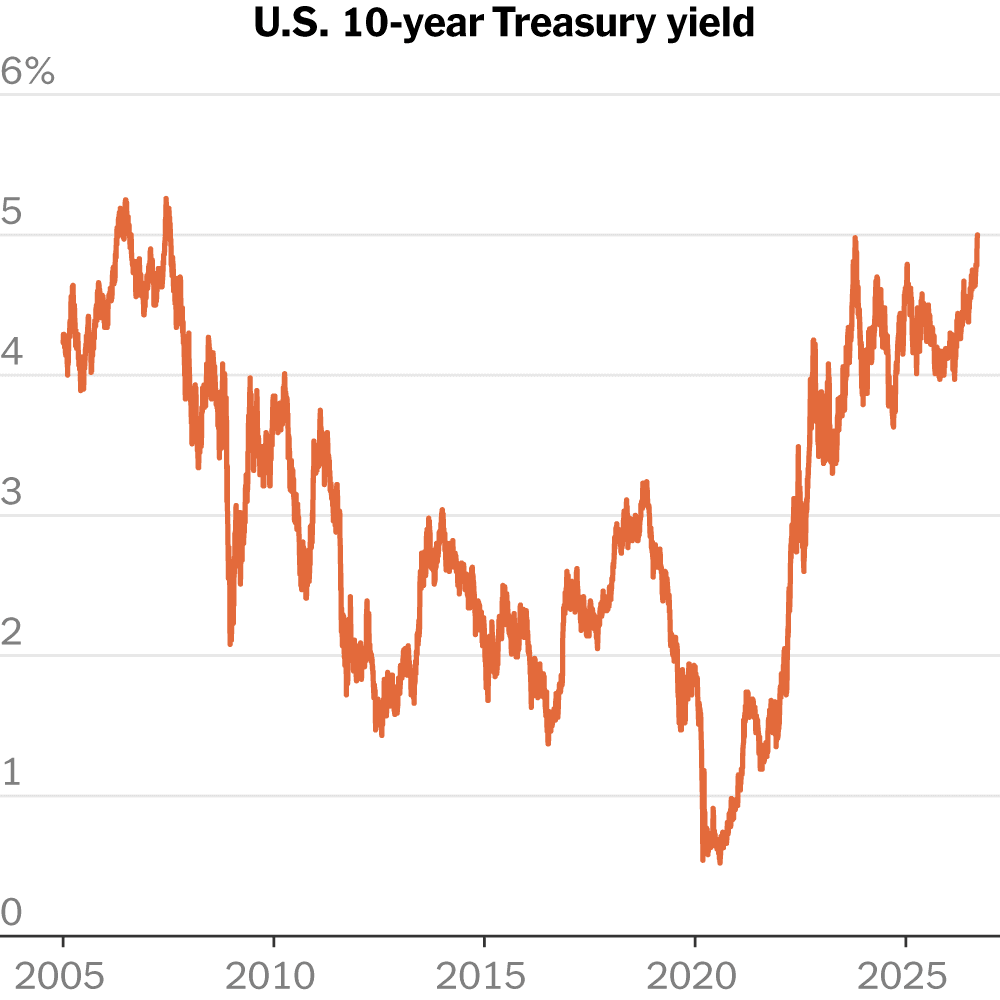
U.S. 10-Year Treasury Yield Hits 5 Percent for First Time in Nearly 20 Years
Why it matters
The rise in the 10-year Treasury yield signals shifting investor sentiment and potential changes in economic conditions that could affect global markets.
What happened (in 30 seconds)
- The yield reached 5 percent on September 14, 2026, marking the highest level in nearly two decades.
- Investor reactions led to increased trading volumes as portfolios adjusted to the new yield environment.
- Equity markets faced downward pressure, with declines noted in U.S. stock indexes as bond prices adjusted lower.
The context you actually need
- Yields had been rising gradually throughout 2026 due to persistent inflation concerns and shifts in Federal Reserve policy expectations.
- Global economic conditions and geopolitical tensions have driven demand for higher yields on longer-term securities.
- The Federal Reserve's stance on interest rates and inflation will be closely monitored by market participants moving forward.
What's really happening
On September 14, 2026, the 10-year U.S. Treasury yield surged to 5 percent, a psychological threshold that has significant implications for both domestic and global financial markets. This increase is rooted in a complex interplay of economic indicators, investor sentiment, and Federal Reserve policy.
The climb in yields reflects growing concerns about inflation, which has been persistent in the U.S. economy. As inflation expectations rise, investors demand higher yields to compensate for the eroding purchasing power of fixed-income returns. This dynamic is particularly relevant as the Federal Reserve has signaled a more hawkish stance on interest rates, aiming to curb inflation through tighter monetary policy.
Moreover, the backdrop of geopolitical tensions and global economic uncertainty has heightened investor demand for safer assets, such as U.S. Treasuries. However, as yields rise, the attractiveness of these bonds diminishes for some investors, leading to a sell-off in equities as capital reallocates towards fixed-income securities. This shift can create a feedback loop where rising yields lead to falling stock prices, further influencing investor behavior.
The stabilization of the yield around 5 percent indicates a new normal for fixed-income markets, where investors will need to recalibrate their expectations for returns. This environment may lead to increased borrowing costs for consumers and businesses alike, as higher Treasury yields often translate to higher interest rates across various lending products.
In the context of Dubai, the implications are significant. Higher U.S. Treasury yields can influence global interest rates, potentially increasing borrowing costs for real estate and corporate financing in the region. Additionally, returns on dollar-denominated investments held by residents and institutions in the UAE may be affected, prompting a reassessment of investment strategies.
Who feels it first (and how)
- Bond Market Investors: Adjust portfolios in response to rising yields, impacting their returns.
- Equity Investors: Experience downward pressure on stock prices as capital shifts towards bonds.
- Real Estate Developers in Dubai: May face increased borrowing costs, affecting project financing.
- Corporate Borrowers: Higher yields could lead to elevated interest rates on loans and credit.
- UAE Residents: Those holding dollar-denominated assets may see changes in investment returns.
What to watch next
- Federal Reserve Communications: Future statements from the Fed will provide insight into monetary policy direction and inflation management.
- Inflation Data Releases: Upcoming economic data will be critical in assessing whether inflationary pressures are easing or persisting.
- Global Economic Indicators: Watch for shifts in geopolitical tensions and their impact on investor sentiment and market stability.
The 10-year Treasury yield reached 5 percent on September 14, 2026.
Continued volatility in equity markets as investors adjust to higher yields.
The long-term trajectory of inflation and its impact on Federal Reserve policy.
Frequently Asked Questions
- Why it matters?
- The rise in the 10-year Treasury yield signals shifting investor sentiment and potential changes in economic conditions that could affect global markets.
- What happened (in 30 seconds)?
- The yield reached 5 percent on September 14, 2026, marking the highest level in nearly two decades. Investor reactions led to increased trading volumes as portfolios adjusted to the new yield environment. Equity markets faced downward pressure, with declines noted in U.S. stock indexes as bond prices adjusted lower.
- What's really happening?
- On September 14, 2026, the 10-year U.S. Treasury yield surged to 5 percent, a psychological threshold that has significant implications for both domestic and global financial markets. This increase is rooted in a complex interplay of economic indicators, investor sentiment, and Federal Reserve policy. The climb in yields reflects growing concerns about inflation, which has been persistent in the U.S. economy. As inflation expectations rise, investors demand higher yields to compensate for the
- Who feels it first (and how)?
- Bond Market Investors: Adjust portfolios in response to rising yields, impacting their returns. Equity Investors: Experience downward pressure on stock prices as capital shifts towards bonds. Real Estate Developers in Dubai: May face increased borrowing costs, affecting project financing. Corporate Borrowers: Higher yields could lead to elevated interest rates on loans and credit. UAE Residents: Those holding dollar-denominated assets may see changes in investment returns.
- What to watch next?
- Federal Reserve Communications: Future statements from the Fed will provide insight into monetary policy direction and inflation management. Inflation Data Releases: Upcoming economic data will be critical in assessing whether inflationary pressures are easing or persisting. Global Economic Indicators: Watch for shifts in geopolitical tensions and their impact on investor sentiment and market stability.
Capitol Hill news, legislation, and policy insight.
"The Hill specializes in U.S. politics and policy, with a focus on Capitol Hill developments and a reputation for insider reporting."
— A47 Editor
Benchmark bond yield reaches highest level in nearly 20 years
The yield on the 10-year U.S. Treasury bond surged to 5.041 percent, marking its highest level since before the 2008 financial crisis, with the note closing above 5 percent. This increase signals potential higher borrowing costs for millions of Ameri...
Markets desk coverage, trading insights, and investor updates.
"WSJ’s markets reporting provides in-depth analysis and context for investors."
— A47 Editor
What Comes Next, Now that the 10-Year Treasury Yield Has Crossed 5%?
The 10-Year Treasury yield has crossed the 5% threshold, marking a significant moment in the financial markets that could indicate a shift towards a new era of higher interest rates. This development follows a prolonged period of low yields post-fina...
Markets, economy, and company analysis from NYT’s business desk.
"The New York Times is a globally recognized newspaper offering authoritative reporting with a center-left editorial stance."
— A47 Editor
Key U.S. Borrowing Rate Rises to Highest Level Since 2007
The 10-year Treasury yield in the U.S. has risen to levels not seen since 2007, driven by concerns over energy-induced inflation that are unsettling bond investors. This spike reflects a broader trend of increasing borrowing costs and market volatili...
Corporate news, economic trends, and markets with UK and global scope.
"BBC News is widely regarded as reputable and impartial, with a public service mandate."
— A47 Editor
US borrowing costs hit highest level since 2007
The effective interest rate on US government bonds, specifically the 10-year Treasury yield, has reached a peak of 5.04%, marking the highest level since 2007, before slightly easing back. This increase reflects growing concerns over inflation and ri...
Markets desk coverage, trading insights, and investor updates.
"WSJ’s markets reporting provides in-depth analysis and context for investors."
— A47 Editor
Global Bond Selloff Deepens as 10-Year Yields Hit Multiyear Highs
The 10-year U.S. Treasury yield has reached its highest level since 2007, intensifying a global bond selloff as investors brace for the U.S. Federal Reserve's upcoming interest rate decision. This surge in yields reflects growing concerns about econo...
Economic trends, financial markets, corporate news, and policy from a Russian perspective.
"RT is widely criticized for promoting pro-Kremlin narratives and is considered by many to be a state propaganda outlet."
— A47 Editor
US Treasury yield highest since 2007 ahead of Fed’s interest-rate decision
The US Treasury yield has surged to 5.04%, marking its highest level since 2007, which is expected to increase borrowing costs for households, businesses, and governments globally. This rise in yields comes as the Federal Reserve prepares for its upc...
Global markets, investing, and macroeconomics from a premier financial newsroom.
"Bloomberg is respected for in-depth financial reporting and data-driven analysis."
— A47 Editor
US 10-Year Yield Rises to Highest Since 2007 as Fed Looms
The 10-year US Treasury yield has surged to its highest level since 2007, reaching 5.04%, amid a global bond selloff driven by rising capital investments and soaring energy prices that are intensifying inflationary pressures.
Markets, economy, and company analysis from NYT’s business desk.
"The New York Times is a globally recognized newspaper offering authoritative reporting with a center-left editorial stance."
— A47 Editor
10-Year Treasury Yield Touches 5%, Highest Level in Years
The 10-Year Treasury yield has reached 5%, a level not seen since the global financial crisis, indicating a significant shift in the bond market as investors have rejected attempts by the Trump administration to influence rates.
Global business headlines with AI angles.
"General business outlet that frequently covers AI."
— A47 Editor
The Benchmark U.S. Treasury Yield Topped 5% For The First Time In Years. Odds Of a Rate Hike Climbed Further.
The benchmark U.S. Treasury yield has surpassed 5% for the first time in years, with the 10-year yield approaching 5.2%, a level not seen since July 2007, prior to the global financial crisis. This increase indicates rising interest rates amid ongoin...
Global markets, investing, and macroeconomics from a premier financial newsroom.
"Bloomberg is respected for in-depth financial reporting and data-driven analysis."
— A47 Editor
US 10-Year Breaches 5% as Inflation, Supply Worries Mount
The US 10-year Treasury yield has surpassed 5% for the first time since 2023, driven by increasing inflation concerns and heightened government and corporate borrowing needs. This surge reflects a significant shift in market dynamics, as investors re...