
U.S. 10-Year Treasury Yield Hits 19-Year High Amid Fiscal and Geopolitical Strains
Why it matters
This surge in Treasury yields signals a tightening financial environment that could affect consumer spending and investment.
What happened (in 30 seconds)
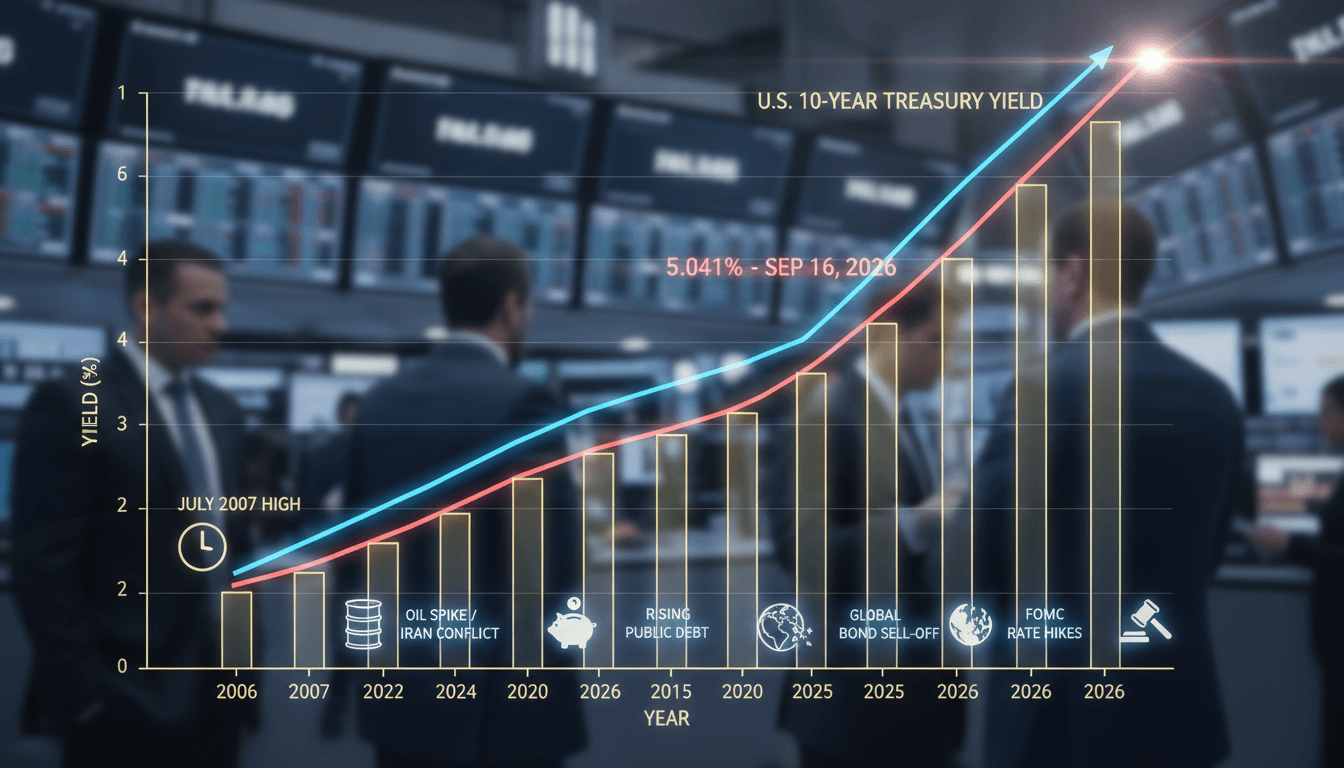
- The 10-year U.S. Treasury yield reached an intraday high of 5.041% on September 16, 2026, the highest since July 2007.
- Elevated borrowing costs are expected across various consumer debts, including mortgages and auto loans.
- Market volatility is anticipated as investors react to fiscal pressures and geopolitical tensions, particularly related to the Iran conflict.
The context you actually need
- Public debt has surpassed $40 trillion, leading to increased Treasury issuance and investor caution.
- Oil prices are rising due to the ongoing Iran conflict, contributing to inflation concerns and impacting global markets.
- Global bond sell-offs this summer have intensified supply pressures on U.S. Treasuries, prompting a flight to safety among investors.
What's really happening
On September 16, 2026, the 10-year U.S. Treasury yield surged to an intraday peak of 5.041%, marking a significant milestone not seen in nearly two decades. This spike reflects a complex interplay of fiscal pressures and geopolitical tensions that have created a challenging environment for investors. The backdrop includes a national debt exceeding $40 trillion, which has necessitated increased issuance of Treasury bonds. As the U.S. government seeks to finance its obligations, the supply of Treasuries has risen, leading to a supply-demand imbalance in the market.
The escalation of the Iran conflict has further complicated matters, driving oil prices higher and raising inflation concerns. As energy costs rise, so too do the costs of goods and services, which can dampen consumer spending and economic growth. Investors are reacting to these pressures by moving away from global bonds, seeking safer assets, which has exacerbated the situation for U.S. Treasuries. The Federal Open Market Committee (FOMC) is closely monitoring these developments, with expectations of a rate hike looming as traders price in tighter monetary policy.
In response to the rising yields, Treasury Secretary Scott Bessent announced expanded bond buybacks of $5.2 billion in longer-term securities, aiming to stabilize the market. However, the mixed reactions in equity markets indicate that investors are wary of the implications of higher borrowing costs. The FOMC meeting is expected to provide further clarity on monetary policy, but the uncertainty surrounding fiscal trajectories continues to weigh on market sentiment.
As yields have risen over a full percentage point from pre-Iran conflict levels, the implications for consumers are significant. Higher borrowing costs will likely translate into increased rates for mortgages, auto loans, and other forms of consumer debt, which could slow down economic activity. The interconnectedness of global markets means that these changes will not only affect U.S. consumers but also have ripple effects worldwide.
Who feels it first (and how)
- Homebuyers: Higher mortgage rates will increase monthly payments, potentially cooling the housing market.
- Auto buyers: Increased loan rates will raise the cost of financing vehicles, impacting sales.
- Investors: Those holding bonds may see declines in portfolio values as yields rise.
- Businesses: Companies relying on loans for expansion may face higher costs, affecting growth plans.
- Consumers: Overall spending may decrease as higher debt costs limit disposable income.
What to watch next
- FOMC Meeting Outcomes: The Federal Reserve's decisions on interest rates will be crucial in shaping market expectations and consumer borrowing costs.
- Oil Price Trends: Continued fluctuations in oil prices due to geopolitical tensions will impact inflation and economic stability.
- Public Debt Developments: Monitoring changes in U.S. fiscal policy and national debt levels will provide insights into future Treasury issuance and market dynamics.
The 10-year Treasury yield has surpassed 5% for the first time in 19 years.
Higher borrowing costs will impact consumer debt and spending.
The long-term effects of geopolitical tensions on global markets remain uncertain.
Frequently Asked Questions
- Why it matters?
- This surge in Treasury yields signals a tightening financial environment that could affect consumer spending and investment.
- What happened (in 30 seconds)?
- The 10-year U.S. Treasury yield reached an intraday high of 5.041% on September 16, 2026, the highest since July 2007. Elevated borrowing costs are expected across various consumer debts, including mortgages and auto loans. Market volatility is anticipated as investors react to fiscal pressures and geopolitical tensions, particularly related to the Iran conflict.
- What's really happening?
- On September 16, 2026, the 10-year U.S. Treasury yield surged to an intraday peak of 5.041%, marking a significant milestone not seen in nearly two decades. This spike reflects a complex interplay of fiscal pressures and geopolitical tensions that have created a challenging environment for investors. The backdrop includes a national debt exceeding $40 trillion, which has necessitated increased issuance of Treasury bonds. As the U.S. government seeks to finance its obligations, the supply of Trea
- Who feels it first (and how)?
- Homebuyers: Higher mortgage rates will increase monthly payments, potentially cooling the housing market. Auto buyers: Increased loan rates will raise the cost of financing vehicles, impacting sales. Investors: Those holding bonds may see declines in portfolio values as yields rise. Businesses: Companies relying on loans for expansion may face higher costs, affecting growth plans. Consumers: Overall spending may decrease as higher debt costs limit disposable income.
- What to watch next?
- FOMC Meeting Outcomes: The Federal Reserve's decisions on interest rates will be crucial in shaping market expectations and consumer borrowing costs. Oil Price Trends: Continued fluctuations in oil prices due to geopolitical tensions will impact inflation and economic stability. Public Debt Developments: Monitoring changes in U.S. fiscal policy and national debt levels will provide insights into future Treasury issuance and market dynamics.
Capitol Hill news, legislation, and policy insight.
"The Hill specializes in U.S. politics and policy, with a focus on Capitol Hill developments and a reputation for insider reporting."
— A47 Editor
Benchmark bond yield reaches highest level in nearly 20 years
The yield on the 10-year U.S. Treasury bond surged to 5.041 percent, marking its highest level since before the 2008 financial crisis, with the note closing above 5 percent. This increase signals potential higher borrowing costs for millions of Ameri...
Markets desk coverage, trading insights, and investor updates.
"WSJ’s markets reporting provides in-depth analysis and context for investors."
— A47 Editor
What Comes Next, Now that the 10-Year Treasury Yield Has Crossed 5%?
The 10-Year Treasury yield has crossed the 5% threshold, marking a significant moment in the financial markets that could indicate a shift towards a new era of higher interest rates. This development follows a prolonged period of low yields post-fina...
Global business headlines with AI angles.
"General business outlet that frequently covers AI."
— A47 Editor
Treasury Yields Hit The Highest Level In Almost 20 Years And Oil Kept Climbing. Stocks Fell Again.
The benchmark 10-year Treasury yield rose to its highest level since 2007, reflecting ongoing sell-offs in government debt just before the Federal Reserve's upcoming policy decision. This surge in yields coincides with rising oil prices and a decline...
Markets, economy, and company analysis from NYT’s business desk.
"The New York Times is a globally recognized newspaper offering authoritative reporting with a center-left editorial stance."
— A47 Editor
Key U.S. Borrowing Rate Rises to Highest Level Since 2007
The 10-year Treasury yield in the U.S. has risen to levels not seen since 2007, driven by concerns over energy-induced inflation that are unsettling bond investors. This spike reflects a broader trend of increasing borrowing costs and market volatili...
Corporate news, economic trends, and markets with UK and global scope.
"BBC News is widely regarded as reputable and impartial, with a public service mandate."
— A47 Editor
US borrowing costs hit highest level since 2007
The effective interest rate on US government bonds, specifically the 10-year Treasury yield, has reached a peak of 5.04%, marking the highest level since 2007, before slightly easing back. This increase reflects growing concerns over inflation and ri...
Markets desk coverage, trading insights, and investor updates.
"WSJ’s markets reporting provides in-depth analysis and context for investors."
— A47 Editor
Global Bond Selloff Deepens as 10-Year Yields Hit Multiyear Highs
The 10-year U.S. Treasury yield has reached its highest level since 2007, intensifying a global bond selloff as investors brace for the U.S. Federal Reserve's upcoming interest rate decision. This surge in yields reflects growing concerns about econo...
Economic trends, financial markets, corporate news, and policy from a Russian perspective.
"RT is widely criticized for promoting pro-Kremlin narratives and is considered by many to be a state propaganda outlet."
— A47 Editor
US Treasury yield highest since 2007 ahead of Fed’s interest-rate decision
The US Treasury yield has surged to 5.04%, marking its highest level since 2007, which is expected to increase borrowing costs for households, businesses, and governments globally. This rise in yields comes as the Federal Reserve prepares for its upc...
Global markets, investing, and macroeconomics from a premier financial newsroom.
"Bloomberg is respected for in-depth financial reporting and data-driven analysis."
— A47 Editor
US 10-Year Yield Rises to Highest Since 2007 as Fed Looms
The 10-year US Treasury yield has surged to its highest level since 2007, reaching 5.04%, amid a global bond selloff driven by rising capital investments and soaring energy prices that are intensifying inflationary pressures.