
Global Survey Shows Majority Expect AI to Cause Job Losses
Why it matters
The widespread expectation of AI-driven job losses could reshape labor markets and influence economic policies globally.
What happened (in 30 seconds)
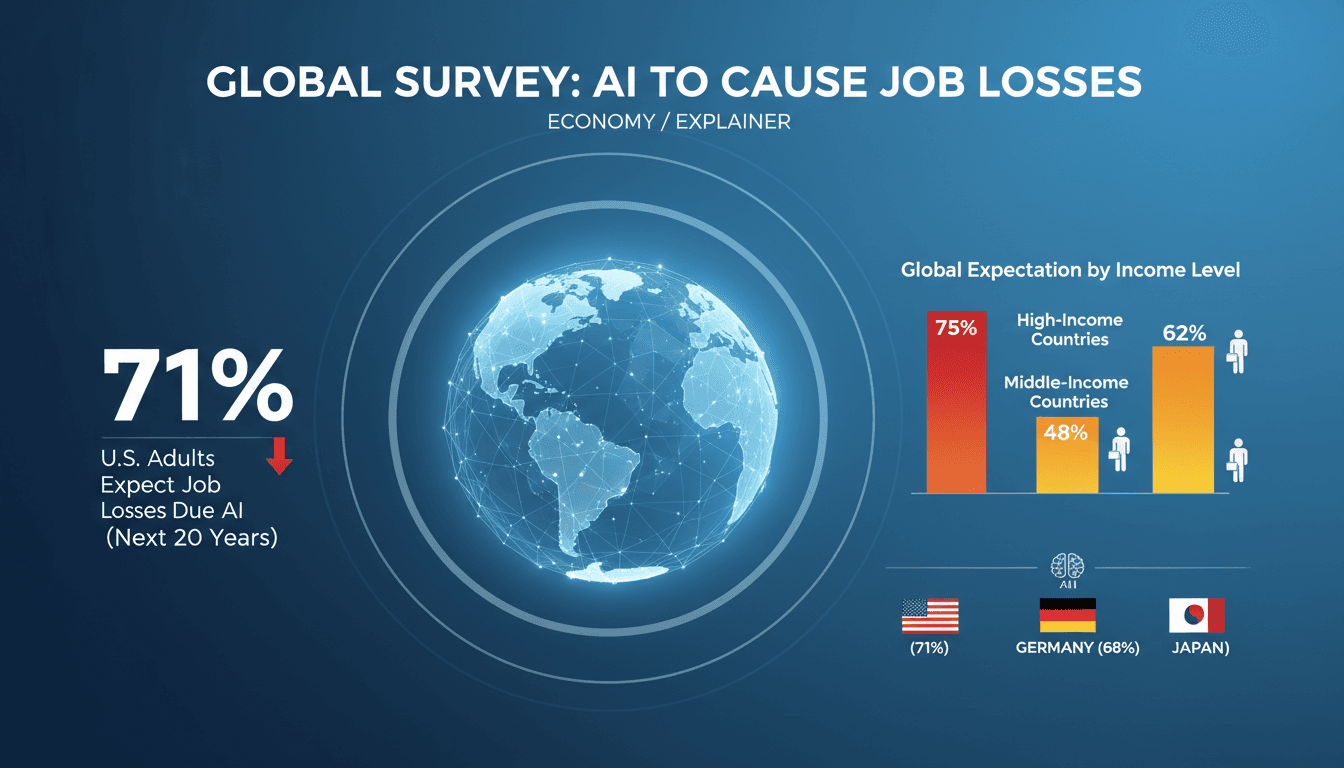
- Pew Research Center released a global survey revealing that 71% of U.S. adults expect AI to reduce jobs over the next 20 years.
- High-income nations show the strongest pessimism, with Australia and South Korea at 76% expecting job losses.
- Job-loss expectations have risen by 7 points in the U.S. since 2024, reflecting growing concerns about AI's impact.
The context you actually need
- Survey scope: Conducted across 36 countries with 42,151 respondents, highlighting a global trend in job-loss expectations.
- Income divide: High-income countries reported a median of 55% expecting fewer jobs, compared to 36% in middle-income nations.
- Corporate actions: Companies like Meta are already reducing workforce numbers in response to AI advancements, indicating a shift in employment strategies.
What's really happening
The Pew Research Center's survey, conducted between February and May 2026, reveals a significant shift in public sentiment regarding artificial intelligence and its impact on employment. The findings indicate that a majority of respondents in high-income countries, particularly the U.S., Australia, and South Korea, anticipate a decline in job opportunities due to AI advancements. This pessimism is not merely anecdotal; it reflects a broader trend of rising anxiety about the future of work as AI technologies become more integrated into various sectors.
The survey results show a stark contrast between high-income and middle-income nations. In high-income countries, 55% of respondents expect job losses, while only 36% in middle-income nations share this view. This disparity suggests that wealthier nations, which are often at the forefront of technological innovation, are more acutely aware of the potential disruptions caused by AI. The U.S. has seen a notable increase in pessimism, with expectations of job losses rising from 64% in 2024 to 71% in 2026. Younger adults, in particular, are expressing heightened concerns, indicating a generational shift in attitudes toward job security in the face of automation.
The backdrop to these findings includes warnings from industry leaders about the potential for significant job displacement, particularly in white-collar roles. For instance, Dario Amodei, CEO of Anthropic, has highlighted the risks associated with AI, suggesting that many jobs may become obsolete as automation takes hold. Additionally, corporate strategies are evolving, with companies like Meta implementing workforce reductions linked to AI initiatives, further fueling public anxiety about job security.
This growing concern is compounded by a lack of clarity regarding the future job market. While some argue that AI will create new opportunities, the prevailing sentiment suggests that many workers may find themselves displaced. The uncertainty surrounding AI's impact on employment is likely to influence labor market dynamics, economic policies, and individual career choices in the coming years.
Who feels it first (and how)
- Tech workers: Likely to experience immediate job displacement as AI tools automate tasks.
- White-collar professionals: Roles in finance, marketing, and administration may see significant reductions.
- Young adults: This demographic shows the highest levels of concern, impacting their career planning and job choices.
- High-income countries: Residents in these nations are more likely to feel the effects due to their reliance on advanced technologies.
What to watch next
- Corporate hiring trends: Monitor how companies adjust their workforce in response to AI advancements, which could signal broader market shifts.
- Policy responses: Watch for government initiatives aimed at addressing job displacement and retraining programs for affected workers.
- Public sentiment: Keep an eye on evolving attitudes toward AI and employment, as shifts in public opinion could influence corporate and governmental actions.
High-income nations are more likely to expect job losses due to AI advancements.
Corporate layoffs and workforce reductions will continue as companies adapt to AI technologies.
The long-term impact of AI on job creation versus job loss remains uncertain.
Frequently Asked Questions
- Why it matters?
- The widespread expectation of AI-driven job losses could reshape labor markets and influence economic policies globally.
- What happened (in 30 seconds)?
- Pew Research Center released a global survey revealing that 71% of U.S. adults expect AI to reduce jobs over the next 20 years. High-income nations show the strongest pessimism, with Australia and South Korea at 76% expecting job losses. Job-loss expectations have risen by 7 points in the U.S. since 2024, reflecting growing concerns about AI's impact.
- What's really happening?
- The Pew Research Center's survey, conducted between February and May 2026, reveals a significant shift in public sentiment regarding artificial intelligence and its impact on employment. The findings indicate that a majority of respondents in high-income countries, particularly the U.S., Australia, and South Korea, anticipate a decline in job opportunities due to AI advancements. This pessimism is not merely anecdotal; it reflects a broader trend of rising anxiety about the future of work as AI
- Who feels it first (and how)?
- Tech workers: Likely to experience immediate job displacement as AI tools automate tasks. White-collar professionals: Roles in finance, marketing, and administration may see significant reductions. Young adults: This demographic shows the highest levels of concern, impacting their career planning and job choices. High-income countries: Residents in these nations are more likely to feel the effects due to their reliance on advanced technologies.
- What to watch next?
- Corporate hiring trends: Monitor how companies adjust their workforce in response to AI advancements, which could signal broader market shifts. Policy responses: Watch for government initiatives aimed at addressing job displacement and retraining programs for affected workers. Public sentiment: Keep an eye on evolving attitudes toward AI and employment, as shifts in public opinion could influence corporate and governmental actions.
Tech news, hardware, and AI tools coverage.
"PC/tech site increasingly covering AI hardware and apps."
— A47 Editor
Most of the world thinks AI is going to kill jobs, a new Pew survey finds
A recent Pew survey reveals that a significant majority of participants globally, including 71% of Americans, believe artificial intelligence (AI) will lead to job losses over the next two decades, with South Korea and Australia expressing even great...
Curated tech headlines including AI stories.
"Influential aggregator surfacing the day’s top tech/AI links."
— A47 Editor
A survey of 42,151 adults in 36 countries and 8,607 US adults: people in 34 of 37 surveyed countries expect AI to cause net job loss rather than net job growth (Pew Research Center)
A recent survey conducted by the Pew Research Center involving 42,151 adults across 36 countries, including 8,607 from the US, reveals that a significant majority in 34 of the 37 surveyed countries anticipate artificial intelligence (AI) will lead to...
Consumer tech and culture with frequent AI coverage.
"Influential tech outlet covering AI products and policy."
— A47 Editor
AI is feared globally as the destroyer of jobs
A recent global survey conducted by Pew Research reveals that a significant majority of respondents across 37 countries perceive artificial intelligence (AI) as a threat to jobs and income equality. The survey, which included 42,151 participants from...
Tech news, reviews, and analysis of consumer electronics, science, art, and culture.
"The Verge is a technology-focused media outlet known for in-depth reporting, product reviews, and coverage of the intersection between technology and culture."
— A47 Editor
AI is feared globally as the destroyer of jobs
A recent global survey conducted by Pew Research reveals that a significant majority of respondents across 37 countries perceive artificial intelligence (AI) as a threat to jobs and income equality. The survey, which included 42,151 participants from...