
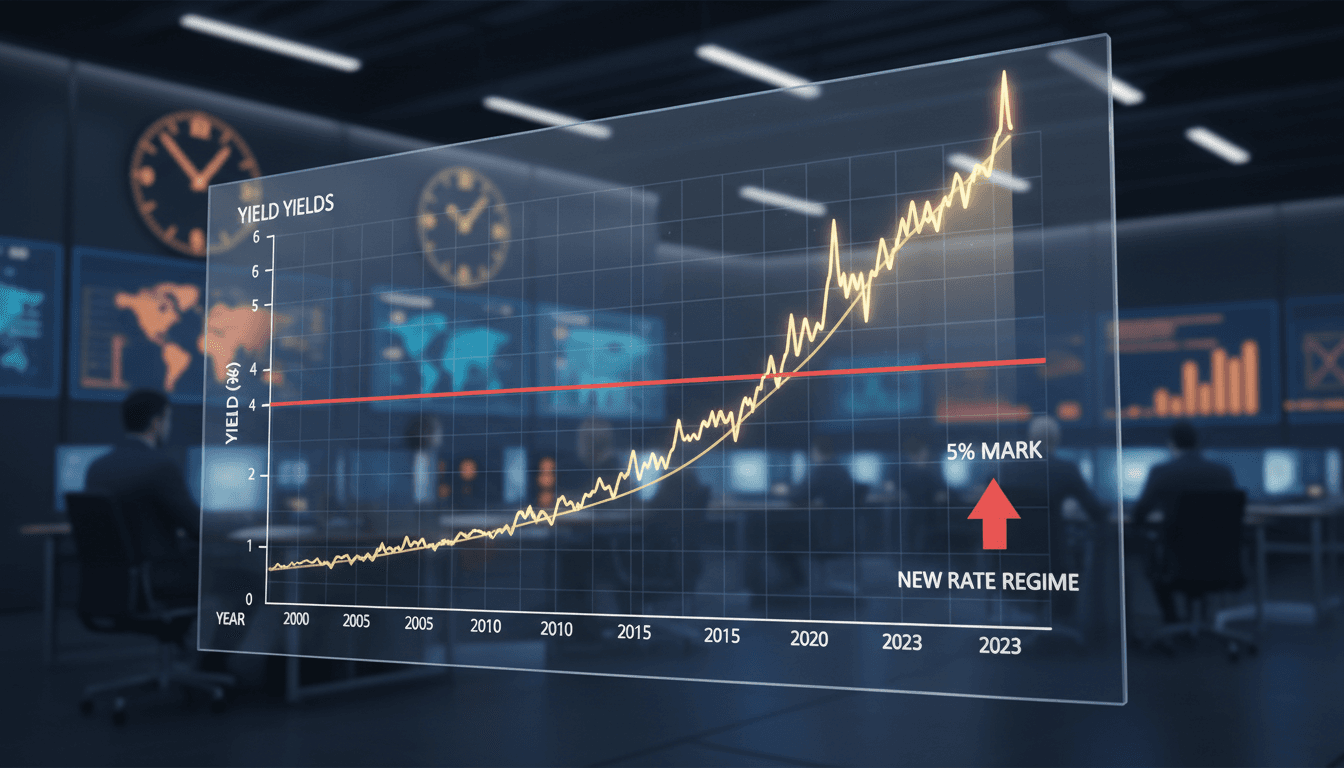
US Treasury Yields Exceed 5% Mark Signaling New Rate Regime
If you’re borrowing money or investing, expect higher costs and potential shifts in market dynamics.
Why it matters
This surge in yields marks a pivotal shift in global borrowing costs, impacting everything from mortgages to corporate financing.
What happened (in 30 seconds)
- US Treasury yields exceeded 5% on the benchmark 10-year note for the first time since 2007, reaching 5.18% on September 24, 2026.
- Elevated oil prices above $100 per barrel and robust AI-driven spending contributed to persistent inflation concerns.
- Longer-dated bonds saw yields at multi-decade highs, prompting a reassessment of rate expectations and economic impacts.
The context you actually need
- Strong economic data indicated resilient growth in the US, with business activity remaining robust despite rising costs.
- Geopolitical tensions and expansive AI capital expenditures have driven oil prices and inflation, complicating the Federal Reserve's monetary policy.
- The national debt has reached a staggering $40 trillion, with large federal budget deficits further influencing borrowing costs.
What's really happening
The recent spike in US Treasury yields is a reflection of multiple interlinked factors that are reshaping the financial landscape. The Federal Reserve has been grappling with inflation that has consistently exceeded its target, prompting a hawkish stance on interest rates. As of late September 2026, the 10-year Treasury yield surpassed 5%, a threshold that signals a fundamental shift in how investors perceive risk and return in the bond market.
This surge was catalyzed by strong Purchasing Managers' Index (PMI) data, which indicated robust economic activity, coupled with hawkish commentary from the Federal Reserve. Investors reacted swiftly, leading to a selloff in Treasury bonds as they recalibrated their expectations for future rate hikes. The 30-year yield reached 5.48%, levels not seen since 2004, indicating a broader reassessment of long-term economic stability and inflation risks.
The backdrop of rising oil prices, which have remained above $100 per barrel, has exacerbated inflationary pressures. This situation is compounded by expansive spending in AI technologies, which, while potentially beneficial for long-term growth, has led to immediate fiscal challenges. The US is also grappling with a record national debt of $40 trillion, which raises concerns about fiscal sustainability and the government's ability to manage its obligations without further increasing borrowing costs.
As yields rise, the implications extend beyond the bond market. Higher borrowing costs will likely translate into increased mortgage rates, which are already approaching 7%. This could dampen consumer spending and slow down the housing market, which has been a critical driver of economic growth. Additionally, Gulf countries, particularly those with economies pegged to the US dollar, will feel the pressure as their borrowing costs rise in tandem with US rates, potentially widening regional debt spreads.
In summary, the surge in Treasury yields is not just a financial statistic; it represents a significant shift in the economic landscape, influencing everything from consumer loans to corporate financing strategies.
Who feels it first (and how)
- Homebuyers: Higher mortgage rates will increase monthly payments, potentially cooling the housing market.
- Corporations: Increased borrowing costs may lead to reduced capital expenditures and slower growth.
- Investors: Those holding bonds will see declines in bond prices, while equities may face volatility as investors reassess risk.
- Gulf Sovereigns: Countries in the Gulf region will experience higher borrowing costs, impacting their fiscal strategies.
What to watch next
- Federal Reserve announcements: Future rate decisions will be critical in shaping market expectations and economic conditions.
- Oil price fluctuations: Continued volatility in oil prices will directly impact inflation and borrowing costs.
- Corporate earnings reports: Watch for how rising rates affect corporate profitability and spending plans.
US Treasury yields have surpassed 5%, indicating a new rate regime.
Higher borrowing costs will affect consumer spending and corporate investments.
The long-term impact on economic growth and inflation remains uncertain.
Frequently Asked Questions
- Why it matters?
- This surge in yields marks a pivotal shift in global borrowing costs, impacting everything from mortgages to corporate financing.
- What happened (in 30 seconds)?
- US Treasury yields exceeded 5% on the benchmark 10-year note for the first time since 2007, reaching 5.18% on September 24, 2026. Elevated oil prices above $100 per barrel and robust AI-driven spending contributed to persistent inflation concerns. Longer-dated bonds saw yields at multi-decade highs, prompting a reassessment of rate expectations and economic impacts.
- What's really happening?
- The recent spike in US Treasury yields is a reflection of multiple interlinked factors that are reshaping the financial landscape. The Federal Reserve has been grappling with inflation that has consistently exceeded its target, prompting a hawkish stance on interest rates. As of late September 2026, the 10-year Treasury yield surpassed 5%, a threshold that signals a fundamental shift in how investors perceive risk and return in the bond market. This surge was catalyzed by strong Purchasing Mana
- Who feels it first (and how)?
- Homebuyers: Higher mortgage rates will increase monthly payments, potentially cooling the housing market. Corporations: Increased borrowing costs may lead to reduced capital expenditures and slower growth. Investors: Those holding bonds will see declines in bond prices, while equities may face volatility as investors reassess risk. Gulf Sovereigns: Countries in the Gulf region will experience higher borrowing costs, impacting their fiscal strategies.
- What to watch next?
- Federal Reserve announcements: Future rate decisions will be critical in shaping market expectations and economic conditions. Oil price fluctuations: Continued volatility in oil prices will directly impact inflation and borrowing costs. Corporate earnings reports: Watch for how rising rates affect corporate profitability and spending plans.
Technology business and AI-related headlines.
"Data-driven tech newsroom with global scope."
— A47 Editor
US Treasury Yields Hit 5% as Wall Street Faces New Rate Regime
US Treasury yields have surpassed 5%, marking a significant shift in the financial landscape as Wall Street and Washington grapple with the implications of this new rate regime. This surge in yields indicates a potential transition from previous econ...
Technology business news, market impacts, and innovation trends.
"Bloomberg is a premier financial and tech news provider, respected for its in-depth reporting and analytical rigor."
— A47 Editor
US Treasury Yields Hit 5% as Wall Street Faces New Rate Regime
US Treasury yields have surpassed 5%, marking a significant shift in the financial landscape as Wall Street and Washington grapple with the implications of this new rate regime. This surge in yields indicates a potential transition from previous econ...
Global business headlines with AI angles.
"General business outlet that frequently covers AI."
— A47 Editor
Bond Yields Keep Rising As Inflation Concerns Mount. Stocks Were Mixed.
The 30-year Treasury bond yield has surged to its highest level since June 2004, reflecting growing inflation concerns that have unsettled investors and contributed to mixed stock market performance.
News from the United States including domestic politics, society, and culture.
"Global News is a mainstream Canadian media outlet generally considered to have a centrist editorial stance, covering news with a focus on factual reporting and national interest."
— A47 Editor
A U.S. bond yield hit 5.1% for 1st time in 19 years. Here’s what it signals
The U.S. 10-year Treasury bond yield has reached 5.1%, marking the first time it has surpassed the five percent threshold in nearly 19 years, amidst ongoing economic uncertainty. This significant milestone reflects shifts in investor sentiment and ma...