
Saudi Royal Directive Introduces 500 Riyal Monthly Support and Phases Nitaqat Wage Threshold to 6,000 Riyals Alongside Utility Tariff Reform
Why it matters
The coordinated policy synchronizes utility fiscal rationalization with corporate wage mandates, shifting the cost of living preservation from state subsidies directly onto private-sector balance sheets.
What happened (in 30 seconds)
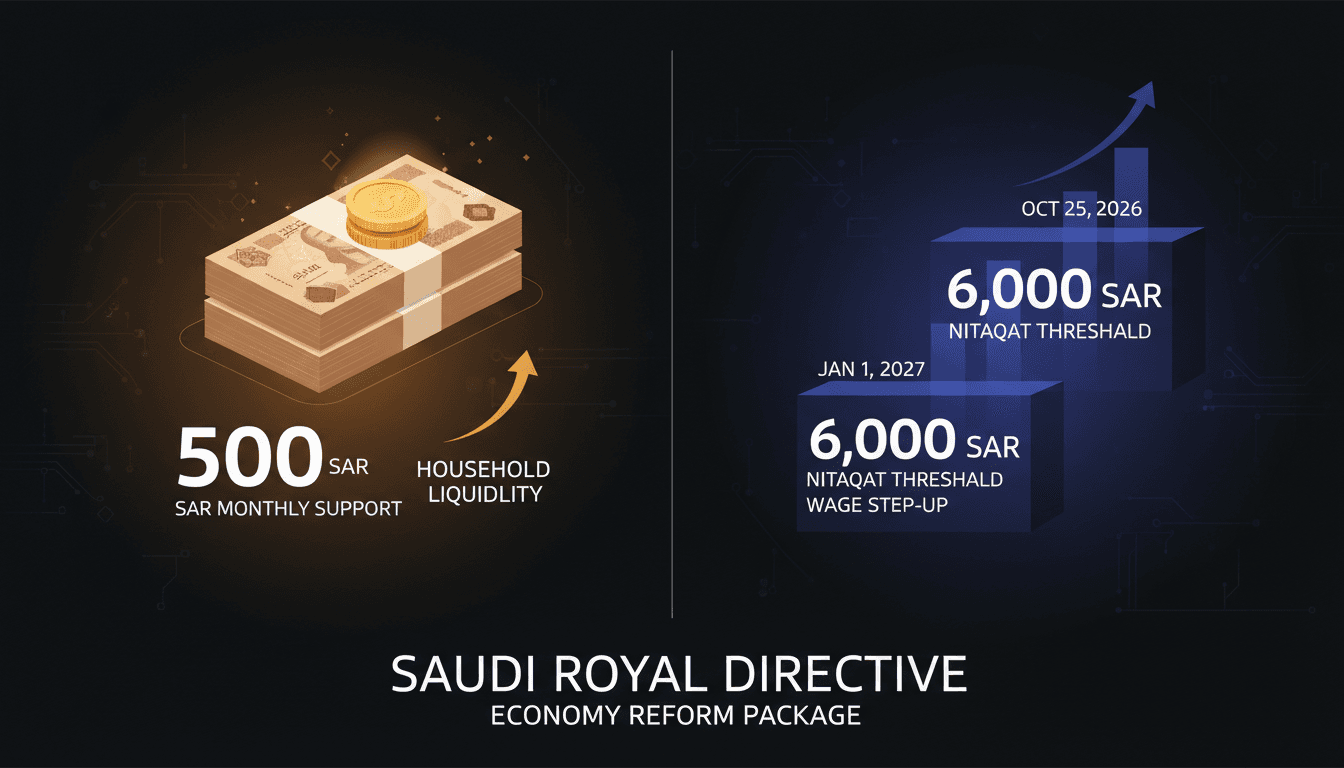
- A cash cushion for citizens: Custodian of the Two Holy Mosques King Salman bin Abdulaziz issued a directive establishing a 500 Saudi Riyal monthly allowance for eligible civil and military personnel, retirees, and social security beneficiaries starting January 1, 2027.
- Utility rate restructuring: The Saudi Energy Company and the National Water Company announced revised electricity and water consumption tariffs taking effect January 1, 2027, introducing fixed monthly service fees tied to meter capacity and diameter.
- Higher Nitaqat payroll floors: The Ministry of Human Resources and Social Development will phase in higher wage thresholds for companies to earn full Saudization credit, climbing to 5,000 Riyals after six months and 6,000 Riyals twelve months later.
The context you actually need
- Fiscal adjustment under Vision 2030: The Kingdom has systematically revised utility pricing structures to promote resource efficiency and fiscal sustainability, replacing variable service charges with fixed infrastructure-based tariffs.
- The evolution of Nitaqat calculations: The Nitaqat framework sets domestic hiring quotas across industries, using monthly wage baselines to determine whether an employee counts as a full unit toward an enterprise's statutory Saudization score.
- Direct household offset design: By scheduling the 500 Riyal monthly payout to coincide precisely with the January 1, 2027 utility adjustments, the policy creates an upfront cash barrier against residential utility bill inflation for public-sector and lower-income families.
What's really happening
The policy architecture reveals a deliberate economic mechanism: pairing utility tariff restructuring with calibrated private-sector labor requirements. Rather than executing energy and water pricing rationalization in isolation—which contracts disposable income across households—policymakers engineered a synchronized offset that shields domestic consumers while recalibrating enterprise wage obligations.
On the household ledger, the structural shift centers on utility billing. The Saudi Energy Company and the National Water Company are moving away from traditional variable service metrics toward fixed monthly charges determined strictly by meter capacity and diameter. This tariff design creates predictable, recurring revenue streams for state utility operators and incentivizes physical consumption efficiency. To ensure domestic consumption capacity does not retrench under these baseline utility adjustments, the royal directive deploys a targeted fiscal cushion: 500 Riyals paid monthly to eligible public employees, military personnel, pensioners, and social security recipients.
On the corporate ledger, the mechanism functions through regulatory compliance leverage. The Ministry of Human Resources and Social Development does not legally mandate immediate private-sector pay raises across the board. Instead, it adjusts the operational incentive structure: private firms must pay Saudi staff at least 5,000 Riyals monthly—and eventually 6,000 Riyals—to receive full single-employee credit under the Nitaqat system.
This phased labor threshold redefines corporate hiring math. To maintain green-tier compliance status—essential for securing work permits, operational licenses, and government contracts—enterprises cannot rely on nominal, entry-level salaries to fulfill localization quotas. Employers face a strategic decision: raise compensation bands for Saudi nationals to preserve full Nitaqat ratios, absorb the operational friction of diluted compliance headcounts, or redesign workforce productivity models.
The broader outcome is a controlled reallocation of economic costs. The state advances utility efficiency and establishes baseline fixed infrastructure fees. Domestic households receive immediate cash liquidity to neutralize increased monthly utility expenses. In turn, the private sector absorbs the medium-term cost of sustaining Saudi wages at higher nominal thresholds, reinforcing domestic purchasing power without placing long-term recurring payroll subsidies on the state balance sheet.
Who feels it first (and how)
- Private-Sector CFOs and HR Directors: Mid-tier enterprises and service-sector firms with low-margin payroll models must remodel compensation packages to reach the 5,000 Riyal and 6,000 Riyal thresholds or see their Nitaqat credit diluted.
- Public-Sector Employees and Retirees: Civil servants, military staff, and social security recipients see an immediate 500 Riyal monthly income supplement starting January 1, 2027 to offset restructured utility meter fees.
- Commercial and Residential Real Estate Operators: Facilities managers face revised recurring costs as the Saudi Energy Company and National Water Company apply fixed tariffs based on meter capacity and diameter.
- Regional Operators and Dubai-Based HQs: Multinational operations overseeing Saudi subsidiaries from regional hubs like Dubai experience no direct domestic policy impact, but must account for higher Saudi talent retention costs and entity compliance budgets.
What to watch next
- Detailed Ministry Implementing Regulations: The Ministry of Human Resources and Social Development will release specific procedural bylaws outlining the exact transition calendar and compliance grace periods for the 5,000 Riyal threshold.
- Fixed Tariff Metric Schedules: Utility filings from the Saudi Energy Company and National Water Company specifying exact monthly billing brackets by meter size and connection diameter ahead of January 1, 2027.
- Corporate Payroll Reclassifications: Private-sector wage reporting data from late 2026 showing whether enterprises front-run the Nitaqat deadline by adjusting basic salaries or adjusting Saudi-to-expatriate staffing ratios.
A 500 Riyal monthly support payment takes effect on January 1, 2027 for eligible civil servants, military personnel, retirees, and social security beneficiaries. Fixed utility charges tied to meter capacity and diameter launch simultaneously. Full Nitaqat credit requires a 5,000 Riyal minimum salary after six months, rising to 6,000 Riyals twelve months later.
Low-margin private service sectors will compress hiring of entry-level roles, choosing to increase pay for existing Saudi personnel to maintain critical Saudization compliance tiers efficiently.
The exact cost delta for high-capacity commercial and industrial properties once the fixed meter diameter tariff schedules are finalized by utility providers.
Frequently Asked Questions
- Why it matters?
- The coordinated policy synchronizes utility fiscal rationalization with corporate wage mandates, shifting the cost of living preservation from state subsidies directly onto private-sector balance sheets.
- What happened (in 30 seconds)?
- A cash cushion for citizens: Custodian of the Two Holy Mosques King Salman bin Abdulaziz issued a directive establishing a 500 Saudi Riyal monthly allowance for eligible civil and military personnel, retirees, and social security beneficiaries starting January 1, 2027. Utility rate restructuring: The Saudi Energy Company and the National Water Company announced revised electricity and water consumption tariffs taking effect January 1, 2027, introducing fixed monthly service fees tied to meter ca
- What's really happening?
- The policy architecture reveals a deliberate economic mechanism: pairing utility tariff restructuring with calibrated private-sector labor requirements. Rather than executing energy and water pricing rationalization in isolation—which contracts disposable income across households—policymakers engineered a synchronized offset that shields domestic consumers while recalibrating enterprise wage obligations. On the household ledger, the structural shift centers on utility billing. The Saudi Energy
- Who feels it first (and how)?
- Private-Sector CFOs and HR Directors: Mid-tier enterprises and service-sector firms with low-margin payroll models must remodel compensation packages to reach the 5,000 Riyal and 6,000 Riyal thresholds or see their Nitaqat credit diluted. Public-Sector Employees and Retirees: Civil servants, military staff, and social security recipients see an immediate 500 Riyal monthly income supplement starting January 1, 2027 to offset restructured utility meter fees. Commercial and Residential Real Estate
- What to watch next?
- Detailed Ministry Implementing Regulations: The Ministry of Human Resources and Social Development will release specific procedural bylaws outlining the exact transition calendar and compliance grace periods for the 5,000 Riyal threshold. Fixed Tariff Metric Schedules: Utility filings from the Saudi Energy Company and National Water Company specifying exact monthly billing brackets by meter size and connection diameter ahead of January 1, 2027. Corporate Payroll Reclassifications: Private-sector
Arabic-language coverage of Saudi, regional, and international affairs.
"Al Bilad offers mainstream Saudi newspaper coverage across domestic and broader Arab topics."
— A47 Editor
بناءً على ما عرضه ولي العهد.. خادم الحرمين يوجه ببدل شهري 500 ريال ورفع الحد الأدنى لـ”نطاقات” إلى 5 آلاف بدءاً من 1 يناير 2027
King Salman bin Abdulaziz, custodian of the two holy mosques, has directed a set of support measures for citizens, based on a proposal presented by Crown Prince and Prime Minister Mohammed bin Salman bin Abdulaziz, including a monthly allowance of 50...
English-language reporting on Saudi politics, policy, and society.
"Saudi Gazette reflects mainstream Saudi institutional perspectives."
— A47 Editor
King Salman orders SR500 allowance increase, raises minimum wage
King Salman has ordered a SR500 monthly allowance increase for eligible civilian and military employees, retirees, and families under the Social Insurance Law, alongside higher wage thresholds for Saudi employees under the Nitaqat Saudization program...
English-language reporting focused on Saudi Arabia and regional affairs.
"Saudi Gazette provides English-language coverage that often aligns with mainstream Saudi news priorities."
— A47 Editor
King Salman orders SR500 allowance increase, raises minimum wage
King Salman has ordered a SR500 monthly increase in allowances for eligible civilian and military employees, retirees, and families under the Social Insurance Law, alongside higher Saudization wage thresholds under the Nitaqat program, with the measu...
Arabic-language political and world news coverage for UAE readers.
"Emarat Al Youm world coverage usually presents international developments through a UAE and Arab audience lens."
— A47 Editor
خادم الحرمين يوجه ببدل شهري 500 ريال لعدد من الفئات بالتزامن مع تعديل تعريفتي الكهرباء والمياه خادم الحرمين يوجه ببدل شهري 500 ريال لعدد من الفئات بالتزامن مع تعديل تعريفتي الكهرباء والمياه
King Salman bin Abdulaziz Al Saud, Custodian of the Two Holy Mosques, has directed the granting of a monthly allowance of 500 riyals to a number of categories, based on a proposal presented by Crown Prince Mohammed bin Salman, coinciding with the ame...
Arabic-language reporting focused on domestic developments in Saudi Arabia.
"Okaz is a mainstream Saudi newspaper that often reflects domestic priorities and official-facing coverage."
— A47 Editor
6000 ريال الحد الأدنى لأجر المواطن في القطاع الخاص و500 بدلاً شهرياً للمدنيين والعسكريين
Custodian of the Two Holy Mosques King Salman bin Abdulaziz directed a set of support measures for citizens, based on a proposal from Crown Prince and Prime Minister Mohammed bin Salman bin Abdulaziz, coinciding with Saudi Electricity Company and Nat...