
US Supreme Court Allows Trump to Advance Mail-In Voting Restrictions Amid Legal Challenges
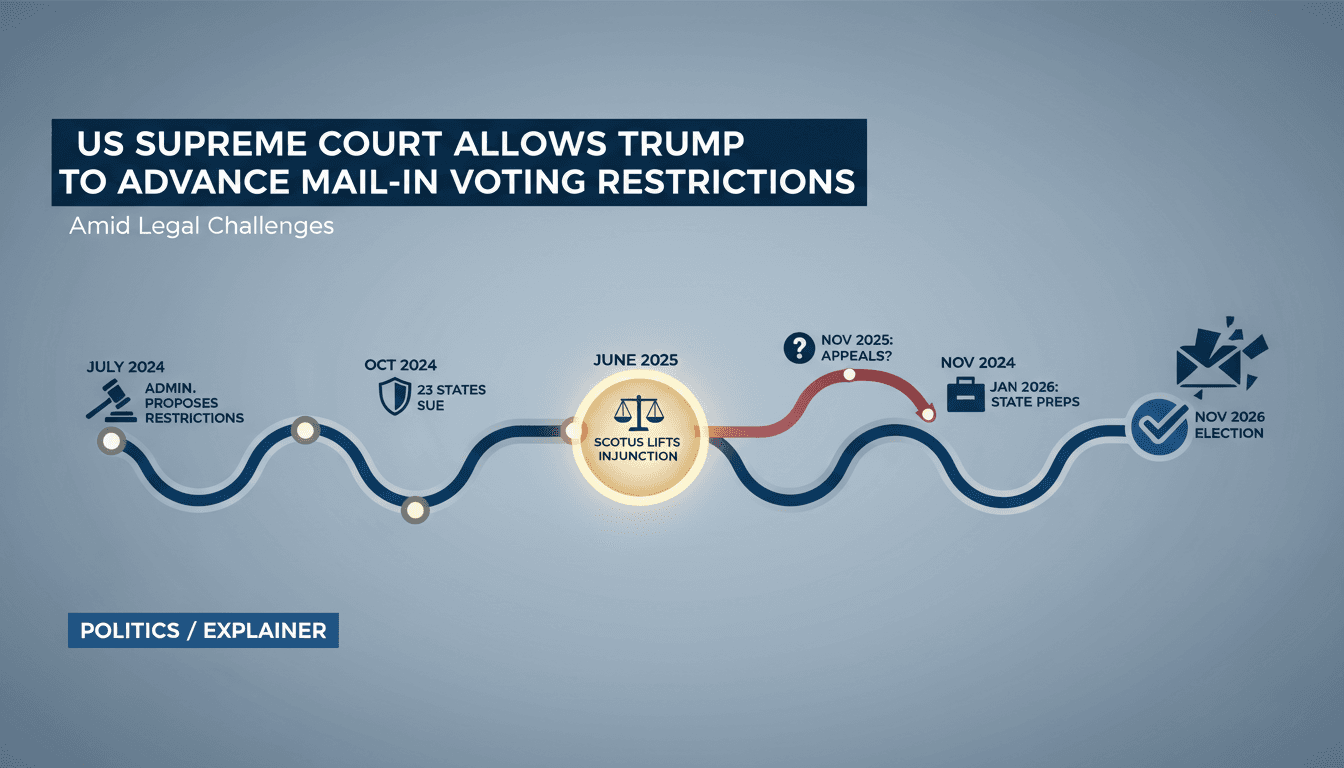
Here's what it means for you.
If you’re involved in U.S. elections or expatriate voting logistics, this ruling could reshape how ballots are processed and delivered.
Why it matters
This decision could influence voter turnout and election integrity perceptions, impacting political dynamics in the upcoming midterms.
What happened (in 30 seconds)
- On August 24, 2026, the U.S. Supreme Court issued a 6-3 ruling allowing the Trump administration to advance its mail-in voting restrictions.
- Twenty-three Democratic-led states challenged the executive order, arguing it infringes on state election authority.
- A separate nationwide injunction against the U.S. Postal Service's new rules remains in effect, complicating the implementation of the order.
The context you actually need
- President Trump’s executive order directs the Department of Homeland Security to create citizenship lists and limit mail ballot delivery to verified voters.
- Democratic-led states argue that the order violates the constitutional allocation of election administration to states, leading to ongoing litigation.
- Previous rulings have upheld state grace periods for late-arriving mail ballots, indicating a complex legal landscape surrounding mail-in voting.
What's really happening
The recent Supreme Court ruling represents a procedural victory for the Trump administration, allowing it to move forward with plans to tighten mail-in voting procedures ahead of the November congressional elections. This decision lifts a federal injunction that had previously blocked the implementation of the executive order, which aims to create state citizenship lists and impose stricter delivery protocols for mail ballots. However, the ruling does not address the constitutionality of the order, leaving a separate nationwide injunction against the U.S. Postal Service's new rules intact.
The legal battle is now shifting into a more uncertain phase, as the ruling compresses timelines for states preparing absentee ballots. With only weeks left before ballots are due, states must navigate the complexities of the new regulations while facing potential operational challenges. Analysts describe the Supreme Court's decision as technical rather than substantive, preserving ongoing litigation while raising concerns about chaos and uncertainty for the upcoming elections.
The dissenting justices highlighted the risks associated with the ruling, emphasizing the potential for confusion among voters and election officials alike. As states scramble to comply with the new requirements, the implications for voter turnout and election integrity could be significant. The ruling may inadvertently favor Republican candidates, as Democrats are more likely to utilize mail-in voting, which could lead to a strategic advantage for the GOP.
Moreover, the ruling reflects broader trends in U.S. electoral politics, where mail-in voting has become a contentious issue. The ongoing litigation and procedural maneuvers underscore the high stakes involved in shaping electoral processes, particularly as the nation approaches a critical midterm election. The outcome of this legal battle will not only affect the immediate election landscape but could also set precedents for future electoral policies and practices.
Who feels it first (and how)
- Election officials in the 23 states challenging the order will face immediate operational challenges in implementing new mail-in voting procedures.
- Voters, particularly those relying on mail-in ballots, may experience confusion and delays in ballot delivery.
- Political analysts and strategists will monitor shifts in voter turnout and party dynamics as the election approaches.
What to watch next
- Litigation outcomes: Keep an eye on how lower courts handle the ongoing challenges to the executive order and its implications for mail-in voting.
- Voter turnout trends: Monitor changes in absentee ballot requests and submissions as states adapt to the new regulations.
- Political polling: Watch for shifts in approval ratings and electoral forecasts as the economy and voter sentiment evolve leading up to the midterms.
The Supreme Court ruling allows the Trump administration to proceed with mail-in voting restrictions.
Increased operational challenges for states and potential confusion among voters as new rules are implemented.
The long-term implications for voter turnout and election integrity as litigation continues.
Frequently Asked Questions
- Why it matters?
- This decision could influence voter turnout and election integrity perceptions, impacting political dynamics in the upcoming midterms.
- What happened (in 30 seconds)?
- On August 24, 2026, the U.S. Supreme Court issued a 6-3 ruling allowing the Trump administration to advance its mail-in voting restrictions. Twenty-three Democratic-led states challenged the executive order, arguing it infringes on state election authority. A separate nationwide injunction against the U.S. Postal Service's new rules remains in effect, complicating the implementation of the order.
- What's really happening?
- The recent Supreme Court ruling represents a procedural victory for the Trump administration, allowing it to move forward with plans to tighten mail-in voting procedures ahead of the November congressional elections. This decision lifts a federal injunction that had previously blocked the implementation of the executive order, which aims to create state citizenship lists and impose stricter delivery protocols for mail ballots. However, the ruling does not address the constitutionality of the ord
- Who feels it first (and how)?
- Election officials in the 23 states challenging the order will face immediate operational challenges in implementing new mail-in voting procedures. Voters, particularly those relying on mail-in ballots, may experience confusion and delays in ballot delivery. Political analysts and strategists will monitor shifts in voter turnout and party dynamics as the election approaches.
- What to watch next?
- Litigation outcomes: Keep an eye on how lower courts handle the ongoing challenges to the executive order and its implications for mail-in voting. Voter turnout trends: Monitor changes in absentee ballot requests and submissions as states adapt to the new regulations. Political polling: Watch for shifts in approval ratings and electoral forecasts as the economy and voter sentiment evolve leading up to the midterms.
Pan-Arab news coverage spanning politics, business, sports, and regional affairs.
"Asharq Al-Awsat reflects a broad Arab editorial perspective with strong attention to regional geopolitics."
— A47 Editor
المحكمة العليا الأميركية تربك معركة التصويت بالبريد قبل انتخابات الكونغرس
The U.S. Supreme Court has granted a temporary legal victory to Trump by lifting a ruling that had blocked parts of his executive order aimed at tightening mail-in voting regulations. This decision comes ahead of the upcoming congressional elections,...
International stories from NPR’s global desk.
"NPR is an American public media organization known for thoughtful reporting and a slightly left-leaning editorial tone."
— A47 Editor
Trump calls leaders to isolate Iran. And, SCOTUS backs Trump for now on mail-in voting
President Trump is urging world leaders to join his economic campaign against Iran, emphasizing a strategy of isolation through sanctions. This call comes as the Supreme Court supports his administration's stance on mail-in voting restrictions, allow...
Business, investment, entrepreneurship, leadership, and innovation.
"Forbes is known for its coverage of business leaders, market trends, and entrepreneurial ventures with a pro-business editorial stance."
— A47 Editor
‘Fight Is Far From Over’: Democratic States Respond To Supreme Court Ruling On Mail-In Voting
The U.S. Supreme Court has lifted a lower court's injunction that blocked the implementation of an executive order by former President Trump aimed at limiting mail-in voting. While the ruling allows the order to proceed, the Court did not address its...
Pan-Arab news coverage spanning politics, business, sports, and regional affairs.
"Asharq Al-Awsat reflects a broad Arab editorial perspective with strong attention to regional geopolitics."
— A47 Editor
المحكمة العليا تسمح بتنفيذ أمر أصدره ترمب لتقييد التصويت عبر البريد
The U.S. Supreme Court granted President Donald Trump a temporary victory on Monday by allowing the enforcement of an order aimed at limiting the use of mail-in ballots. This decision reflects ongoing legal battles surrounding voting procedures in th...
Global news coverage with extensive reporting on Middle Eastern conflicts and geopolitics.
"Al Jazeera is a Qatar-based broadcaster known for wide regional coverage and alternative perspectives."
— A47 Editor
US Supreme Court allows Trump’s mail voting restrictions to proceed
The US Supreme Court has sided with the Trump administration regarding mail voting, a decision that aligns with President Donald Trump's long-standing opposition to mail balloting. This ruling comes amidst ongoing debates about the integrity and acce...
Comprehensive coverage of Middle Eastern and global issues.
"Al Jazeera is a prominent voice from the Global South, especially the Middle East, with an emphasis on underreported stories."
— A47 Editor
US Supreme Court sides with Trump administration on mail voting
The US Supreme Court has sided with the Trump administration regarding mail voting, a decision that aligns with President Donald Trump's long-standing opposition to mail balloting. This ruling comes amidst ongoing debates about the integrity and acce...
Conservative-leaning coverage of current events.
"Fox News is a highly influential conservative news outlet known for right-leaning political commentary and coverage."
— A47 Editor
Trump scores Supreme Court win on mail-in voting restrictions before midterms
The U.S. Supreme Court has authorized the Trump administration to enforce new mail-in voting restrictions across 23 states ahead of the upcoming midterm elections. This decision allows for immediate implementation of revised regulations that could si...
News from the United States including domestic politics, society, and culture.
"Global News is a mainstream Canadian media outlet generally considered to have a centrist editorial stance, covering news with a focus on factual reporting and national interest."
— A47 Editor
U.S. Supreme Court clears way for Trump mail voting limits as midterms near
The U.S. Supreme Court has cleared the way for new mail voting limits championed by former President Donald Trump as the midterm elections approach, allowing states to implement changes despite potential for further legal challenges.