
Trump Submits Saudi Nuclear Agreement to Congress Linked to Israel Normalization
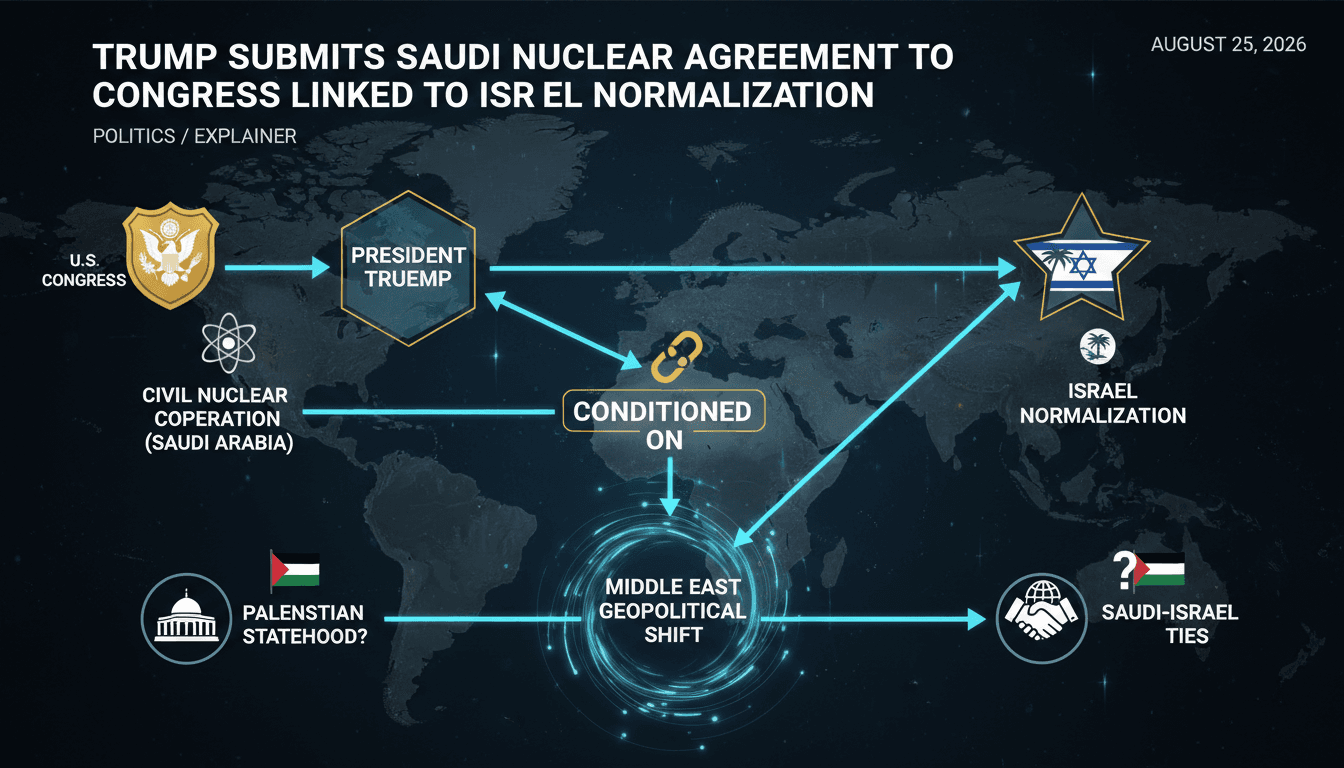
Here's what it means for you.
If you’re in the energy sector or follow Middle Eastern geopolitics, this agreement could reshape market dynamics and diplomatic relations.
Why it matters
This agreement could significantly alter energy cooperation in the Gulf while impacting U.S. foreign policy and regional stability.
What happened (in 30 seconds)
- On August 25, 2026, President Trump submitted a civil nuclear cooperation agreement with Saudi Arabia to Congress, linking it to Saudi normalization with Israel.
- The agreement allows U.S. companies to export civilian nuclear technology, including AP1000 reactors, to Saudi Arabia, valued at tens of billions of dollars.
- Congress has 90 session days to review the agreement; if not rejected, it will take effect, contingent on Saudi Arabia recognizing Israel.
The context you actually need
- The U.S. has pursued a civil nuclear agreement with Saudi Arabia for over a decade to support the kingdom's energy diversification efforts.
- Saudi Arabia's recognition of Israel has been tied to a credible path to Palestinian statehood, complicating previous negotiations.
- The July 2026 agreement was initially reached without the normalization condition, but U.S. officials later clarified that it is now a prerequisite for implementation.
What's really happening
The proposed civil nuclear cooperation agreement between the U.S. and Saudi Arabia represents a strategic pivot in U.S. foreign policy, intertwining energy cooperation with complex geopolitical dynamics. The agreement, signed by U.S. Energy Secretary Chris Wright and Saudi Energy Minister Prince Abdulaziz bin Salman, allows for the export of advanced nuclear technology, specifically AP1000 reactors, to Saudi Arabia. This move is part of a broader U.S. strategy to enhance energy diversification in the Gulf region, which has been heavily reliant on oil.
However, the linkage of this nuclear deal to Saudi normalization with Israel introduces a significant diplomatic hurdle. Saudi Arabia has consistently maintained that any recognition of Israel must come with a clear and irreversible pathway to Palestinian statehood. This condition reflects the kingdom's commitment to regional stability and its domestic audience, which largely supports Palestinian rights. The U.S. administration's insistence on this linkage indicates a shift in how nuclear cooperation is being negotiated, moving from a purely energy-focused agreement to one that also serves as a diplomatic tool.
Critics of the agreement have raised concerns about the absence of stringent nonproliferation safeguards, which were a hallmark of the 2009 UAE nuclear agreement. The lack of prohibitions on uranium enrichment and reprocessing in the Saudi deal has alarmed nonproliferation experts, who fear it could lead to nuclear proliferation in a volatile region. The potential construction of AP1000 reactors, valued at tens of billions of dollars, could also spark a regional arms race if neighboring countries perceive it as a threat.
The agreement's current status is under a 90-session-day review by Congress, during which lawmakers can object. If Congress does not reject the deal, it will automatically enter into force, provided Saudi Arabia moves forward with recognizing Israel. This timeline places significant pressure on both U.S. and Saudi officials to navigate the complex political landscape surrounding the Israeli-Palestinian conflict while advancing their respective national interests.
Who feels it first (and how)
- Energy companies: U.S. firms like Westinghouse Electric Company stand to gain lucrative contracts for reactor construction.
- Middle Eastern governments: Regional players will closely monitor Saudi-Israeli relations and their implications for energy security and political alliances.
- Palestinian advocates: The outcome of this agreement could influence the Palestinian statehood movement and regional stability.
What to watch next
- Congressional response: Watch for any objections from lawmakers during the 90-session-day review, as this will determine the agreement's fate.
- Saudi-Israeli negotiations: Monitor developments in Saudi Arabia's discussions with Israel regarding normalization and its impact on the Palestinian issue.
- Regional energy market reactions: Observe how this agreement affects energy prices and investments in the Gulf region, particularly in nuclear energy.
The agreement allows U.S. companies to export civilian nuclear technology to Saudi Arabia.
Saudi Arabia will continue to link recognition of Israel to progress on Palestinian statehood.
The long-term implications for regional stability and energy markets remain uncertain.
Frequently Asked Questions
- Why it matters?
- This agreement could significantly alter energy cooperation in the Gulf while impacting U.S. foreign policy and regional stability.
- What happened (in 30 seconds)?
- On August 25, 2026, President Trump submitted a civil nuclear cooperation agreement with Saudi Arabia to Congress, linking it to Saudi normalization with Israel. The agreement allows U.S. companies to export civilian nuclear technology, including AP1000 reactors, to Saudi Arabia, valued at tens of billions of dollars. Congress has 90 session days to review the agreement; if not rejected, it will take effect, contingent on Saudi Arabia recognizing Israel.
- What's really happening?
- The proposed civil nuclear cooperation agreement between the U.S. and Saudi Arabia represents a strategic pivot in U.S. foreign policy, intertwining energy cooperation with complex geopolitical dynamics. The agreement, signed by U.S. Energy Secretary Chris Wright and Saudi Energy Minister Prince Abdulaziz bin Salman, allows for the export of advanced nuclear technology, specifically AP1000 reactors, to Saudi Arabia. This move is part of a broader U.S. strategy to enhance energy diversification i
- Who feels it first (and how)?
- Energy companies: U.S. firms like Westinghouse Electric Company stand to gain lucrative contracts for reactor construction. Middle Eastern governments: Regional players will closely monitor Saudi-Israeli relations and their implications for energy security and political alliances. Palestinian advocates: The outcome of this agreement could influence the Palestinian statehood movement and regional stability.
- What to watch next?
- Congressional response: Watch for any objections from lawmakers during the 90-session-day review, as this will determine the agreement's fate. Saudi-Israeli negotiations: Monitor developments in Saudi Arabia's discussions with Israel regarding normalization and its impact on the Palestinian issue. Regional energy market reactions: Observe how this agreement affects energy prices and investments in the Gulf region, particularly in nuclear energy.
Oil, metals, and agriculture: supply/demand headlines, OPEC chatter, inventories, and price action.
"Solid tape for energy and metals traders tracking macro and micro catalysts."
— A47 Editor
Trump sends Saudi nuclear deal to Congress but says Riyadh must recognize Israel
President Trump has submitted a nuclear deal with Saudi Arabia to Congress, stipulating that Riyadh must recognize Israel as part of the agreement. This move highlights the ongoing geopolitical dynamics in the Middle East and the U.S. role in facilit...
Regional coverage and analysis focused on politics, diplomacy, and business across the Middle East.
"Al-Monitor is known for analytical reporting on Middle East politics and policy developments."
— A47 Editor
Trump sends Saudi nuclear deal to Congress but says Riyadh must recognize Israel
President Donald Trump has submitted a proposed civil nuclear energy agreement with Saudi Arabia to Congress, contingent upon the kingdom's recognition of Israel. This agreement, reached in July, would permit U.S. companies to export civilian nuclear...
Business and economy coverage focused on Dubai, the UAE, Saudi Arabia, and the wider Middle East.
"Arabian Business is a well-known regional business outlet with strong focus on Gulf markets, leadership, and investment stories."
— A47 Editor
Saudi Arabia-US nuclear deal sent to Congress as Trump sets Israel condition
President Donald Trump has submitted a civil nuclear deal between the United States and Saudi Arabia to Congress, contingent upon Saudi Arabia normalizing relations with Israel. This proposal aims to allow U.S. companies to export civilian nuclear te...
Arabic-language coverage of international news and geopolitics.
"RT Arabic is a Russian state-funded outlet often criticized for promoting Kremlin-aligned narratives."
— A47 Editor
ترامب يحيل الاتفاق النووي مع السعودية إلى الكونغرس مع الإبقاء على شرط التطبيع مع إسرائيل
U.S. President Donald Trump has submitted a nuclear agreement with Saudi Arabia to Congress for review, while maintaining a condition that Riyadh must normalize relations with Israel, as reported by The Wall Street Journal.