
U.S. Begins Diplomatic Redeployment to Middle East Amid Eased Tensions with Iran
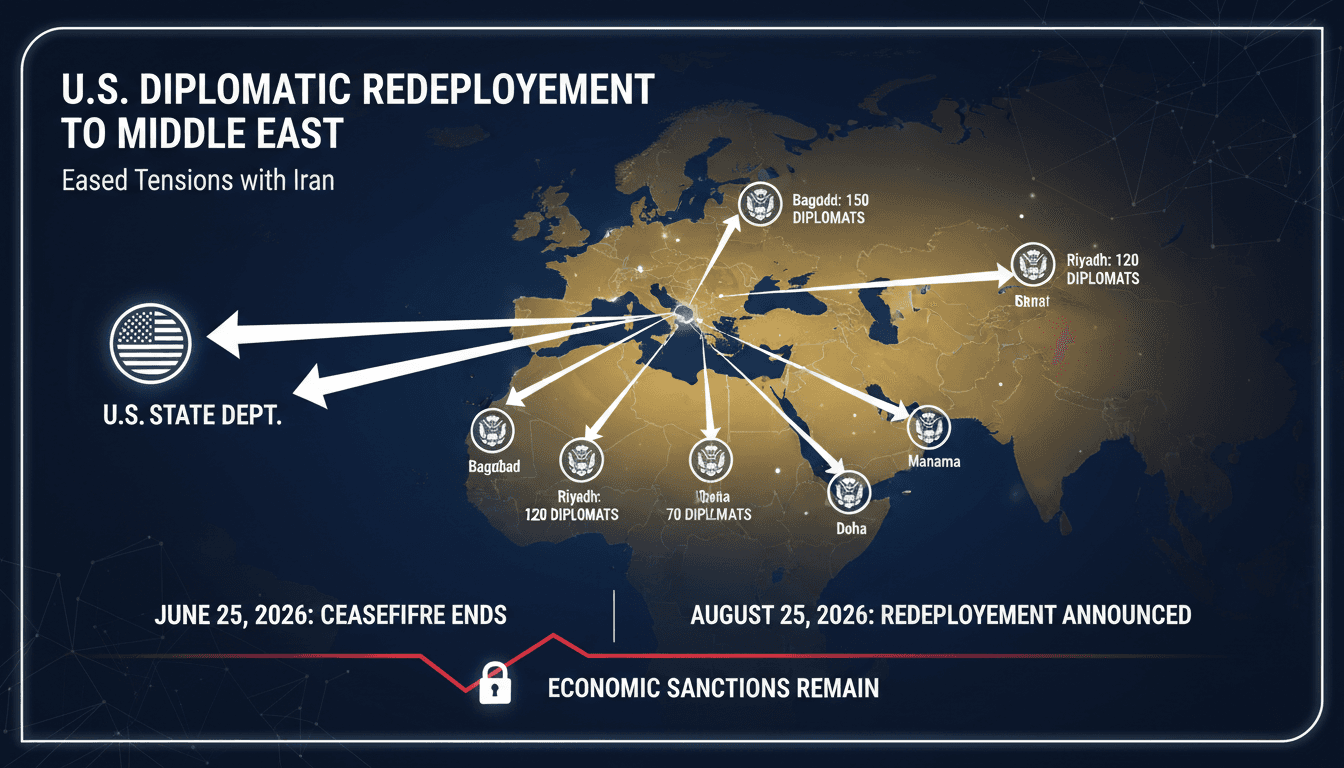
Here's what it means for you.
If you’re an American expatriate in the Middle East, this shift could impact your access to consular services and support.
Why it matters
This redeployment reflects a significant shift in U.S. foreign policy, indicating a potential easing of tensions in a historically volatile region.
What happened (in 30 seconds)
- On August 25, 2026, the U.S. State Department began preparations to redeploy diplomats to Middle East embassies previously evacuated due to conflict with Iran.
- The Trump administration anticipates reduced security risks, allowing for partial staffing restoration at embassies in eight countries.
- Despite stalled ceasefire talks, the move signals a strategic pivot towards economic isolation of Iran rather than military escalation.
The context you actually need
- The U.S.-Iran conflict escalated in early 2026, leading to evacuations of non-emergency personnel from multiple regional posts.
- A 60-day ceasefire expired just before the redeployment announcement, with negotiations for an extension currently stalled.
- Economic sanctions have been imposed as a primary tool of pressure against Iran, reflecting a shift in U.S. strategy.
What's really happening
The U.S. State Department's decision to redeploy diplomats to embassies in the Middle East marks a notable shift in the U.S. approach to its foreign policy in the region. Following the escalation of conflict with Iran, which began with joint U.S.-Israeli strikes in February 2026, the U.S. had evacuated non-emergency personnel and families from its embassies. This evacuation was a direct response to heightened security risks and the potential for full-scale hostilities.
As of August 25, 2026, the U.S. is preparing to restore partial staffing levels at embassies in key countries, including Saudi Arabia, Lebanon, and Israel. The initial focus is on the embassy in Lebanon, with staffing levels set to reach 85% in several Gulf states and 75% in Iraq and Kuwait. This redeployment reflects a reassessment of security risks, suggesting that the U.S. government believes the immediate threat of renewed conflict has diminished.
However, the situation remains fluid. While the redeployment indicates a belief that the conflict is winding down, it does not eliminate the possibility of future military actions against Iran. The Trump administration has emphasized economic isolation as a more effective strategy moving forward, which may lead to ongoing tensions even as diplomatic personnel return.
The implications of this redeployment extend beyond diplomatic circles. For American expatriates living in the region, particularly in Dubai, the restoration of embassy staff could mean improved access to consular services. However, family member restrictions remain in place, which may limit the support available to those living abroad. The U.S. Embassy in the UAE, which serves Dubai residents, is expected to restore staffing to 85%, but ongoing regional tensions could still impact the level of service provided.
Overall, this diplomatic redeployment is a calculated move by the U.S. to balance personnel safety with its policy objectives in the Middle East. While it signals a potential easing of tensions, the situation remains precarious, and the U.S. will continue to monitor developments closely.
Who feels it first (and how)
- American expatriates in the Middle East, particularly in Dubai, who rely on consular services.
- U.S. businesses operating in the region that may benefit from improved diplomatic relations.
- Regional governments that may experience shifts in U.S. foreign policy and economic engagement.
What to watch next
- Future ceasefire negotiations: The outcome of ongoing talks will indicate whether tensions will continue to ease or escalate.
- Economic sanctions updates: Any new sanctions imposed on Iran could signal a shift back towards a more aggressive U.S. stance.
- Diplomatic engagement levels: Increased diplomatic activity could suggest a long-term commitment to stability in the region.
The U.S. is redeploying diplomats to several Middle Eastern embassies.
The U.S. will continue to prioritize economic sanctions over military action against Iran.
The long-term implications of this redeployment on U.S.-Iran relations remain uncertain.
Frequently Asked Questions
- Why it matters?
- This redeployment reflects a significant shift in U.S. foreign policy, indicating a potential easing of tensions in a historically volatile region.
- What happened (in 30 seconds)?
- On August 25, 2026, the U.S. State Department began preparations to redeploy diplomats to Middle East embassies previously evacuated due to conflict with Iran. The Trump administration anticipates reduced security risks, allowing for partial staffing restoration at embassies in eight countries. Despite stalled ceasefire talks, the move signals a strategic pivot towards economic isolation of Iran rather than military escalation.
- What's really happening?
- The U.S. State Department's decision to redeploy diplomats to embassies in the Middle East marks a notable shift in the U.S. approach to its foreign policy in the region. Following the escalation of conflict with Iran, which began with joint U.S.-Israeli strikes in February 2026, the U.S. had evacuated non-emergency personnel and families from its embassies. This evacuation was a direct response to heightened security risks and the potential for full-scale hostilities. As of August 25, 2026, th
- Who feels it first (and how)?
- American expatriates in the Middle East, particularly in Dubai, who rely on consular services. U.S. businesses operating in the region that may benefit from improved diplomatic relations. Regional governments that may experience shifts in U.S. foreign policy and economic engagement.
- What to watch next?
- Future ceasefire negotiations: The outcome of ongoing talks will indicate whether tensions will continue to ease or escalate. Economic sanctions updates: Any new sanctions imposed on Iran could signal a shift back towards a more aggressive U.S. stance. Diplomatic engagement levels: Increased diplomatic activity could suggest a long-term commitment to stability in the region.
Arabic-language coverage of political affairs and current events.
"Okaz political coverage typically follows mainstream Saudi framing on national and regional affairs."
— A47 Editor
واشنطن تستعد لإعادة دبلوماسييها إلى المنطقة.. هل تقترب حرب إيران من النهاية؟
The U.S. State Department is preparing to return its diplomats to embassies in the Middle East after their evacuation during the conflict with Iran, indicating that the Trump administration does not anticipate a return to widespread hostilities. An i...
Pan-Arab news coverage spanning politics, business, sports, and regional affairs.
"Asharq Al-Awsat reflects a broad Arab editorial perspective with strong attention to regional geopolitics."
— A47 Editor
أميركا تستعد لإعادة دبلوماسيين للشرق الأوسط بعد إجلائهم بسبب الحرب
The U.S. State Department is preparing to return diplomats to embassies in the Middle East after their evacuation prior to the Iran conflict, as reported by The New York Times based on an internal document.
Arabic-language coverage of international news and geopolitics.
"RT Arabic is a Russian state-funded outlet often criticized for promoting Kremlin-aligned narratives."
— A47 Editor
بعد أشهر من الإجلاء.. واشنطن تستعد لإعادة دبلوماسييها إلى سفارات الشرق الأوسط
The New York Times reported that the U.S. State Department is preparing to return diplomats to its embassies in the Middle East, following their evacuation before and during the conflict with Iran. This move indicates a shift in U.S. foreign policy a...