
US Removes Syria from State Sponsors of Terrorism List
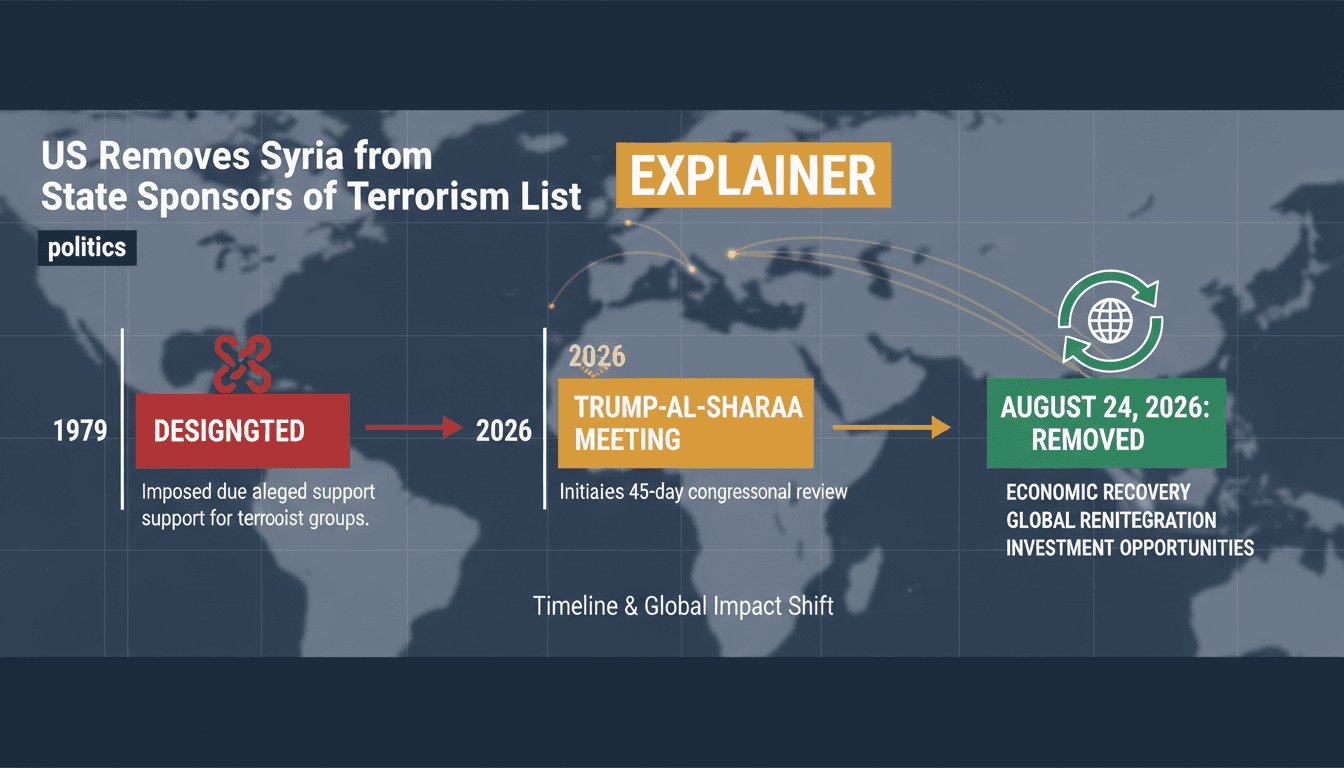
Here's what it means for you.
This shift opens new avenues for investment and economic recovery in Syria, impacting regional markets.
Why it matters
The removal of Syria from the state sponsors of terrorism list signals a potential shift in international relations and economic opportunities in the Middle East.
What happened (in 30 seconds)
- On August 24, 2026, the US officially removed Syria from its state sponsors of terrorism list, a designation that had been in place since 1979.
- Syrian President Ahmed al-Sharaa hailed the decision as a historic shift, emphasizing a new era for development and reconstruction.
- The move follows a 45-day congressional review after President Trump notified Congress of the intent to rescind the designation on July 8, 2026.
The context you actually need
- Syria was designated a state sponsor of terrorism in 1979 due to alleged support for militant groups, a classification that persisted through multiple administrations.
- The new Syrian government, led by al-Sharaa, has committed to counterterrorism efforts, which facilitated prior US actions, including the delisting of Hayat Tahrir al-Sham (HTS).
- This decision is seen as a critical step towards Syria's reintegration into the global economy, potentially attracting foreign investment and aiding in reconstruction efforts.
What's really happening
The removal of Syria from the US state sponsors of terrorism list marks a significant pivot in US-Syrian relations, reflecting broader geopolitical dynamics. For 47 years, Syria was burdened by this designation, which severely limited its ability to engage with international markets and attract foreign investment. The US government's decision to rescind this classification is rooted in a complex interplay of diplomatic negotiations and evolving security assessments.
President Trump’s notification to Congress on July 8, 2026, followed a meeting with President al-Sharaa in Ankara, indicating a willingness to engage with the new Syrian leadership. This engagement is not merely symbolic; it is tied to a series of commitments made by the Syrian government to counter terrorism and stabilize the region. The US State Department and Treasury's decision to delist HTS as a Specially Designated Global Terrorist organization further underscores this shift, suggesting a broader strategy to reshape the narrative around Syria's role in regional security.
The implications of this decision extend beyond diplomatic niceties. By removing the designation, the US is effectively signaling to international investors that Syria is open for business. This could lead to a surge in foreign direct investment, particularly in reconstruction projects, which are critical for Syria's economic recovery post-conflict. The Syrian government views this as a chance to rebuild its economy and reestablish its place in the international community.
Moreover, the delisting could have ripple effects throughout the region. Countries like the UAE, with vested interests in Syrian reconstruction, may find new opportunities for trade and investment. This could enhance regional stability, as economic recovery often correlates with reduced conflict potential. However, the success of this reintegration will depend on the Syrian government's ability to maintain its commitments to counterterrorism and foster a secure environment for investors.
Who feels it first (and how)
- Investors: Increased confidence in Syrian markets may lead to a surge in foreign investments, particularly in infrastructure and reconstruction.
- Regional businesses: Companies in the UAE and neighboring countries may find new opportunities in trade and investment corridors linked to Syria.
- Syrian citizens: The potential for economic recovery could improve living conditions and job opportunities for the Syrian populace.
What to watch next
- Foreign investment trends: Monitor the influx of foreign capital into Syria, as this will indicate the level of international confidence in the new government.
- Reconstruction projects: Keep an eye on major contracts awarded for rebuilding efforts, particularly those involving UAE firms, as they may signal broader economic recovery.
- Geopolitical developments: Watch for shifts in regional alliances and responses from other nations regarding Syria's reintegration into the global economy.
Syria has been removed from the US state sponsors of terrorism list, effective immediately.
Increased foreign investment and economic activity in Syria, particularly from regional players.
The long-term stability of the new Syrian government and its ability to maintain commitments to counterterrorism.
Frequently Asked Questions
- Why it matters?
- The removal of Syria from the state sponsors of terrorism list signals a potential shift in international relations and economic opportunities in the Middle East.
- What happened (in 30 seconds)?
- On August 24, 2026, the US officially removed Syria from its state sponsors of terrorism list, a designation that had been in place since 1979. Syrian President Ahmed al-Sharaa hailed the decision as a historic shift, emphasizing a new era for development and reconstruction. The move follows a 45-day congressional review after President Trump notified Congress of the intent to rescind the designation on July 8, 2026.
- What's really happening?
- The removal of Syria from the US state sponsors of terrorism list marks a significant pivot in US-Syrian relations, reflecting broader geopolitical dynamics. For 47 years, Syria was burdened by this designation, which severely limited its ability to engage with international markets and attract foreign investment. The US government's decision to rescind this classification is rooted in a complex interplay of diplomatic negotiations and evolving security assessments. President Trump’s notificati
- Who feels it first (and how)?
- Investors: Increased confidence in Syrian markets may lead to a surge in foreign investments, particularly in infrastructure and reconstruction. Regional businesses: Companies in the UAE and neighboring countries may find new opportunities in trade and investment corridors linked to Syria. Syrian citizens: The potential for economic recovery could improve living conditions and job opportunities for the Syrian populace.
- What to watch next?
- Foreign investment trends: Monitor the influx of foreign capital into Syria, as this will indicate the level of international confidence in the new government. Reconstruction projects: Keep an eye on major contracts awarded for rebuilding efforts, particularly those involving UAE firms, as they may signal broader economic recovery. Geopolitical developments: Watch for shifts in regional alliances and responses from other nations regarding Syria's reintegration into the global economy.
Algerian and regional news coverage.
"Echorouk is a major Algerian outlet with broad national reporting."
— A47 Editor
هذا ما قاله الشرع بعد رفع اسم سوريا من قائمة الإرهاب؟
Syrian President Ahmad al-Shara congratulated the Syrian people on the United States' decision to officially remove Syria from the list of state sponsors of terrorism. In a video message shared on his official account, al-Shara expressed his satisfac...
Regional and international reporting focused on Middle Eastern politics, diplomacy, and economics.
"Asharq Al-Awsat is a Saudi-owned international newspaper reflecting mainstream Gulf political perspectives."
— A47 Editor
Sharaa Says Syria 'Shakes Off Dark Stain' with Removal from US Terror List
The United States has officially removed Syria from its list of state sponsors of terrorism, a designation that had been in place for 47 years. This significant policy shift was announced on August 24, 2026, by U.S. Secretary of State Marco Rubio, fo...
Comprehensive coverage of Middle Eastern and global issues.
"Al Jazeera is a prominent voice from the Global South, especially the Middle East, with an emphasis on underreported stories."
— A47 Editor
Syrian president thanks nation for getting off US state terror list
Syrian President Ahmed al-Sharaa expressed gratitude towards the nation following Syria's removal from the U.S. list of state sponsors of terrorism, marking a significant shift in U.S. foreign policy. This decision was officially announced on August ...