
United States Removes Syria from State Sponsors of Terrorism List
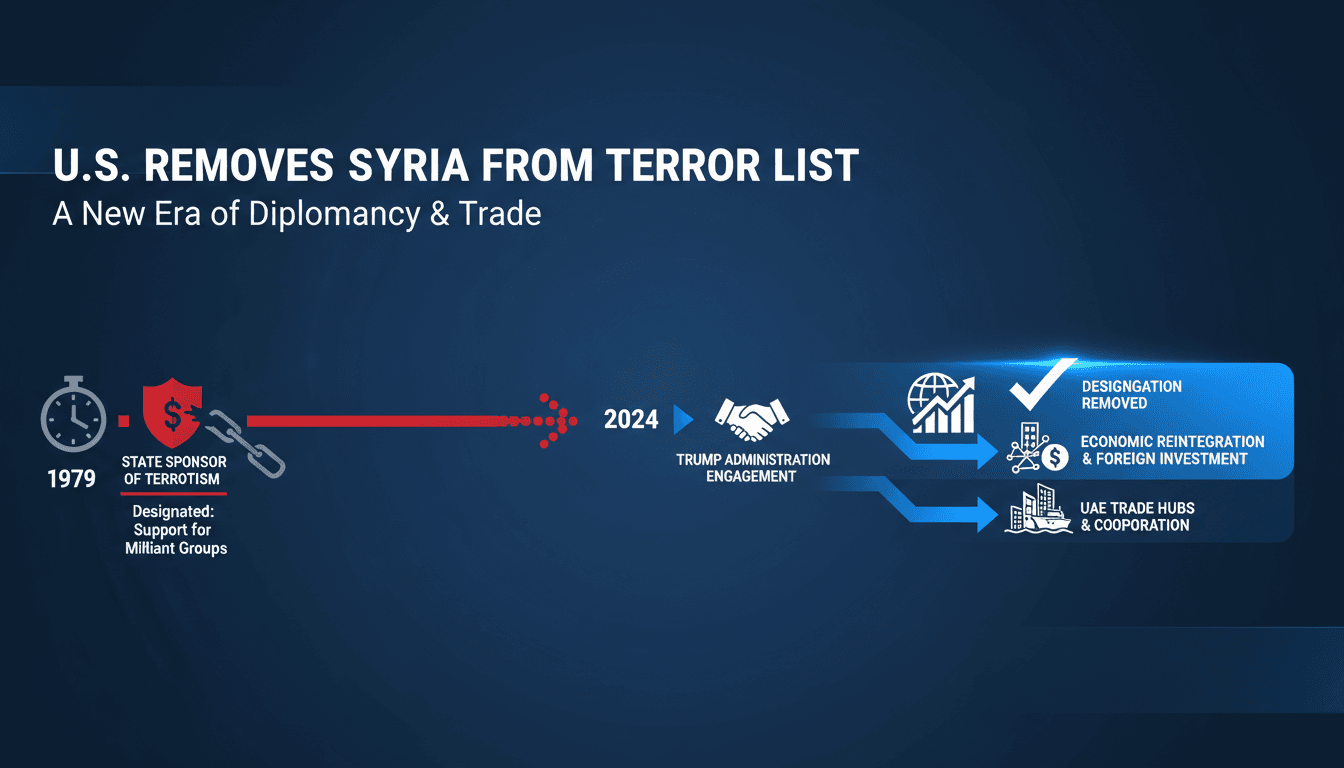
Here's what it means for you.
If you’re involved in international business or investment, this shift could open new opportunities in the Syrian market.
Why it matters
This decision signals a potential thaw in U.S.-Syria relations, which could reshape regional economic dynamics.
What happened (in 30 seconds)
- On August 25, 2026, the U.S. removed Syria from its state sponsors of terrorism list after 47 years.
- Syrian President Ahmed al-Sharaa hailed the decision as a historic shift towards development and reconstruction.
- Hay'at Tahrir al-Sham (HTS) was also delisted, leaving only Cuba, Iran, and North Korea on the list.
The context you actually need
- Syria was designated a state sponsor of terrorism since 1979 due to its support for militant groups under the Assad regime.
- The transitional government led by al-Sharaa has pursued counterterrorism cooperation and joined the Global Coalition to Defeat ISIS.
- The Trump administration initiated the delisting process in July 2026 after meetings between Trump and al-Sharaa, reflecting a shift in U.S. foreign policy.
What's really happening
The removal of Syria from the U.S. state sponsors of terrorism list marks a significant pivot in U.S. foreign policy, particularly under the Trump administration. This decision follows the ousting of Bashar al-Assad in December 2024, which created a power vacuum that the new transitional government, led by President Ahmed al-Sharaa, has sought to fill with a focus on reconstruction and economic development.
The U.S. Treasury Department's decision to delist Syria and HTS is rooted in the new government's commitments to counterterrorism and its willingness to engage with the international community. By removing the designation, the U.S. is signaling its readiness to support Syria's reintegration into the global economy, which has been largely isolated due to decades of sanctions and conflict.
This shift is not merely symbolic; it has tangible implications for investment and trade. U.S. officials, including Secretary of State Marco Rubio and Treasury Secretary Scott Bessent, have emphasized the potential for increased private investment in Syria, which could lead to economic recovery and stability in the region. The Syrian government has expressed optimism about attracting foreign investment, particularly in reconstruction projects, which could revitalize its war-torn economy.
Moreover, the delisting could facilitate increased Syrian investment flows and trade through regional hubs like Dubai. This is particularly relevant for the large Syrian expatriate community in the UAE, which may benefit from improved financial connectivity and remittance channels. The expectation is that as Syria opens up, it will create new business opportunities, not just for Syrians but also for international investors looking to capitalize on the reconstruction efforts.
However, the decision is not without its complexities. While it opens doors for economic engagement, it also raises questions about the long-term stability of the new government and its ability to maintain control over various factions within Syria. The international community will be watching closely to see how the situation evolves and whether the new government can deliver on its promises of reform and stability.
Who feels it first (and how)
- Investors: Those looking for opportunities in emerging markets may find Syria appealing for reconstruction projects.
- Syrian expatriates: Individuals in the UAE and elsewhere may benefit from improved financial channels and investment opportunities back home.
- Regional businesses: Companies in neighboring countries may see increased trade opportunities as Syria reopens its markets.
What to watch next
- Investment flows: Monitor the level of foreign investment in Syria, as this will indicate the success of the delisting in attracting capital.
- Economic indicators: Keep an eye on Syria's GDP growth and employment rates as signs of economic recovery.
- Political stability: Watch for any signs of unrest or challenges to the al-Sharaa government, which could impact the trajectory of U.S.-Syria relations.
Syria has been removed from the U.S. state sponsors of terrorism list.
Increased foreign investment and economic activity in Syria as a result of the delisting.
The long-term stability of the al-Sharaa government and its ability to maintain control over the country.
Frequently Asked Questions
- Why it matters?
- This decision signals a potential thaw in U.S.-Syria relations, which could reshape regional economic dynamics.
- What happened (in 30 seconds)?
- On August 25, 2026, the U.S. removed Syria from its state sponsors of terrorism list after 47 years. Syrian President Ahmed al-Sharaa hailed the decision as a historic shift towards development and reconstruction. Hay'at Tahrir al-Sham (HTS) was also delisted, leaving only Cuba, Iran, and North Korea on the list.
- What's really happening?
- The removal of Syria from the U.S. state sponsors of terrorism list marks a significant pivot in U.S. foreign policy, particularly under the Trump administration. This decision follows the ousting of Bashar al-Assad in December 2024, which created a power vacuum that the new transitional government, led by President Ahmed al-Sharaa, has sought to fill with a focus on reconstruction and economic development. The U.S. Treasury Department's decision to delist Syria and HTS is rooted in the new go
- Who feels it first (and how)?
- Investors: Those looking for opportunities in emerging markets may find Syria appealing for reconstruction projects. Syrian expatriates: Individuals in the UAE and elsewhere may benefit from improved financial channels and investment opportunities back home. Regional businesses: Companies in neighboring countries may see increased trade opportunities as Syria reopens its markets.
- What to watch next?
- Investment flows: Monitor the level of foreign investment in Syria, as this will indicate the success of the delisting in attracting capital. Economic indicators: Keep an eye on Syria's GDP growth and employment rates as signs of economic recovery. Political stability: Watch for any signs of unrest or challenges to the al-Sharaa government, which could impact the trajectory of U.S.-Syria relations.
Pan-Arab news coverage spanning politics, business, sports, and regional affairs.
"Asharq Al-Awsat reflects a broad Arab editorial perspective with strong attention to regional geopolitics."
— A47 Editor
الشرع: سوريا «تمزِّق صفحة من ماضيها الأليم» بإزالتها من قائمة الدول الراعية للإرهاب
President Ahmad al-Shara stated that Syria is shedding a dark chapter from its past by being removed from the list of state sponsors of terrorism, marking a significant step towards development and reconstruction.
Arabic-language political and world news coverage for UAE readers.
"Emarat Al Youm world coverage usually presents international developments through a UAE and Arab audience lens."
— A47 Editor
الشرع: سورية "تمزّق صفحة من ماضيها الأليم" بإزالتها من قائمة الدول الراعية للإرهاب الشرع: سورية "تمزّق صفحة من ماضيها الأليم" بإزالتها من قائمة الدول الراعية للإرهاب
Syrian President Ahmad al-Shara stated that the country is turning a page on its painful past following the United States' decision to remove Syria from the list of state sponsors of terrorism. This development marks a significant shift in Syria's in...
Arabic-language coverage of international news and geopolitics.
"RT Arabic is a Russian state-funded outlet often criticized for promoting Kremlin-aligned narratives."
— A47 Editor
"فعلتموها مجددا".. الشرع يهنئ الشعب السوري بقرار إزالة اسم سوريا من قائمة الدول الراعية للإرهاب
Syrian President Ahmad al-Shara congratulated the Syrian people on the official removal of Syria from the list of state sponsors of terrorism, a decision announced early Tuesday. This development marks a significant shift in Syria's international sta...
Arabic-language coverage of political affairs and current events.
"Okaz political coverage typically follows mainstream Saudi framing on national and regional affairs."
— A47 Editor
الشرع يهنئ الشعب بإزالة اسم سورية من قائمة الدول الراعية للإرهاب
Syrian President Ahmad al-Shara congratulated the Syrian people on the official removal of Syria from the list of state sponsors of terrorism, thanking U.S. President Donald Trump and allies for their support. He emphasized that this marks a new begi...