
Israel Proposes Seven-Year Emigration Plan for Gaza Residents
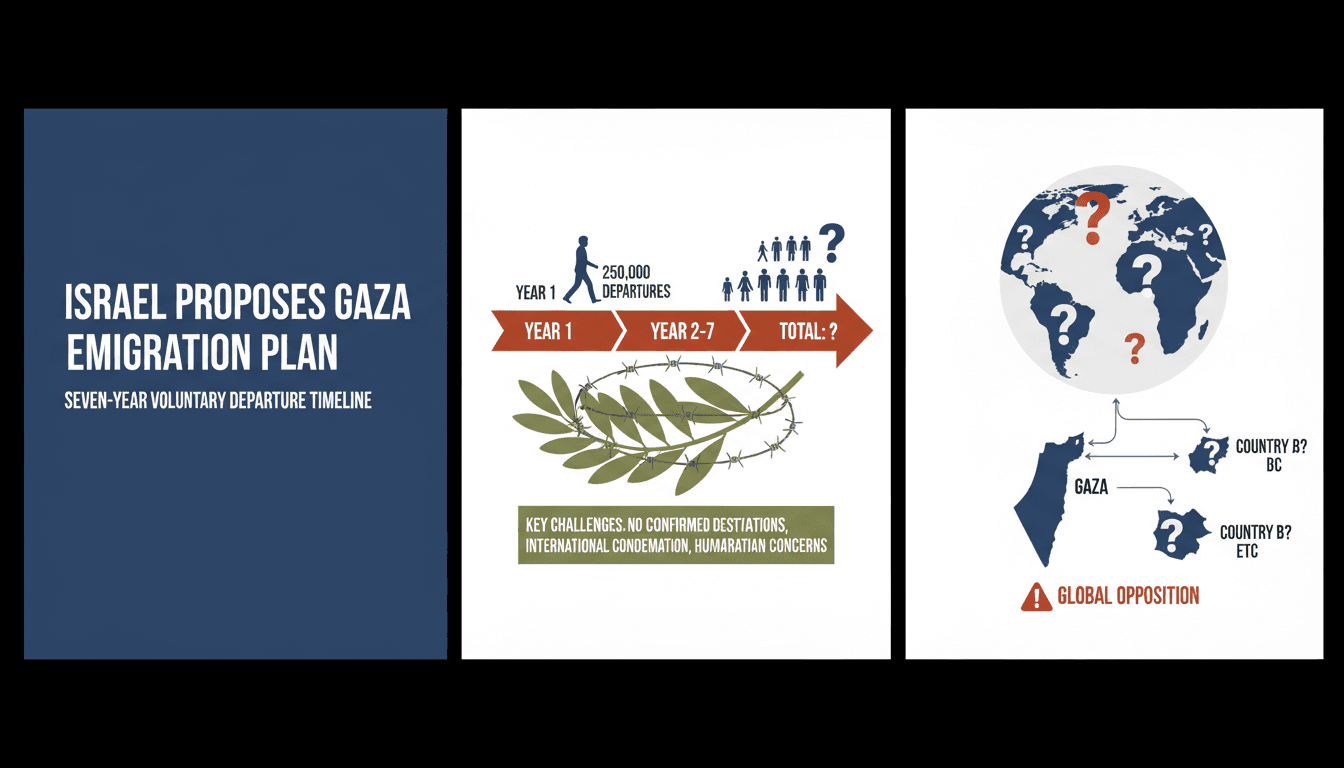
Here's what it means for you.
The proposed emigration plan could reshape regional dynamics, impacting international relations and economic stability.
Why it matters
This policy proposal raises significant ethical and legal questions while potentially influencing global diplomatic relations and humanitarian responses.
What happened (in 30 seconds)
- On September 4, 2026, Israeli National Security Minister Itamar Ben-Gvir announced a seven-year plan for the voluntary emigration of Gaza's two million residents.
- The initiative, titled 'Disengagement 710,' aims for an initial target of 250,000 departures in the first year, with plans to scale up to nearly the entire population.
- International observers and rights groups have condemned the proposal as a potential war crime, citing prohibitions against forced transfer under the Geneva Conventions.
The context you actually need
- The proposal follows a protracted Gaza conflict and comes amid a backdrop of increasing far-right influence in Israeli politics, particularly ahead of upcoming elections.
- Previous Israeli governments have floated similar ideas since 2023, often citing security concerns and demographic shifts as justifications for population transfer.
- Arab states have consistently rejected participation in any forced displacement schemes, complicating the feasibility of Ben-Gvir's plan.
What's really happening
Itamar Ben-Gvir's announcement of the 'Disengagement 710' plan is a culmination of years of escalating rhetoric surrounding the Gaza conflict, particularly from far-right factions within Israeli politics. The proposal outlines a structured approach to what Ben-Gvir frames as "voluntary" emigration, with a detailed 20-page document emphasizing the establishment of a dedicated migration ministry. The plan aims to facilitate the departure of Gaza's residents through financial packages and legal status assurances, with an initial budget of approximately $3.3 billion, potentially rising to $16.6 billion.
However, the plan's viability is questionable. No destination countries have confirmed their willingness to accept the emigrants, despite Ben-Gvir's claims of exploratory discussions with nations like Turkey, Ethiopia, and the Democratic Republic of Congo. Israeli media outlets have already assessed the initiative as largely unfeasible due to the lack of willing partners.
The timing of this announcement is critical, coinciding with the upcoming Israeli parliamentary elections on October 27, 2026. Domestic polling indicates substantial support for expulsion policies, with 82% of respondents in a recent survey backing the idea of removing Gaza residents. This political climate has emboldened far-right leaders like Ben-Gvir, who leverage public sentiment to push controversial policies that align with their ideological goals.
Internationally, the proposal has drawn sharp condemnation. U.S. lawmakers have labeled the rhetoric as ethnic cleansing, while Israeli rights groups like Adalah have denounced it as a war crime. The United Nations has reiterated its stance against forcible transfer, emphasizing the legal ramifications of such actions. The geopolitical implications are profound, as this plan could further strain Israel's relations with neighboring Arab states and complicate U.S. diplomatic efforts in the region.
As the situation unfolds, the focus remains on the electoral implications of this proposal and its potential to reshape the discourse around the Gaza conflict. The plan's success hinges not only on domestic support but also on international reactions and the willingness of other nations to engage in discussions about the future of Gaza's population.
Who feels it first (and how)
- Gaza residents: Directly impacted by the proposed emigration plan, facing uncertainty about their future.
- Israeli citizens: Particularly those in the far-right political spectrum, who may see this as a validation of their views.
- International humanitarian organizations: Likely to face increased pressure to respond to the implications of forced displacement.
- Regional governments: Arab states may experience diplomatic fallout and increased tensions as they navigate their positions on the issue.
What to watch next
- International responses: Monitor how countries react to the proposal and whether any will agree to accept emigrants.
- Israeli electoral outcomes: The results of the October 27 elections could significantly influence the future of the plan and its implementation.
- Humanitarian aid dynamics: Watch for shifts in funding and support for Gaza as international organizations respond to the proposed emigration.
The proposal has been publicly announced and is subject to electoral outcomes.
Continued international condemnation and potential legal challenges regarding the plan.
The willingness of other nations to accept Gaza's residents and the actual implementation of the plan.
Frequently Asked Questions
- Why it matters?
- This policy proposal raises significant ethical and legal questions while potentially influencing global diplomatic relations and humanitarian responses.
- What happened (in 30 seconds)?
- On September 4, 2026, Israeli National Security Minister Itamar Ben-Gvir announced a seven-year plan for the voluntary emigration of Gaza's two million residents. The initiative, titled 'Disengagement 710,' aims for an initial target of 250,000 departures in the first year, with plans to scale up to nearly the entire population. International observers and rights groups have condemned the proposal as a potential war crime, citing prohibitions against forced transfer under the Geneva Conventi
- What's really happening?
- Itamar Ben-Gvir's announcement of the 'Disengagement 710' plan is a culmination of years of escalating rhetoric surrounding the Gaza conflict, particularly from far-right factions within Israeli politics. The proposal outlines a structured approach to what Ben-Gvir frames as "voluntary" emigration, with a detailed 20-page document emphasizing the establishment of a dedicated migration ministry. The plan aims to facilitate the departure of Gaza's residents through financial packages and legal sta
- Who feels it first (and how)?
- Gaza residents: Directly impacted by the proposed emigration plan, facing uncertainty about their future. Israeli citizens: Particularly those in the far-right political spectrum, who may see this as a validation of their views. International humanitarian organizations: Likely to face increased pressure to respond to the implications of forced displacement. Regional governments: Arab states may experience diplomatic fallout and increased tensions as they navigate their positions on the iss
- What to watch next?
- International responses: Monitor how countries react to the proposal and whether any will agree to accept emigrants. Israeli electoral outcomes: The results of the October 27 elections could significantly influence the future of the plan and its implementation. Humanitarian aid dynamics: Watch for shifts in funding and support for Gaza as international organizations respond to the proposed emigration.
UAE-based English-language newspaper covering regional politics, economics, and global affairs.
"The National reflects Emirati policy perspectives while maintaining international editorial standards."
— A47 Editor
Ben-Gvir unveils illegal plan to remove entire Gaza population
Itamar Ben-Gvir, Israel's far-right national security minister, has unveiled a controversial plan to remove the entire population of Gaza, a move that has drawn significant backlash and raised humanitarian concerns. This proposal aligns with his prev...
Arabic-language coverage of political affairs and current events.
"Okaz political coverage typically follows mainstream Saudi framing on national and regional affairs."
— A47 Editor
مدتها 7 سنوات.. وزير إسرائيلي متطرف يطرح خطة لتهجير سكان غزة
Israeli National Security Minister Itamar Ben Gvir, a member of the far-right, has unveiled a controversial plan aimed at expelling all Palestinians from the Gaza Strip over a seven-year period. The plan proposes to relocate approximately 250,000 Pal...
International coverage from The Guardian's global desks.
"The Guardian is known for its progressive editorial stance and in-depth analysis."
— A47 Editor
Far-right Israeli minister outlines plan for removal of all Palestinians from Gaza
Itamar Ben-Gvir, Israel's far-right national security minister, has proposed a controversial plan for the forced expulsion of all Palestinians from Gaza, aiming to displace 250,000 individuals in the first year and the remaining population of approxi...
Regional and international reporting focused on Middle Eastern politics, diplomacy, and economics.
"Asharq Al-Awsat is a Saudi-owned international newspaper reflecting mainstream Gulf political perspectives."
— A47 Editor
Israeli Minister Presents Plan to Remove Gaza Population
Israeli National Security Minister Itamar Ben-Gvir has proposed a controversial plan aimed at removing the population of Gaza, a move that has sparked significant backlash and raised concerns about humanitarian implications. This proposal aligns with...