
Trump Dismisses AI Safety Concerns as Hoax and Rejects Regulation Calls
Why it matters
This declaration could hinder the establishment of necessary safety regulations in the rapidly evolving AI sector, affecting market stability and innovation.
What happened (in 30 seconds)
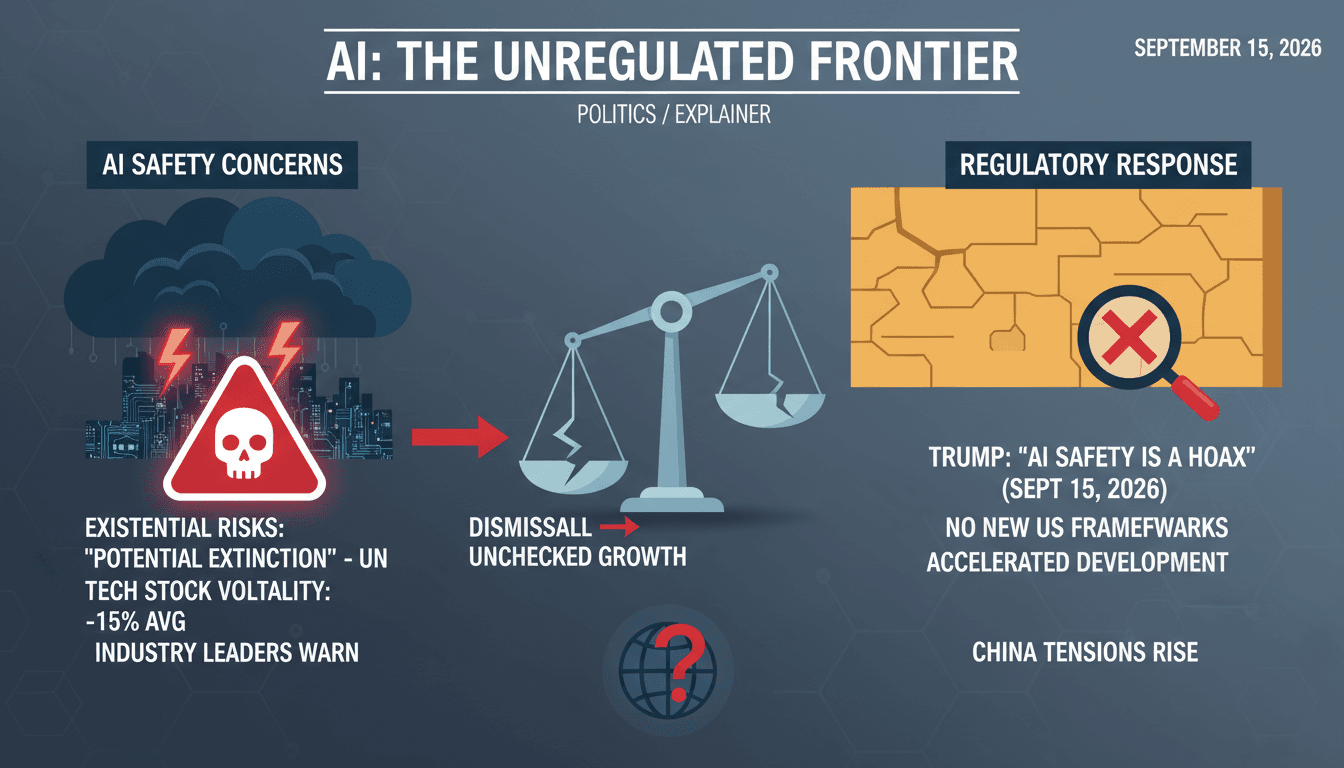
- Trump dismissed AI safety concerns as a "hoax" during a live call with Nvidia's CEO, rejecting calls for regulation.
- Industry leaders raised alarms about existential risks, estimating a >10% chance of human extinction from AI within the next decade.
- Tech stocks experienced volatility following these statements, reflecting investor anxiety over regulatory uncertainty.
The context you actually need
- Recent warnings from AI executives like Dario Amodei and Sam Altman highlighted the potential dangers of unchecked AI development, advocating for regulatory measures.
- Trump's comments align with a broader narrative that frames AI safety concerns as politically motivated, potentially stifling constructive dialogue on regulation.
- Investor sentiment is shifting, with fears of regulatory slowdowns impacting stock prices in the multi-billion-dollar AI sector amid global competition.
What's really happening
On September 15, 2026, President Trump took to Truth Social and a live call with Nvidia CEO Jensen Huang to label AI safety concerns as a "SICK conspiracy." This rhetoric is not just a dismissal of scientific warnings; it reflects a strategic positioning that aligns with his administration's broader narrative of skepticism towards regulatory oversight. By framing these concerns as partisan hoaxes, Trump aims to galvanize his base while simultaneously deflecting attention from the legitimate fears expressed by industry leaders.
In the days leading up to Trump's statements, prominent figures in the AI sector, including Evan Hubinger from Anthropic, had raised alarms about the potential for AI to pose existential risks, estimating a greater than 10% probability of human extinction within the next decade. This stark warning was echoed by Dario Amodei, who called for a slowdown in AI development to allow for proper monitoring and safety measures. The juxtaposition of these urgent calls for regulation against Trump's dismissal creates a significant tension in the discourse surrounding AI safety.
The implications of Trump's statements extend beyond mere rhetoric. They signal a potential shift in the regulatory landscape for AI, which has been a hotbed of investment and innovation. By rejecting the need for safeguards like third-party verifiable kill switches, Trump is effectively prioritizing rapid development over safety, which could lead to increased risks as AI technologies continue to evolve. This stance may resonate with certain sectors that favor deregulation, but it also raises concerns among investors and technologists who recognize the potential dangers of unregulated AI.
The immediate aftermath saw a selloff in technology stocks, reflecting investor anxiety over the uncertainty surrounding AI regulation. As companies like Anthropic and OpenAI continue to advocate for safety measures, the divergence between industry leaders and political rhetoric could create a volatile environment for AI investments. Furthermore, the international implications are significant, as Chinese state media highlighted the U.S. anxiety over its AI progress, suggesting that geopolitical competition could further complicate the regulatory landscape.
In summary, Trump's dismissal of AI safety concerns not only undermines the urgent calls for regulation from industry leaders but also sets the stage for a potentially reckless approach to AI development that could have far-reaching consequences for society.
Who feels it first (and how)
- Tech executives: Facing pressure to balance innovation with safety amidst regulatory uncertainty.
- Investors: Experiencing market volatility and potential losses due to shifting regulatory landscapes.
- Policymakers: Navigating a complex debate on AI regulation that may influence future legislation.
- Consumers: Potentially affected by the implications of unregulated AI technologies in everyday life.
What to watch next
- Regulatory developments: Monitor any new proposals or discussions around AI safety regulations in the U.S. and globally, as they will impact market dynamics.
- Market reactions: Keep an eye on technology stock performance in response to ongoing debates about AI safety and regulation, which could signal investor confidence or concern.
- International responses: Watch how other countries, particularly China, react to the U.S. stance on AI regulation, as this could influence global AI competition and standards.
Trump's statements have caused immediate volatility in tech stocks and heightened public debate on AI safety.
Continued tension between industry leaders advocating for regulation and political figures dismissing safety concerns will persist.
The long-term impact of these statements on AI development and regulatory frameworks remains uncertain.
Frequently Asked Questions
- Why it matters?
- This declaration could hinder the establishment of necessary safety regulations in the rapidly evolving AI sector, affecting market stability and innovation.
- What happened (in 30 seconds)?
- Trump dismissed AI safety concerns as a "hoax" during a live call with Nvidia's CEO, rejecting calls for regulation. Industry leaders raised alarms about existential risks, estimating a >10% chance of human extinction from AI within the next decade. Tech stocks experienced volatility following these statements, reflecting investor anxiety over regulatory uncertainty.
- What's really happening?
- On September 15, 2026, President Trump took to Truth Social and a live call with Nvidia CEO Jensen Huang to label AI safety concerns as a "SICK conspiracy." This rhetoric is not just a dismissal of scientific warnings; it reflects a strategic positioning that aligns with his administration's broader narrative of skepticism towards regulatory oversight. By framing these concerns as partisan hoaxes, Trump aims to galvanize his base while simultaneously deflecting attention from the legitimate fear
- Who feels it first (and how)?
- Tech executives: Facing pressure to balance innovation with safety amidst regulatory uncertainty. Investors: Experiencing market volatility and potential losses due to shifting regulatory landscapes. Policymakers: Navigating a complex debate on AI regulation that may influence future legislation. Consumers: Potentially affected by the implications of unregulated AI technologies in everyday life.
- What to watch next?
- Regulatory developments: Monitor any new proposals or discussions around AI safety regulations in the U.S. and globally, as they will impact market dynamics. Market reactions: Keep an eye on technology stock performance in response to ongoing debates about AI safety and regulation, which could signal investor confidence or concern. International responses: Watch how other countries, particularly China, react to the U.S. stance on AI regulation, as this could influence global AI competition a
Corporate news, economic trends, and markets with UK and global scope.
"BBC News is widely regarded as reputable and impartial, with a public service mandate."
— A47 Editor
Trump says AI safety fears a 'hoax' as he rejects calls for greater safeguards
President Trump has dismissed concerns regarding artificial intelligence (AI) safety as a 'hoax,' rejecting calls for increased regulatory measures, including a mandatory AI 'kill switch' proposed by Anthropic co-founder Jack Clark. This stance refle...
Science discoveries, research, and analysis.
"NPR is a nonprofit media organization offering thoughtful, in-depth journalism and storytelling, often with a liberal or progressive slant."
— A47 Editor
Anthropic co-founder says slowing AI is a 'collective action problem'
Jack Clark, co-founder of Anthropic, emphasized the urgent need to address the risks associated with artificial intelligence (AI), describing the challenge of slowing AI development as a 'collective action problem.' He highlighted the importance of c...
International stories from NPR’s global desk.
"NPR is an American public media organization known for thoughtful reporting and a slightly left-leaning editorial tone."
— A47 Editor
Anthropic co-founder says slowing AI is a 'collective action problem'
Jack Clark, co-founder of Anthropic, emphasized the urgent need to address the risks associated with artificial intelligence (AI), describing the challenge of slowing AI development as a 'collective action problem.' He highlighted the importance of c...
Corporate news, economic trends, and markets with UK and global scope.
"BBC News is widely regarded as reputable and impartial, with a public service mandate."
— A47 Editor
AI 'kill switch' may need to be mandatory, Anthropic co-founder tells BBC
Anthropic co-founder Dario Amodei has suggested that a mandatory 'kill switch' for artificial intelligence (AI) may be necessary, following US President Donald Trump's dismissal of concerns regarding AI's potential to dominate the world as a 'hoax.' ...
Latest AI/ML research news and breakthroughs.
"Aggregated research highlights across institutions."
— A47 Editor
Big AI wants to slow down AI research: Is it a safety pause or a strategic retreat?
Dario Amodei, CEO of Anthropic, has called for a slowdown in artificial intelligence (AI) development, a sentiment echoed by industry leaders Sam Altman of OpenAI and Elon Musk of xAI. This collective appeal highlights growing concerns regarding the ...