
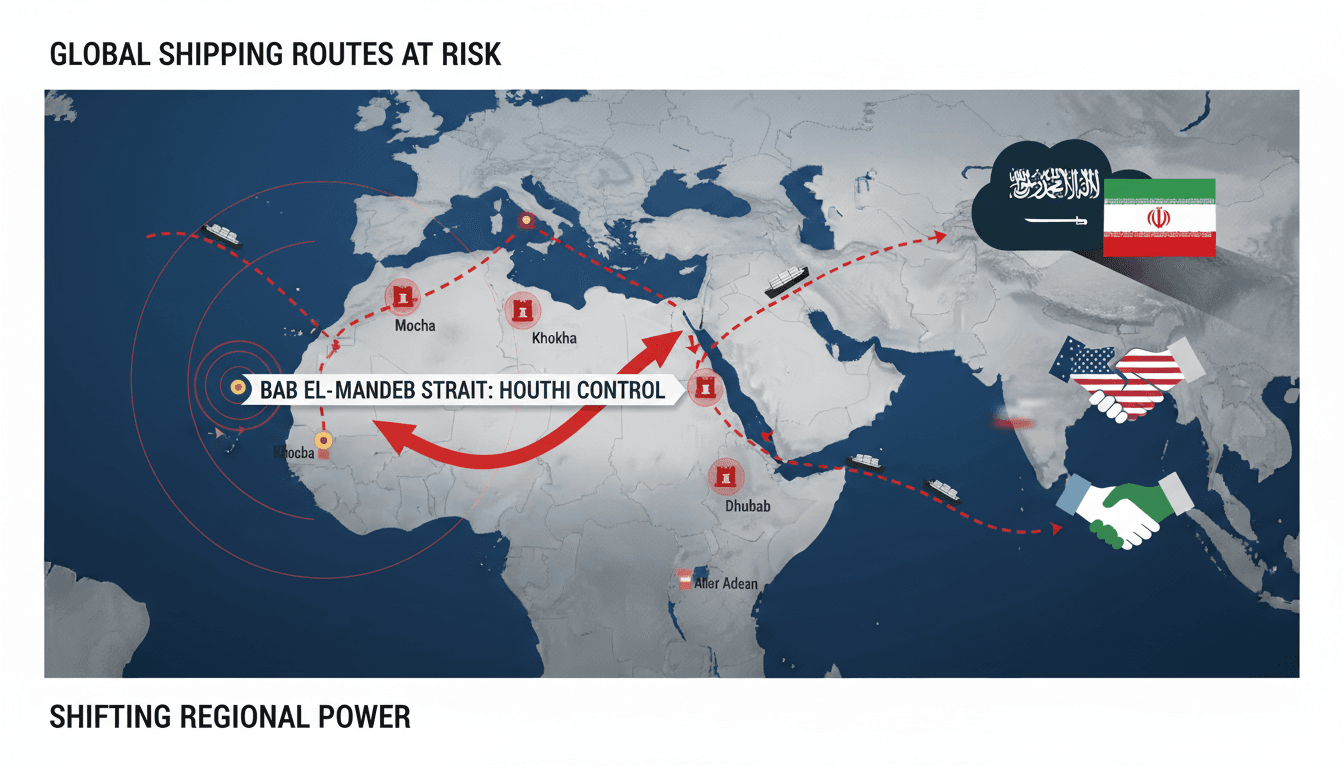
Houthi Forces Capture Strategic Positions in Bab el-Mandeb Strait
Why it matters
This military escalation threatens the stability of critical maritime routes, influencing global oil prices and economic conditions.
What happened (in 30 seconds)
- Houthi forces captured key positions along Yemen's Red Sea coast, including the port of Mokha and Perim Island, in mid-September 2026.
- Saudi-backed Yemeni forces collapsed with minimal resistance, abandoning advanced weaponry amid the offensive.
- Iran's influence grows as the Houthis launch retaliatory strikes on Saudi targets, prompting Saudi Arabia to seek new military partnerships.
The context you actually need
- U.S.-Iran conflict: The ongoing war has already disrupted shipping through the Strait of Hormuz, affecting oil exports.
- Saudi intervention setbacks: Previous military efforts in Yemen faced challenges, including coordination issues after the Emirati withdrawal.
- Houthi capabilities underestimated: Saudi Arabia and its allies misjudged the strength and resolve of Houthi forces, leading to significant territorial losses.
What's really happening
In mid-September 2026, Houthi forces executed a rapid military offensive along Yemen's western Red Sea coast, capturing strategic locations that overlook the Bab el-Mandeb Strait. This strait is a crucial maritime chokepoint for global shipping, particularly for oil exports. The Houthis, estimated to number around 100,000 fighters, launched their advance with surprising speed, overwhelming Saudi-backed Yemeni forces that had been weakened by internal divisions and a lack of coordination. The collapse of these forces was stark, as they abandoned advanced weaponry supplied by the U.S. and Saudi Arabia, revealing significant intelligence and operational failures on the part of Saudi Arabia.
Following the territorial gains, the Houthis escalated their campaign by launching drone and missile strikes on key Saudi targets, including Yanbu port and Khamis Mushait airbase. These attacks prompted Saudi Arabia to issue security alerts and conduct over 50 airstrikes in retaliation. The situation has forced Saudi Crown Prince Mohammed bin Salman to seek military cooperation with Egypt, indicating a shift in regional alliances as the kingdom grapples with its vulnerabilities.
The backdrop of this offensive is a broader U.S.-Iran conflict that began in February 2026, which has already disrupted shipping through the Strait of Hormuz. This conflict has forced Saudi Arabia to reroute oil exports through the Red Sea, increasing the stakes for the kingdom as it faces both military and economic pressures. The Houthi advance not only enhances Iran's leverage over critical maritime chokepoints but also raises questions about the effectiveness of U.S. military support in the region, as Western powers have declined direct intervention.
As the Houthis gain momentum, the implications for Saudi Arabia are profound. The kingdom finds itself at a crossroads, facing the dual pressures of consolidating its military position while avoiding further escalation that could lead to broader regional conflict. Analysts note that Saudi Arabia's options are narrowing, caught between the risks of consolidation and the dangers of escalation.
Who feels it first (and how)
- Saudi Arabia: Increased military pressure and potential economic instability due to rising oil prices.
- Global energy markets: Fluctuations in oil prices above $100 per barrel could affect costs for consumers and businesses worldwide.
- Expatriates in Dubai: Potential disruptions in shipping lanes may impact economic stability and job security for expatriates reliant on global trade.
What to watch next
- Oil prices: Monitor fluctuations as regional tensions could push prices higher, impacting global markets.
- Saudi diplomatic efforts: Watch for new partnerships or military alliances as Saudi Arabia seeks to bolster its position.
- Houthi military capabilities: Assess the ongoing developments in Houthi strength and strategy, which could influence future conflicts in the region.
Houthi forces have captured significant territory along the Red Sea coast.
Saudi Arabia will seek new military partnerships to counter Houthi advances.
The long-term implications for U.S. involvement in the region and its impact on global energy markets.
Frequently Asked Questions
- Why it matters?
- This military escalation threatens the stability of critical maritime routes, influencing global oil prices and economic conditions.
- What happened (in 30 seconds)?
- Houthi forces captured key positions along Yemen's Red Sea coast, including the port of Mokha and Perim Island, in mid-September 2026. Saudi-backed Yemeni forces collapsed with minimal resistance, abandoning advanced weaponry amid the offensive. Iran's influence grows as the Houthis launch retaliatory strikes on Saudi targets, prompting Saudi Arabia to seek new military partnerships.
- What's really happening?
- In mid-September 2026, Houthi forces executed a rapid military offensive along Yemen's western Red Sea coast, capturing strategic locations that overlook the Bab el-Mandeb Strait. This strait is a crucial maritime chokepoint for global shipping, particularly for oil exports. The Houthis, estimated to number around 100,000 fighters, launched their advance with surprising speed, overwhelming Saudi-backed Yemeni forces that had been weakened by internal divisions and a lack of coordination. The col
- Who feels it first (and how)?
- Saudi Arabia: Increased military pressure and potential economic instability due to rising oil prices. Global energy markets: Fluctuations in oil prices above $100 per barrel could affect costs for consumers and businesses worldwide. Expatriates in Dubai: Potential disruptions in shipping lanes may impact economic stability and job security for expatriates reliant on global trade.
- What to watch next?
- Oil prices: Monitor fluctuations as regional tensions could push prices higher, impacting global markets. Saudi diplomatic efforts: Watch for new partnerships or military alliances as Saudi Arabia seeks to bolster its position. Houthi military capabilities: Assess the ongoing developments in Houthi strength and strategy, which could influence future conflicts in the region.
Regional coverage and analysis focused on politics, diplomacy, and business across the Middle East.
"Al-Monitor is known for analytical reporting on Middle East politics and policy developments."
— A47 Editor
Houthi blitz leaves Saudi Arabia exposed, Iran emboldened
The Houthi rebels have made significant military advances in Yemen, capturing strategic locations around the Bab el-Mandeb Strait, including the port city of Mocha and the island of Perim. This escalation has exposed Saudi Arabia to its most severe s...
English-language reporting on Saudi politics, policy, and society.
"Saudi Gazette reflects mainstream Saudi institutional perspectives."
— A47 Editor
Saudi Arabia warns Houthi Attacks threaten Red Sea navigation and Global Trade
Saudi Arabia has issued a warning regarding Houthi threats to maritime navigation in the Red Sea and Bab Al-Mandab Strait, emphasizing that these actions jeopardize global trade and supply chains. This statement was made by Dr. Abdulaziz Al-Wasil, th...
English-language reporting focused on Saudi Arabia and regional affairs.
"Saudi Gazette provides English-language coverage that often aligns with mainstream Saudi news priorities."
— A47 Editor
Saudi Arabia warns Houthi Attacks threaten Red Sea navigation and Global Trade
Saudi Arabia has issued a warning regarding Houthi threats to maritime navigation in the Red Sea and Bab Al-Mandab Strait, emphasizing that these actions jeopardize global trade and supply chains. This statement was made by Dr. Abdulaziz Al-Wasil, th...
European coverage of Middle East politics and security issues.
"France 24 offers international reporting with a European editorial perspective."
— A47 Editor
First Hormuz, now the Red Sea? Oil spikes as Saudis sucked into Yemen spiral
The ongoing conflict in Yemen has escalated as Houthi forces have seized control of key strategic locations around the Bab el-Mandeb Strait, including the island of Perim and the port city of Mocha. This military advance follows a series of drone att...
Coverage of current events and conflicts in the Middle East.
"France 24 is viewed as a globally focused outlet with balanced coverage and a European perspective."
— A47 Editor
First Hormuz, now the Red Sea? Oil spikes as Saudis sucked into Yemen spiral
The ongoing conflict in Yemen has escalated as Houthi forces have seized control of key strategic locations around the Bab el-Mandeb Strait, including the island of Perim and the port city of Mocha. This military advance follows a series of drone att...
U.S. political news and right-leaning commentary.
"Fox News is a highly influential conservative news outlet known for right-leaning political commentary and coverage."
— A47 Editor
Oil squeeze tightens as Iran-backed attacks cripple Hormuz escape routes
A recent drone attack has damaged Saudi Arabia's East-West Pipeline, while Houthi rebels have seized strategic islands near Bab el-Mandeb, significantly impacting oil routes beyond the Strait of Hormuz. This escalation highlights the ongoing tensions...