
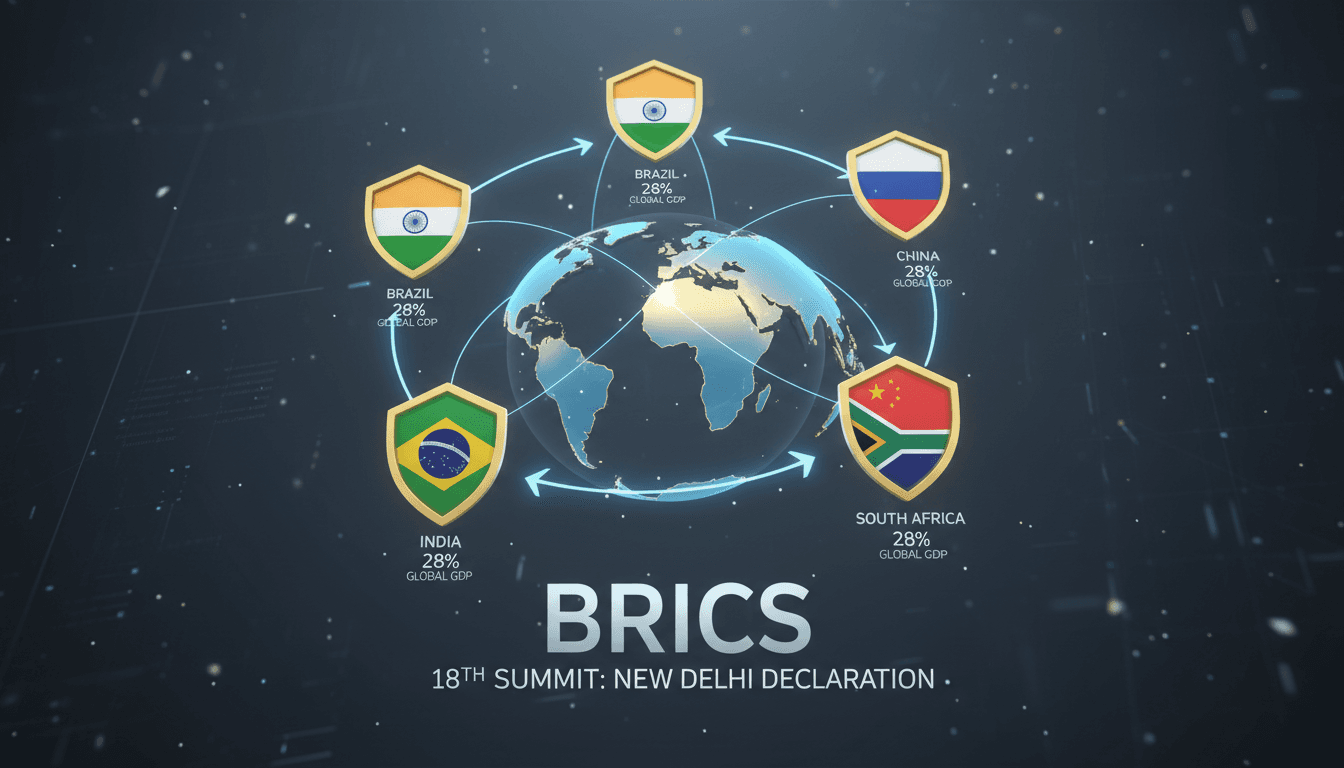
India Successfully Concludes 18th BRICS Summit with New Delhi Declaration
Why it matters
India's ability to secure consensus among BRICS nations signals a shift towards a more unified Global South, influencing international economic policies.
What happened (in 30 seconds)
- India hosted the 18th BRICS Summit in New Delhi on September 12-13, 2026, with leaders from 11 member states.
- The New Delhi Declaration was adopted unanimously, addressing global governance, counter-terrorism, and trade without anti-West rhetoric.
- Key sideline meetings included discussions between Modi and Xi, and Iran and UAE, aimed at easing regional tensions.
The context you actually need
- BRICS expanded to 11 members in 2024, including Egypt, Ethiopia, Iran, UAE, and Indonesia, enhancing its global influence.
- Previous foreign ministers' meetings in May 2026 struggled to reach consensus due to disagreements over Middle East conflicts.
- India's chairmanship emphasized resilience and cooperation, positioning BRICS as a platform for Global South priorities rather than confrontation with the West.
What's really happening
The 18th BRICS Summit marked a significant moment for India as it navigated complex geopolitical waters to foster unity among diverse member states. By hosting the summit, India not only showcased its diplomatic prowess but also reinforced its role as a leader in the Global South. The unanimous adoption of the New Delhi Declaration, which includes 140 paragraphs, reflects a collective commitment to addressing pressing global issues such as governance reform, counter-terrorism, and trade.
One of the standout achievements was India's ability to bridge internal divisions, particularly between Iran and the UAE, two nations often at odds due to regional tensions. This diplomatic maneuvering is crucial as it highlights India's strategy of promoting dialogue over confrontation. The explicit condemnation of the April 2025 Pahalgam terror attack within the declaration underscores a shared commitment to counter-terrorism, a priority for many BRICS nations.
Moreover, the summit's focus on multipolarity and Global South priorities indicates a strategic pivot away from traditional Western-centric narratives. By avoiding explicit anti-West rhetoric, India has positioned BRICS as a cooperative bloc rather than an adversarial one. This approach not only enhances India's standing on the global stage but also appeals to nations seeking alternatives to Western dominance in international affairs.
The summit's outcomes are likely to influence global economic policies, particularly in trade and currency cooperation. While there were no immediate references to de-dollarization, the emphasis on multilateral trade suggests a gradual shift towards more diversified economic partnerships. This could have significant implications for businesses operating in or with BRICS nations, as they may need to adapt to new trade dynamics and currency arrangements.
In summary, the 18th BRICS Summit was not just a diplomatic event; it was a strategic move by India to solidify its leadership role and promote a vision of a more inclusive and cooperative global order. The implications of this summit will resonate across various sectors, influencing everything from trade policies to international relations.
Who feels it first (and how)
- Businesses in BRICS nations: They may experience shifts in trade dynamics and new opportunities for partnerships.
- Diplomatic sectors: Increased engagement and dialogue among member states could lead to more stable international relations.
- Investors: They will need to monitor changes in economic policies and currency cooperation that may arise from the summit's outcomes.
What to watch next
- Implementation of the New Delhi Declaration: Monitoring how the commitments made at the summit translate into actionable policies will be crucial for understanding future BRICS dynamics.
- Future BRICS meetings: The upcoming chairmanship under China in 2027 will be pivotal in shaping the bloc's direction and priorities.
- Regional tensions: Observing how the summit's diplomatic efforts impact relations between Iran and the UAE will provide insights into broader Middle Eastern stability.
The BRICS Summit concluded with a consensus declaration addressing key global issues.
Increased cooperation among BRICS nations will influence global trade dynamics.
The long-term impact of the summit on Western relations and economic policies remains to be seen.
Frequently Asked Questions
- Why it matters?
- India's ability to secure consensus among BRICS nations signals a shift towards a more unified Global South, influencing international economic policies.
- What happened (in 30 seconds)?
- India hosted the 18th BRICS Summit in New Delhi on September 12-13, 2026, with leaders from 11 member states. The New Delhi Declaration was adopted unanimously, addressing global governance, counter-terrorism, and trade without anti-West rhetoric. Key sideline meetings included discussions between Modi and Xi, and Iran and UAE, aimed at easing regional tensions.
- What's really happening?
- The 18th BRICS Summit marked a significant moment for India as it navigated complex geopolitical waters to foster unity among diverse member states. By hosting the summit, India not only showcased its diplomatic prowess but also reinforced its role as a leader in the Global South. The unanimous adoption of the New Delhi Declaration, which includes 140 paragraphs, reflects a collective commitment to addressing pressing global issues such as governance reform, counter-terrorism, and trade. One of
- Who feels it first (and how)?
- Businesses in BRICS nations: They may experience shifts in trade dynamics and new opportunities for partnerships. Diplomatic sectors: Increased engagement and dialogue among member states could lead to more stable international relations. Investors: They will need to monitor changes in economic policies and currency cooperation that may arise from the summit's outcomes.
- What to watch next?
- Implementation of the New Delhi Declaration: Monitoring how the commitments made at the summit translate into actionable policies will be crucial for understanding future BRICS dynamics. Future BRICS meetings: The upcoming chairmanship under China in 2027 will be pivotal in shaping the bloc's direction and priorities. Regional tensions: Observing how the summit's diplomatic efforts impact relations between Iran and the UAE will provide insights into broader Middle Eastern stability.
English-language digital publication covering business, politics, technology, and current affairs.
"The Arabian Post mixes original and syndicated-style coverage with a broad regional and global business-news orientation."
— A47 Editor
India steers 18th BRICS summit deftly, keeps anti-West rhetoric at bay
The 18th BRICS Summit took place in New Delhi from September 12-13, 2026, where Prime Minister Narendra Modi successfully guided member states towards a New Delhi Declaration that notably refrained from direct criticism of the United States. This sum...
English-language digital publication covering business, politics, technology, and current affairs.
"The Arabian Post mixes original and syndicated-style coverage with a broad regional and global business-news orientation."
— A47 Editor
BRICS elevates Global South development priorities
At the 18th BRICS Summit in New Delhi, leaders emphasized the development priorities of emerging economies, advocating for stronger representation of the Global South in global governance. Chinese President Xi Jinping highlighted the importance of po...
RT is a Russian state-funded network covering global events from a Russian perspective.
"RT is widely criticized for promoting pro-Kremlin narratives and is considered by many to be a state propaganda outlet."
— A47 Editor
BRICS is no longer just a slogan
The recent BRICS summit in New Delhi marked a significant shift from rhetoric to practical initiatives, focusing on enhancing trade, payment systems, and strategic autonomy among member nations. Leaders emphasized the importance of economic cooperati...