
Pentagon Report Reveals US Munitions Shortfalls Due to Iran War
Why it matters
The Pentagon's admission of munitions shortfalls signals potential shifts in defense spending and procurement strategies that could impact global military readiness.
What happened (in 30 seconds)
- The Pentagon Inspector General released a report on 15 September 2026 confirming significant munitions shortfalls due to the ongoing war with Iran.
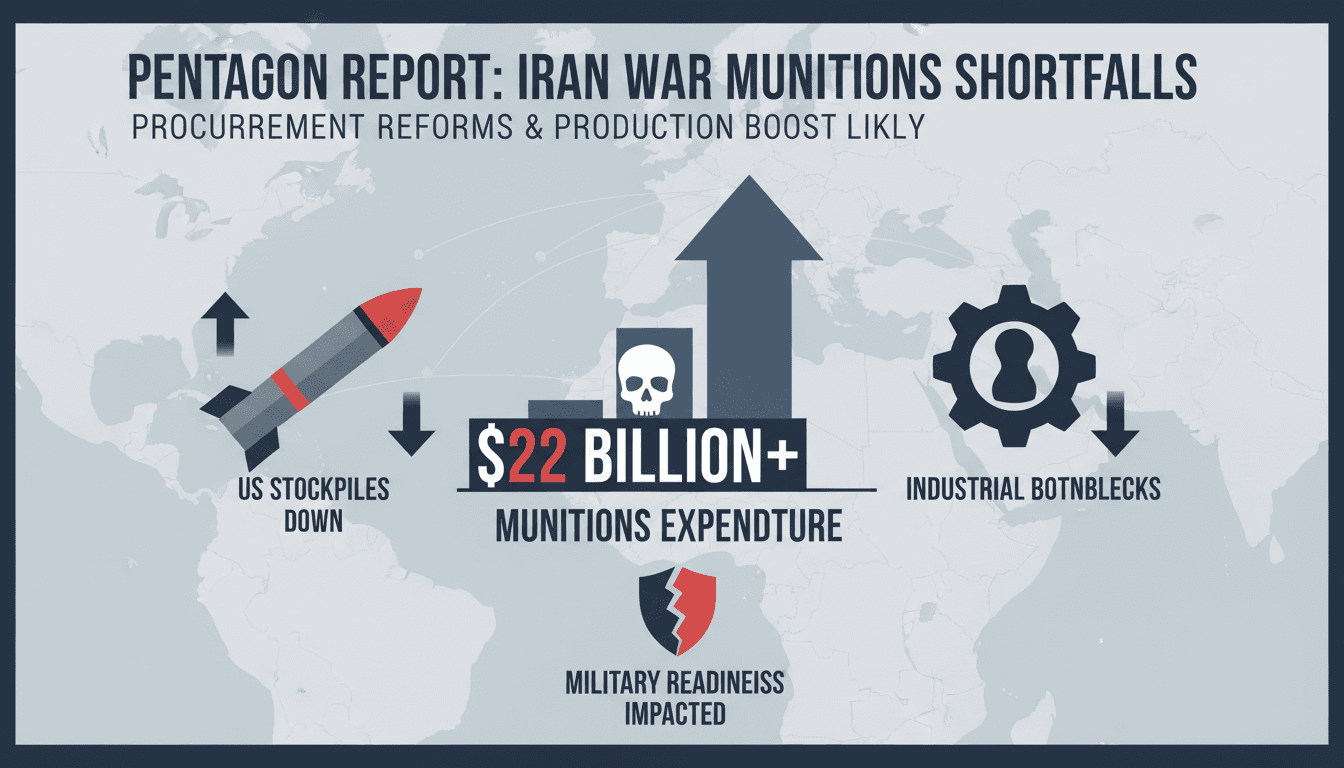
- Expenditures exceeded $22 billion on munitions from 28 February to 30 June 2026, leading to depleted inventories of critical defense systems.
- The report contradicts previous claims by President Trump and Defense Secretary Hegseth that US munitions supplies were virtually unlimited.
The context you actually need
- Operation Epic Fury, initiated on 28 February 2026, aimed to degrade Iran's military capabilities through a joint US-Israeli campaign.
- Prior estimates indicated significant depletion of interceptor missiles, raising concerns about US military readiness.
- The report highlights industrial bottlenecks in the production of essential munitions components, prompting the Pentagon to reform procurement processes.
What's really happening
The Pentagon Inspector General's report provides a critical, independent assessment of the munitions consumption during the Iran conflict, revealing a stark reality that contradicts the administration's narrative. The war, designated as Operation Epic Fury, has led to unprecedented expenditures, with over $33.4 billion spent by the end of June 2026. This includes $22.3 billion specifically allocated for munitions, which has resulted in significant shortfalls in strategic inventories, particularly for systems like the Patriot and THAAD interceptors.
The report outlines that US forces have expended vast quantities of long-range ground-attack systems and air/missile defense interceptors to counter Iranian threats. This consumption has not only depleted existing stockpiles but has also exposed critical vulnerabilities in the US military's industrial base. The report identifies bottlenecks in the production of solid-rocket motors, explosives, and skilled labor, which are essential for replenishing munitions supplies.
In response to these findings, the Pentagon is implementing reforms aimed at accelerating procurement timelines and streamlining the acquisition of critical components. This includes initiatives to enhance production capabilities and address labor shortages that have hampered munitions manufacturing. The urgency of these reforms is underscored by the ongoing nature of the conflict, which may extend beyond the upcoming November 2026 midterms.
The implications of these munitions shortfalls extend beyond military readiness; they also affect defense contractors and the broader defense industry. With sustained pressure on defense contractors to ramp up output, companies involved in munitions production may see increased demand, but they will also face challenges related to capacity and labor shortages. The market dynamics are shifting, and companies must adapt to the evolving landscape of defense procurement.
As the conflict continues, the Pentagon's acknowledgment of these shortfalls may lead to increased scrutiny from Congress and the public regarding military spending and resource allocation. The report serves as a wake-up call, highlighting the need for a more robust and resilient defense industrial base capable of meeting the demands of modern warfare.
Who feels it first (and how)
- Defense contractors: Increased demand for munitions production may lead to new contracts but also challenges in scaling operations.
- Military personnel: Potential shortages in critical defense systems could impact operational readiness and effectiveness.
- Expatriate communities in the Gulf: Heightened tensions and military activities may affect safety and commercial aviation routes.
What to watch next
- Procurement reforms: Monitor the Pentagon's implementation of reforms to accelerate munitions production and address supply chain issues.
- Congressional scrutiny: Watch for increased oversight and potential hearings regarding military spending and resource allocation in light of the report.
- Market responses: Observe how defense contractors adjust to the demand for increased output and the challenges they face in meeting these needs.
The Pentagon has confirmed significant munitions shortfalls due to the Iran conflict.
Defense contractors will face increased demand but also operational challenges in scaling production.
The long-term implications for US military readiness and defense spending remain to be fully understood.
Frequently Asked Questions
- Why it matters?
- The Pentagon's admission of munitions shortfalls signals potential shifts in defense spending and procurement strategies that could impact global military readiness.
- What happened (in 30 seconds)?
- The Pentagon Inspector General released a report on 15 September 2026 confirming significant munitions shortfalls due to the ongoing war with Iran. Expenditures exceeded $22 billion on munitions from 28 February to 30 June 2026, leading to depleted inventories of critical defense systems. The report contradicts previous claims by President Trump and Defense Secretary Hegseth that US munitions supplies were virtually unlimited.
- What's really happening?
- The Pentagon Inspector General's report provides a critical, independent assessment of the munitions consumption during the Iran conflict, revealing a stark reality that contradicts the administration's narrative. The war, designated as Operation Epic Fury, has led to unprecedented expenditures, with over $33.4 billion spent by the end of June 2026. This includes $22.3 billion specifically allocated for munitions, which has resulted in significant shortfalls in strategic inventories, particularl
- Who feels it first (and how)?
- Defense contractors: Increased demand for munitions production may lead to new contracts but also challenges in scaling operations. Military personnel: Potential shortages in critical defense systems could impact operational readiness and effectiveness. Expatriate communities in the Gulf: Heightened tensions and military activities may affect safety and commercial aviation routes.
- What to watch next?
- Procurement reforms: Monitor the Pentagon's implementation of reforms to accelerate munitions production and address supply chain issues. Congressional scrutiny: Watch for increased oversight and potential hearings regarding military spending and resource allocation in light of the report. Market responses: Observe how defense contractors adjust to the demand for increased output and the challenges they face in meeting these needs.
Arabic-language reporting on global and regional news.
"BBC Arabic is part of the BBC, generally regarded for editorial standards and broad international coverage."
— A47 Editor
البنتاغون يؤكد أنّ الحرب مع إيران أدت إلى نقص في الذخائر الأمريكية
The Pentagon has confirmed that the ongoing conflict with Iran has resulted in a shortage of U.S. ammunition, contradicting President Trump's repeated assertions that there is no such deficit in American weaponry. This statement comes from the Pentag...
International coverage of politics, culture, and current affairs.
"BBC News is widely regarded as a reputable international news organization, known for its impartial tone and public service mandate."
— A47 Editor
Iran war has led to US munitions shortfalls, Pentagon inspector confirms
A Pentagon inspector has confirmed that the ongoing war with Iran has resulted in significant shortfalls in U.S. munitions, contradicting previous claims by President Donald Trump that U.S. supplies are nearly limitless. The inspector also highlighte...
News across North, Central, and South America including politics and economics.
"France 24 is viewed as a globally focused outlet with balanced coverage and a European perspective."
— A47 Editor
Iran war exposes US munitions shortfall, industrial bottlenecks, Pentagon report says
A recent Pentagon report has revealed that the ongoing war with Iran has led to significant shortages of key munitions for the US military, highlighting industrial bottlenecks that hinder the replenishment of stockpiles. This contradicts previous ass...
Pan-Arab political news and analysis.
"Al-Quds Al-Arabi is a London-based Arabic newspaper known for political coverage."
— A47 Editor
البنتاغون يقر بوجود “نقص” في الذخيرة بسبب الحرب في إيران
The Pentagon has acknowledged a 'shortage' of ammunition linked to the ongoing conflict in Iran, a claim that the Trump administration largely denied in recent months. The report from the Pentagon's Inspector General highlights that the consumption o...
Right-of-center views on political news.
"The Washington Times is a conservative-leaning newspaper known for its political coverage and advocacy of right-of-center viewpoints."
— A47 Editor
Trump says U.S. has plenty of 'exquisite and elite' weapons, despite reports of shortages
President Trump asserted that the U.S. military is equipped with 'exquisite and elite' weapons for troops in the Middle East, despite reports indicating a depletion of military stockpiles due to the ongoing conflict with Iran.