
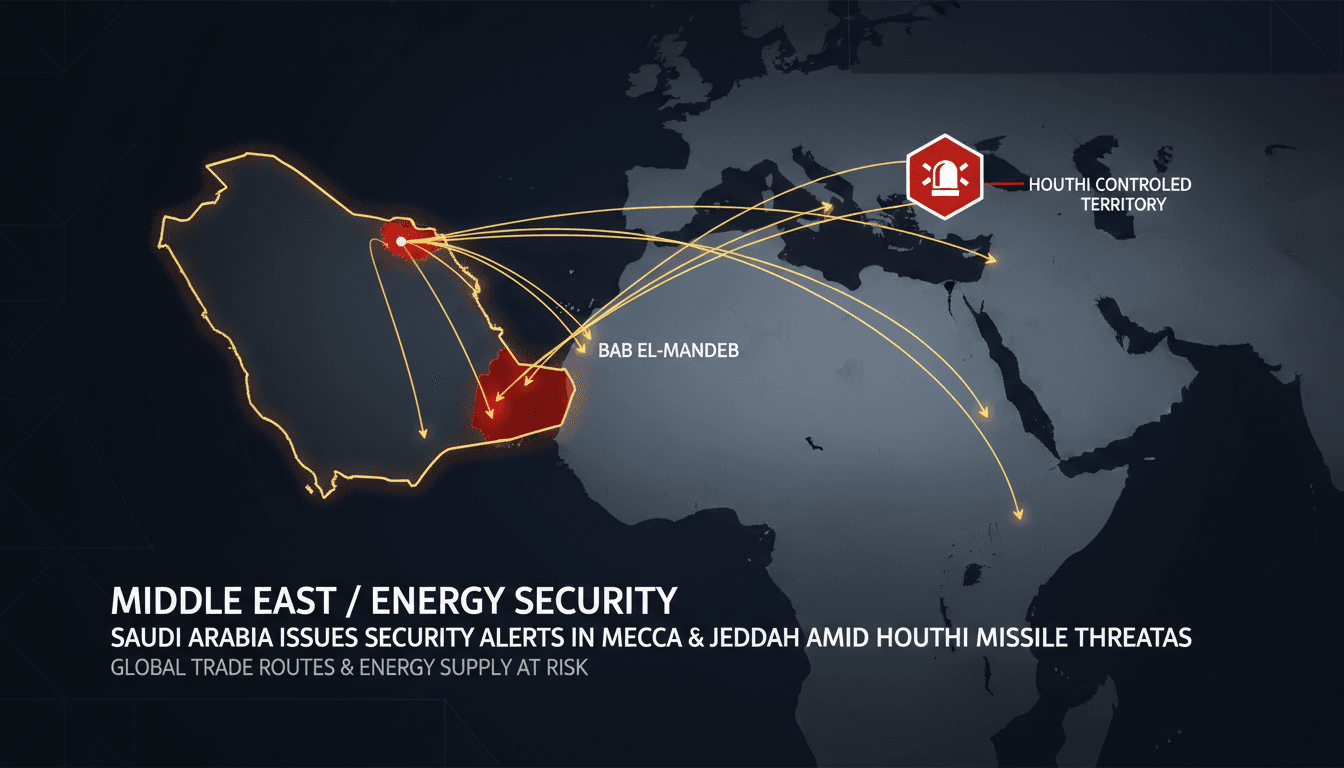
Saudi Arabia Issues Security Alerts in Mecca and Jeddah Amid Houthi Missile Strikes
Why it matters
The escalation of hostilities in the region threatens stability in key shipping lanes, affecting global oil prices and supply chains.
What happened (in 30 seconds)
- Saudi authorities issued security alerts in Mecca and Jeddah for the first time amid Houthi missile and drone threats.
- Thirteen civilians were injured in southern Saudi cities due to Houthi attacks, coinciding with significant ground fighting in Yemen.
- Over 100,000 people have been displaced in Yemen as Houthi forces gain territory along the western coast.
The context you actually need
- A truce in the Yemeni conflict held until July 2026, when Houthi forces launched a major offensive against Saudi-backed troops.
- Control of the Bab el-Mandeb Strait by the Houthis poses a risk to global trade routes and Saudi energy infrastructure.
- Broader Middle East tensions involving Iran and the U.S. have disrupted shipping through the Strait of Hormuz, leading to rerouted oil exports.
What's really happening
On September 14-15, 2026, the Houthi movement, also known as Ansar Allah, executed a series of ballistic missile and drone strikes targeting Saudi military installations, including the King Khalid airbase in Khamis Mushait. These attacks resulted in injuries to 13 civilians and damage to residential areas in Abha and Taif. In response, Saudi civil defense authorities activated emergency alerts across Mecca, Jeddah, and Taif, advising residents to shelter indoors. However, these alerts were lifted shortly after being issued, indicating a rapid response to the perceived threat.
The Houthi attacks are framed as retaliation against Saudi airstrikes in Yemen, reflecting the ongoing cycle of violence that has characterized the conflict. Concurrently, Houthi forces have made significant territorial gains along Yemen's western coast, securing control over strategic areas near the Bab el-Mandeb Strait. This strait is crucial for global shipping, and its control by the Houthis raises alarms about potential disruptions to maritime trade routes.
The humanitarian impact of this renewed fighting is severe, with the UN reporting over 100,000 people displaced internally in Yemen since the resumption of major hostilities. The situation is compounded by the broader geopolitical landscape, where tensions between Iran and the United States have escalated, affecting regional stability. Saudi Arabia's rerouting of oil exports through the Red Sea is a direct response to these tensions, highlighting the interconnectedness of regional conflicts and global energy markets.
Saudi officials have vowed a firm response to the Houthi attacks, emphasizing the protection of holy sites in Mecca as a red line. The international community, including the UN Security Council, is closely monitoring the situation, particularly the implications for global trade and energy security. As the conflict continues, the potential for further escalation remains high, with significant implications for both regional and global stakeholders.
Who feels it first (and how)
- Energy sector professionals: Fluctuations in oil prices due to instability in the region.
- Shipping and logistics companies: Potential disruptions in trade routes through the Red Sea and Bab el-Mandeb Strait.
- Local businesses in Saudi Arabia: Increased security measures may affect tourism and commerce in Mecca and Jeddah.
What to watch next
- Houthi military advancements: Continued territorial gains could lead to further escalations and international responses.
- Global oil prices: Watch for fluctuations as tensions impact supply routes and energy markets.
- International diplomatic efforts: Look for responses from the UN and regional powers aimed at de-escalating the conflict.
Houthi missile strikes have injured civilians and prompted security alerts in Saudi Arabia.
Continued military engagement between Houthi forces and Saudi-led coalitions, with potential for further international involvement.
The long-term impact on global energy markets and trade routes remains uncertain as the situation evolves.
Frequently Asked Questions
- Why it matters?
- The escalation of hostilities in the region threatens stability in key shipping lanes, affecting global oil prices and supply chains.
- What happened (in 30 seconds)?
- Saudi authorities issued security alerts in Mecca and Jeddah for the first time amid Houthi missile and drone threats. Thirteen civilians were injured in southern Saudi cities due to Houthi attacks, coinciding with significant ground fighting in Yemen. Over 100,000 people have been displaced in Yemen as Houthi forces gain territory along the western coast.
- What's really happening?
- On September 14-15, 2026, the Houthi movement, also known as Ansar Allah, executed a series of ballistic missile and drone strikes targeting Saudi military installations, including the King Khalid airbase in Khamis Mushait. These attacks resulted in injuries to 13 civilians and damage to residential areas in Abha and Taif. In response, Saudi civil defense authorities activated emergency alerts across Mecca, Jeddah, and Taif, advising residents to shelter indoors. However, these alerts were lifte
- Who feels it first (and how)?
- Energy sector professionals: Fluctuations in oil prices due to instability in the region. Shipping and logistics companies: Potential disruptions in trade routes through the Red Sea and Bab el-Mandeb Strait. Local businesses in Saudi Arabia: Increased security measures may affect tourism and commerce in Mecca and Jeddah.
- What to watch next?
- Houthi military advancements: Continued territorial gains could lead to further escalations and international responses. Global oil prices: Watch for fluctuations as tensions impact supply routes and energy markets. International diplomatic efforts: Look for responses from the UN and regional powers aimed at de-escalating the conflict.
Arabic-language reporting on global and regional news.
"BBC Arabic is part of the BBC, generally regarded for editorial standards and broad international coverage."
— A47 Editor
تحذيرات سعودية واسعة شملت مكة وجدة، و100 ألف نازح منذ تجدد المعارك في اليمن
Widespread warnings have been issued in Saudi Arabia, particularly in Mecca and Jeddah, as tensions escalate in Yemen. The Houthi forces continue their attacks on Saudi territory, while Iran denies any involvement in the recent outbreak of conflict. ...
European coverage of Middle East politics and security issues.
"France 24 offers international reporting with a European editorial perspective."
— A47 Editor
Houthis and Saudi Arabia renew fighting, Iran denies any interference
Saudi Arabia has intensified its military response with numerous airstrikes on western Yemen following attacks by Iran-backed Houthi rebels on military facilities within the kingdom. This escalation marks a significant increase in hostilities, furthe...
Coverage of current events and conflicts in the Middle East.
"France 24 is viewed as a globally focused outlet with balanced coverage and a European perspective."
— A47 Editor
Houthis and Saudi Arabia renew fighting, Iran denies any interference
Saudi Arabia has intensified its military response with numerous airstrikes on western Yemen following attacks by Iran-backed Houthi rebels on military facilities within the kingdom. This escalation marks a significant increase in hostilities, furthe...
Global news coverage with extensive reporting on Middle Eastern conflicts and geopolitics.
"Al Jazeera is a Qatar-based broadcaster known for wide regional coverage and alternative perspectives."
— A47 Editor
Yemen’s Houthis advance on government strongholds of Marib, Taiz
Fighting has intensified in Yemen as Houthi fighters advance toward the government-held strongholds of Marib and Taiz, raising concerns over the stability of these regions amid ongoing conflict. The Houthis have reportedly launched missile and drone ...
Comprehensive coverage of Middle Eastern and global issues.
"Al Jazeera is a prominent voice from the Global South, especially the Middle East, with an emphasis on underreported stories."
— A47 Editor
Yemen’s Houthis advance on government strongholds of Marib, Taiz
Fighting has intensified in Yemen as Houthi fighters advance toward the government-held strongholds of Marib and Taiz, raising concerns over the stability of these regions amid ongoing conflict. The Houthis have reportedly launched missile and drone ...