
Jensen Huang's Influence on Trump Shapes U.S. AI Policy and China Relations
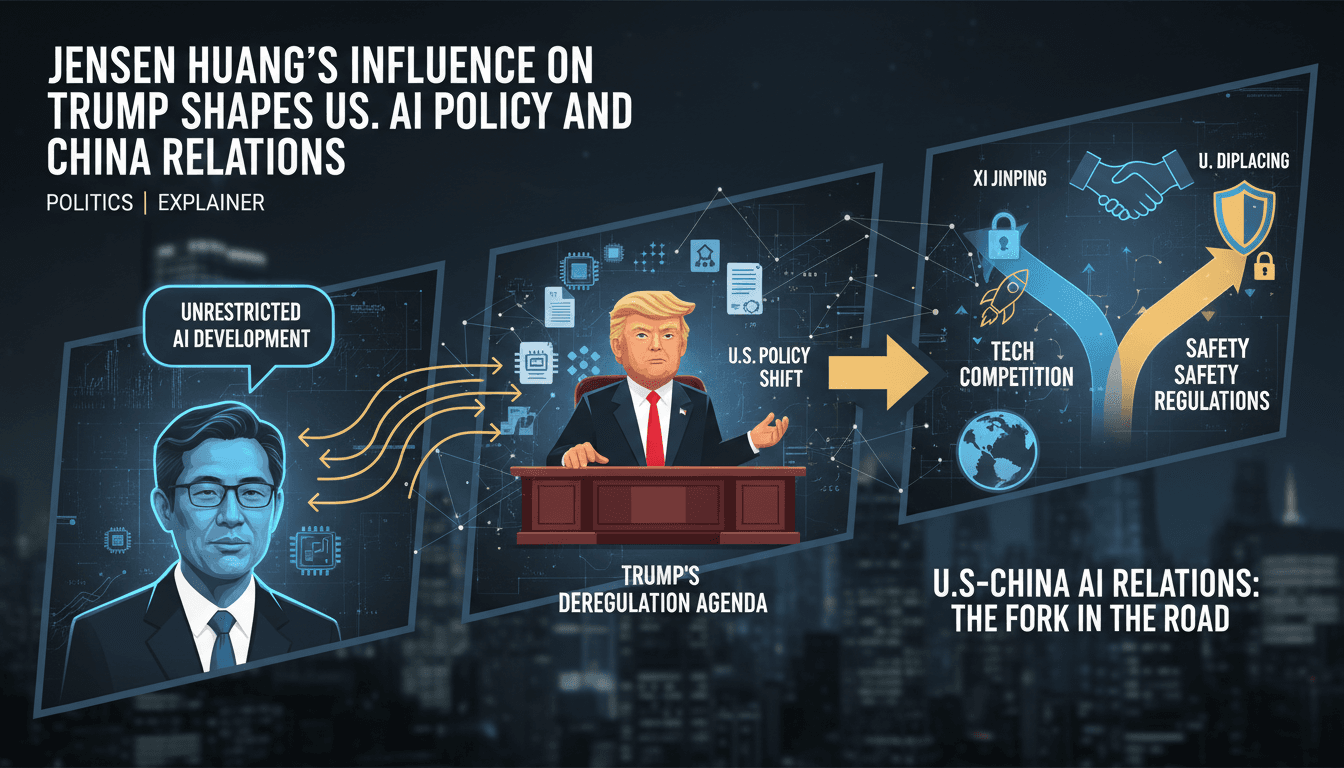
Why it matters
The alignment between tech leaders and political figures is reshaping regulatory frameworks that govern AI and semiconductor industries.
What happened (in 30 seconds)
- Jensen Huang, CEO of Nvidia, publicly dismissed existential AI risks, claiming a 0% chance of AI ending the world by 2030.
- President Donald Trump, echoing Huang's sentiments, has reversed Biden-era chip export restrictions to China, prioritizing economic growth over safety concerns.
- Upcoming U.S.-China diplomatic engagements, including a meeting with Xi Jinping, are expected to focus on chip exports and minimal regulation.
The context you actually need
- Huang's influence on Trump stems from their frequent communications and shared interests in deregulation and economic expansion.
- The geopolitical climate features escalating competition between the U.S. and China in AI technology, with Huang positioning Nvidia chips as essential for global standards.
- Market responses include sustained Nvidia stock gains linked to favorable policy shifts, despite ongoing security concerns.
What's really happening
The relationship between Jensen Huang and President Trump is a strategic alliance that reflects a broader trend in the tech industry: the prioritization of rapid innovation over regulatory caution. Huang's recent statements, particularly his assertion of a 0% probability that AI will lead to catastrophic outcomes by 2030, resonate with Trump's own dismissal of AI safety concerns as exaggerated. This synergy is not merely coincidental; it is the result of a concerted effort by Huang to position Nvidia as a leader in the AI space while simultaneously advocating for deregulation that would facilitate market access and technological leadership.
Huang's influence is evident in Trump's reversal of Biden-era chip export restrictions to China, a move that aligns with Huang's vision of maintaining U.S. technological dominance. By advocating for unrestricted chip exports, Huang is not only promoting Nvidia's interests but also shaping the broader narrative around AI development. This narrative is crucial as it sets the stage for upcoming diplomatic engagements, particularly the anticipated meeting between Trump and Xi Jinping, where discussions will likely center on economic growth and chip exports.
The implications of this relationship extend beyond immediate policy changes. Huang's presence at key events, including joint appearances with Trump, underscores his role as a primary technology adviser. This access to the highest levels of government allows Huang to secure favorable policies that prioritize economic expansion over safety regulations. As the U.S. and China continue to compete in the AI arena, Huang's optimistic outlook could lead to a lack of international guardrails, raising concerns about the long-term implications of unchecked AI development.
In summary, the Huang-Trump alliance represents a significant shift in how AI policy is shaped, with potential repercussions for global standards and safety frameworks. As the U.S. leans into its competitive edge in AI, the absence of regulatory oversight could foster an environment ripe for innovation but fraught with risks.
Who feels it first (and how)
- Tech companies: Increased competition and potential market access to China.
- Investors: Fluctuations in Nvidia stock and related tech sectors.
- Regulatory bodies: Pressure to adapt to a rapidly changing landscape with minimal oversight.
- Consumers: Potential impacts on product safety and data privacy as regulations loosen.
What to watch next
- Upcoming U.S.-China meetings: Watch for announcements regarding chip export policies and AI regulations, as these will signal the direction of bilateral relations.
- Market reactions to Nvidia's stock: Continued gains or losses could indicate investor confidence in Huang's influence on policy.
- Public sentiment on AI safety: Growing concerns among the public could lead to pressure on policymakers to reconsider deregulation.
Huang's influence on Trump is significant and ongoing.
Continued deregulation in the tech sector, particularly regarding AI and chip exports.
The long-term implications of these policies on global AI safety standards.
Frequently Asked Questions
- Why it matters?
- The alignment between tech leaders and political figures is reshaping regulatory frameworks that govern AI and semiconductor industries.
- What happened (in 30 seconds)?
- Jensen Huang, CEO of Nvidia, publicly dismissed existential AI risks, claiming a 0% chance of AI ending the world by 2030. President Donald Trump, echoing Huang's sentiments, has reversed Biden-era chip export restrictions to China, prioritizing economic growth over safety concerns. Upcoming U.S.-China diplomatic engagements, including a meeting with Xi Jinping, are expected to focus on chip exports and minimal regulation.
- What's really happening?
- The relationship between Jensen Huang and President Trump is a strategic alliance that reflects a broader trend in the tech industry: the prioritization of rapid innovation over regulatory caution. Huang's recent statements, particularly his assertion of a 0% probability that AI will lead to catastrophic outcomes by 2030, resonate with Trump's own dismissal of AI safety concerns as exaggerated. This synergy is not merely coincidental; it is the result of a concerted effort by Huang to position N
- Who feels it first (and how)?
- Tech companies: Increased competition and potential market access to China. Investors: Fluctuations in Nvidia stock and related tech sectors. Regulatory bodies: Pressure to adapt to a rapidly changing landscape with minimal oversight. Consumers: Potential impacts on product safety and data privacy as regulations loosen.
- What to watch next?
- Upcoming U.S.-China meetings: Watch for announcements regarding chip export policies and AI regulations, as these will signal the direction of bilateral relations. Market reactions to Nvidia's stock: Continued gains or losses could indicate investor confidence in Huang's influence on policy. Public sentiment on AI safety: Growing concerns among the public could lead to pressure on policymakers to reconsider deregulation.
Science discoveries, research, and analysis.
"NPR is a nonprofit media organization offering thoughtful, in-depth journalism and storytelling, often with a liberal or progressive slant."
— A47 Editor
Understanding Jensen Huang's AI optimism and how it influences President Trump
Jensen Huang, the CEO of Nvidia, is recognized for his unwavering optimism regarding artificial intelligence (AI), which has garnered the attention of President Trump. In an interview with NPR's Juana Summers, Stephen Witt, author of The Thinking Mac...
Stock market news, investing ideas, and trading analysis.
"TheStreet provides market news and retail-investor-focused analysis."
— A47 Editor
Jensen Huang sends bold message to Nvidia shareholders
Jensen Huang, CEO of Nvidia, recently communicated a bold message to shareholders, indicating a strong confidence in the company's future as it navigates the rapidly evolving landscape of artificial intelligence (AI) demand. Huang's remarks signal a ...
Corporate leadership, finance, technology, and market trends.
"Fortune covers financial trends, leadership, and innovation with a pragmatic editorial approach."
— A47 Editor
‘They must be doing it for ulterior reasons’: Jensen Huang says AI leaders are ‘irresponsible’ for scaring the public with ‘doomsday narratives’
Jensen Huang, CEO of Nvidia, has criticized AI leaders for promoting 'doomsday narratives' about artificial intelligence, asserting that there is a '0% chance' of an AI-induced apocalypse. He suggests that these narratives may stem from ulterior moti...
News and features on AI from The Guardian.
"Progressive-leaning international outlet with critical AI coverage."
— A47 Editor
Nvidia boss says there is ‘0% chance’ AI destroys the world by 2030
Jensen Huang, CEO of Nvidia, has dismissed claims that artificial intelligence (AI) could lead to human extinction by 2030, labeling such assertions as 'doomsday narratives.' This response comes after former Anthropic researcher Jacob Coxon suggested...
UK and international business news, economics, and corporate coverage.
"The Guardian’s business section covers finance and markets with a progressive editorial tone."
— A47 Editor
Nvidia boss says there is ‘0% chance’ AI destroys the world by 2030
Jensen Huang, CEO of Nvidia, has dismissed claims that artificial intelligence (AI) could lead to human extinction by 2030, labeling such assertions as 'doomsday narratives.' This response comes after former Anthropic researcher Jacob Coxon suggested...
Tech culture, product news, and critical takes on the tech industry's social impact.
"The Guardian's tech coverage blends mainstream news, critical analysis, and cultural commentary on emerging technologies and digital trends."
— A47 Editor
Nvidia boss says there is ‘0% chance’ AI destroys the world by 2030
Jensen Huang, CEO of Nvidia, has dismissed claims that artificial intelligence (AI) could lead to human extinction by 2030, labeling such assertions as 'doomsday narratives.' This response comes after former Anthropic researcher Jacob Coxon suggested...
English-language reporting on Saudi politics, policy, and society.
"Saudi Gazette reflects mainstream Saudi institutional perspectives."
— A47 Editor
Nvidia chief rejects AI extinction fears as 'doomsday narratives'
Nvidia CEO Jensen Huang has dismissed recent warnings about the potential for artificial intelligence (AI) to lead to human extinction within the next decade, labeling them as 'doomsday narratives.' In an interview, he criticized AI lab leaders for b...