
Canada Announces $100 Million Aid for Palestinians at UNGA Amid Calls for Two-State Solution
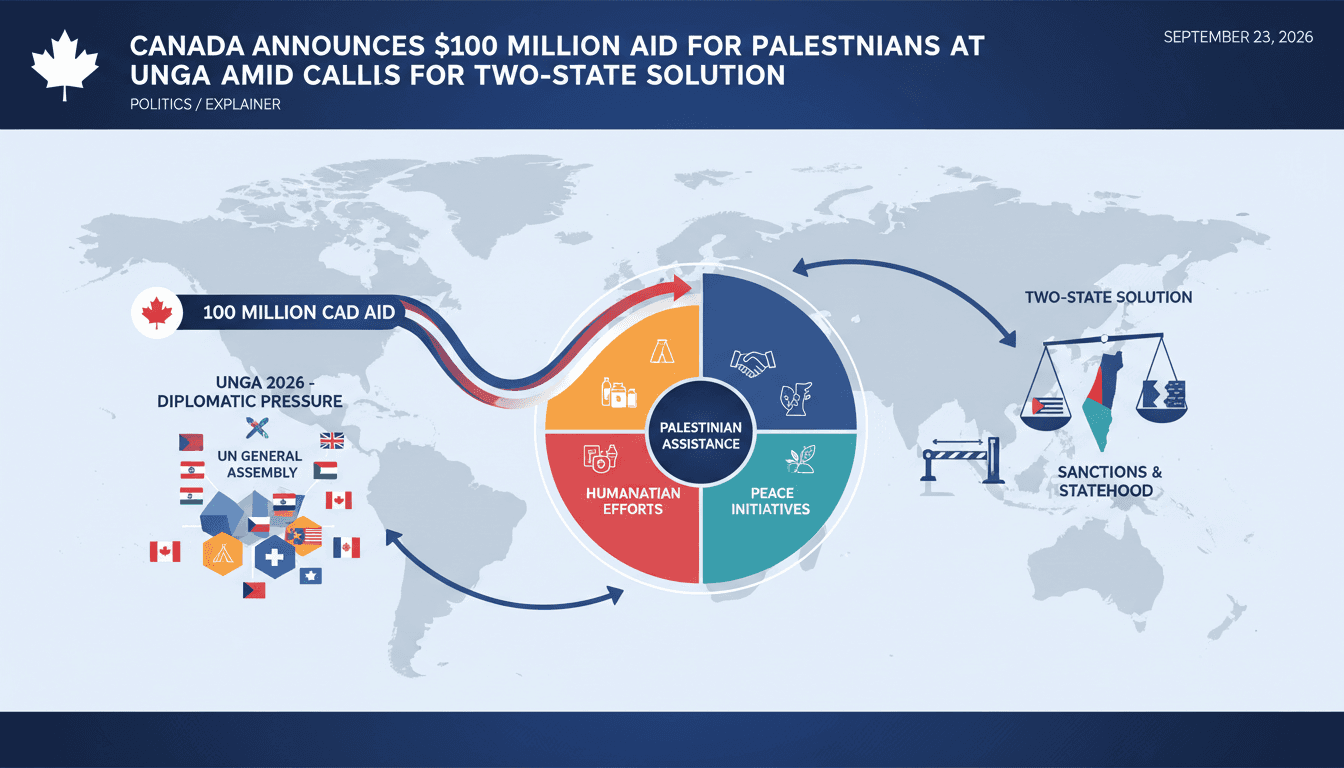
Why it matters
This aid commitment signals a renewed focus on the Palestinian humanitarian crisis and the viability of a two-state solution, impacting global diplomatic relations.
What happened (in 30 seconds)
- Canada announced a $100 million CAD aid pledge for Palestinians during the UN General Assembly on September 23, 2026.
- UK and French leaders joined the call for coordinated actions to support a two-state solution amid ongoing humanitarian challenges.
- The aid allocation includes 80% for humanitarian efforts and 20% for peace initiatives, including police training for Palestinians.
The context you actually need
- The Israel-Hamas conflict has persisted since October 2023, with ongoing humanitarian access restrictions and settlement expansions in the West Bank.
- Canada, the UK, and France recognized Palestinian statehood in 2025, reflecting a shift in international policy towards the Israeli-Palestinian conflict.
- Joint actions include commitments to ban imports from illegal settlements, driven by concerns over projects threatening Palestinian territorial integrity.
What's really happening
The recent pledge by Canada, alongside the UK and France, is a strategic move to address the humanitarian crisis in Palestine while reinforcing the international community's commitment to a two-state solution. This aid comes at a time when the humanitarian situation in Gaza is dire, with an estimated 73,900 people killed since the onset of the Israel-Hamas conflict. The leaders' coordinated efforts highlight a growing consensus among Western nations regarding the need for tangible actions rather than mere rhetoric.
The aid allocation is significant: 80% is earmarked for immediate humanitarian assistance, which is crucial given the ongoing restrictions on aid access in Gaza. The remaining 20% focuses on peace and security initiatives, including training for Palestinian police forces. This dual approach aims to not only alleviate immediate suffering but also to foster long-term stability and governance in Palestinian territories.
The backdrop of this announcement is critical. The Israel-Hamas conflict has created a complex landscape where humanitarian needs are escalating, yet access to aid remains severely restricted. The leaders' statements at the UNGA emphasized the urgent need for action, with Macron describing the situation in Gaza as a "spectacle that shames us all." This sentiment reflects a broader frustration within the international community regarding the lack of progress towards peace.
Moreover, the coordinated stance against Israeli settlement expansions, particularly the controversial E1 project, indicates a shift in diplomatic tactics. By collectively imposing trade restrictions on goods from illegal settlements, these nations are signaling a willingness to leverage economic measures to influence Israeli policies. This could lead to increased tensions in the region, as Israel may perceive these actions as direct challenges to its sovereignty.
The implications of this aid pledge extend beyond immediate humanitarian relief. It represents a potential pivot in international relations, where Western nations are increasingly willing to confront Israel's policies in pursuit of a viable peace process. As these countries continue to advocate for a two-state solution, the dynamics of the Israeli-Palestinian conflict may evolve, impacting regional stability and international diplomatic efforts.
Who feels it first (and how)
- Humanitarian organizations: Increased funding for aid projects in Gaza and the West Bank.
- Palestinian authorities: Potential for enhanced governance and security training, impacting local stability.
- Israeli policymakers: Pressure from international allies to reconsider settlement policies and engage in peace talks.
- Global citizens: Heightened awareness and potential shifts in public opinion regarding the Israeli-Palestinian conflict.
What to watch next
- Implementation of the aid pledge: Monitoring how effectively the $100 million CAD is utilized for humanitarian and peace initiatives will be crucial.
- Reactions from Israel: Observing Israel's response to the coordinated sanctions and aid efforts could indicate future diplomatic tensions.
- Further international commitments: Watch for additional pledges from other nations, which could signal a broader shift in global policy towards the Palestinian issue.
The aid pledge is officially announced and allocated.
Increased diplomatic pressure on Israel regarding settlement policies and humanitarian access.
The long-term impact of this aid on the peace process and regional stability.
Frequently Asked Questions
- Why it matters?
- This aid commitment signals a renewed focus on the Palestinian humanitarian crisis and the viability of a two-state solution, impacting global diplomatic relations.
- What happened (in 30 seconds)?
- Canada announced a $100 million CAD aid pledge for Palestinians during the UN General Assembly on September 23, 2026. UK and French leaders joined the call for coordinated actions to support a two-state solution amid ongoing humanitarian challenges. The aid allocation includes 80% for humanitarian efforts and 20% for peace initiatives, including police training for Palestinians.
- What's really happening?
- The recent pledge by Canada, alongside the UK and France, is a strategic move to address the humanitarian crisis in Palestine while reinforcing the international community's commitment to a two-state solution. This aid comes at a time when the humanitarian situation in Gaza is dire, with an estimated 73,900 people killed since the onset of the Israel-Hamas conflict. The leaders' coordinated efforts highlight a growing consensus among Western nations regarding the need for tangible actions rather
- Who feels it first (and how)?
- Humanitarian organizations: Increased funding for aid projects in Gaza and the West Bank. Palestinian authorities: Potential for enhanced governance and security training, impacting local stability. Israeli policymakers: Pressure from international allies to reconsider settlement policies and engage in peace talks. Global citizens: Heightened awareness and potential shifts in public opinion regarding the Israeli-Palestinian conflict.
- What to watch next?
- Implementation of the aid pledge: Monitoring how effectively the $100 million CAD is utilized for humanitarian and peace initiatives will be crucial. Reactions from Israel: Observing Israel's response to the coordinated sanctions and aid efforts could indicate future diplomatic tensions. Further international commitments: Watch for additional pledges from other nations, which could signal a broader shift in global policy towards the Palestinian issue.
Global news coverage with extensive reporting on Middle Eastern conflicts and geopolitics.
"Al Jazeera is a Qatar-based broadcaster known for wide regional coverage and alternative perspectives."
— A47 Editor
Canada pledges aid for Palestine as UK and France demand action at UNGA
Canada has pledged 100 million Canadian dollars (approximately $71 million) in aid for Palestine as the UK and France call for action regarding Israeli settlements during the United Nations General Assembly (UNGA). This financial commitment reflects ...
Regional coverage and analysis focused on politics, diplomacy, and business across the Middle East.
"Al-Monitor is known for analytical reporting on Middle East politics and policy developments."
— A47 Editor
Canada is giving C$100 million in international aid for Palestine, says Carney
Canada has announced a C$100 million aid package for Palestine, as stated by Prime Minister Mark Carney during a press conference at the United Nations. The funding includes C$80 million designated for humanitarian assistance to address immediate nee...
International coverage of politics, security, and social issues.
"Global News is a mainstream Canadian outlet with a centrist editorial stance, focusing on factual reporting."
— A47 Editor
Carney pledges $100 million in new aid for Palestinians
Prime Minister Mark Carney announced a pledge of $100 million in new aid for Palestinians, focusing primarily on humanitarian assistance for those in Gaza and the West Bank. This commitment reflects Canada's ongoing support for humanitarian efforts i...