
Dubai Court Orders Debtor to Repay 680,000 Dirhams Following Default on Installment Agreement
Why it matters
This ruling reinforces the enforceability of personal loans in Dubai, impacting both residents and expatriates engaged in informal lending.
What happened (in 30 seconds)
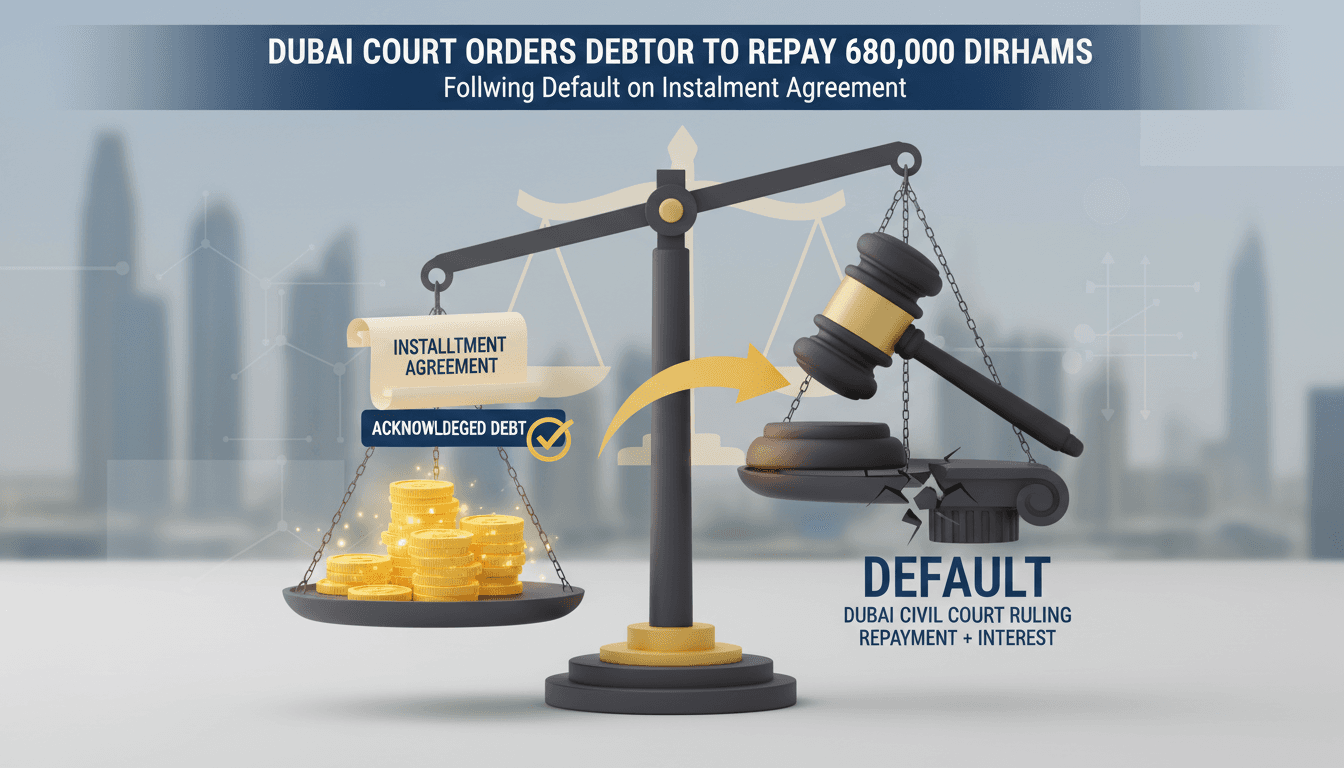
- On September 30, 2026, the Dubai Civil Court mandated a debtor to repay 680,000 dirhams plus 5% annual interest after failing to honor a repayment agreement.
- The defendant acknowledged the debt in writing and agreed to monthly installments but defaulted despite repeated demands from the creditor.
- The court ruled in absentia, emphasizing the validity of the signed acknowledgment and the absence of any defense from the debtor.
The context you actually need
- Debt recovery disputes in Dubai often hinge on written acknowledgments and installment agreements, which are treated as binding under UAE civil law.
- The burden of proof shifts to the debtor once the debt is established, meaning they must provide evidence of payment to contest claims.
- Good faith performance of contractual obligations is a key principle in Dubai's legal framework, influencing how courts handle such cases.
What's really happening
The Dubai Civil Court's ruling on September 30, 2026, highlights a critical aspect of the UAE's legal landscape regarding personal loans and debt recovery. In this case, the plaintiff lent 680,000 dirhams to the defendant, who acknowledged the debt in writing and agreed to repay it in monthly installments of 30,000 dirhams. However, the defendant defaulted on these payments, prompting the plaintiff to seek legal recourse.
The court's decision to mandate repayment, along with a 5% annual interest on the outstanding amount, underscores the importance of written agreements in personal lending scenarios. Under UAE civil law, such documents serve as binding evidence unless the debtor can provide a valid defense or proof of payment. In this instance, the defendant neither appeared in court nor presented any evidence to contest the claim, leading to a judgment rendered in absentia.
This ruling is significant for several reasons. First, it reinforces the legal weight of signed acknowledgments in personal lending, which can serve as a safeguard for creditors. The court's emphasis on the absence of a defense from the debtor indicates a judicial preference for upholding contractual obligations, thereby promoting good faith in financial transactions.
Moreover, the ruling sets a precedent for future cases involving personal loans, particularly in a city like Dubai, where expatriates often engage in informal lending arrangements. The implications extend beyond individual cases; they signal to both lenders and borrowers the necessity of adhering to contractual terms and the potential consequences of defaulting on payments.
As the judgment is enforced, standard measures such as asset disclosure and collection proceedings will likely follow, further illustrating the legal mechanisms available to creditors in Dubai. This case serves as a reminder that the legal framework in the UAE is designed to protect the rights of lenders while holding borrowers accountable for their financial commitments.
Who feels it first (and how)
- Lenders: Individuals and businesses providing loans will see increased confidence in the enforceability of their agreements.
- Borrowers: Those borrowing money must be more cautious, understanding that defaulting can lead to legal repercussions.
- Legal professionals: Lawyers specializing in debt recovery will likely see an uptick in cases as creditors seek to enforce judgments.
- Expatriates: Foreign residents engaging in personal lending must recognize the legal implications of their agreements under UAE law.
What to watch next
- Enforcement proceedings: Monitor how quickly and effectively the court's judgment is enforced, as this will indicate the efficiency of Dubai's legal system in debt recovery.
- Market reactions: Watch for any shifts in lending practices among expatriates and residents, particularly in informal lending circles, as they adjust to the implications of this ruling.
- Legal precedents: Keep an eye on future court cases that may reference this ruling, as they could further clarify the legal landscape surrounding personal loans in Dubai.
The court ruled in favor of the creditor, mandating repayment of the debt.
There will be increased caution among borrowers regarding their repayment obligations.
The long-term impact on informal lending practices in Dubai remains to be seen.
Frequently Asked Questions
- Why it matters?
- This ruling reinforces the enforceability of personal loans in Dubai, impacting both residents and expatriates engaged in informal lending.
- What happened (in 30 seconds)?
- On September 30, 2026, the Dubai Civil Court mandated a debtor to repay 680,000 dirhams plus 5% annual interest after failing to honor a repayment agreement. The defendant acknowledged the debt in writing and agreed to monthly installments but defaulted despite repeated demands from the creditor. The court ruled in absentia, emphasizing the validity of the signed acknowledgment and the absence of any defense from the debtor.
- What's really happening?
- The Dubai Civil Court's ruling on September 30, 2026, highlights a critical aspect of the UAE's legal landscape regarding personal loans and debt recovery. In this case, the plaintiff lent 680,000 dirhams to the defendant, who acknowledged the debt in writing and agreed to repay it in monthly installments of 30,000 dirhams. However, the defendant defaulted on these payments, prompting the plaintiff to seek legal recourse. The court's decision to mandate repayment, along with a 5% annual interes
- Who feels it first (and how)?
- Lenders: Individuals and businesses providing loans will see increased confidence in the enforceability of their agreements. Borrowers: Those borrowing money must be more cautious, understanding that defaulting can lead to legal repercussions. Legal professionals: Lawyers specializing in debt recovery will likely see an uptick in cases as creditors seek to enforce judgments. Expatriates: Foreign residents engaging in personal lending must recognize the legal implications of their agreement
- What to watch next?
- Enforcement proceedings: Monitor how quickly and effectively the court's judgment is enforced, as this will indicate the efficiency of Dubai's legal system in debt recovery. Market reactions: Watch for any shifts in lending practices among expatriates and residents, particularly in informal lending circles, as they adjust to the implications of this ruling. Legal precedents: Keep an eye on future court cases that may reference this ruling, as they could further clarify the legal landscape su
Arabic-language local coverage focused on UAE domestic issues, civic affairs, and community reporting.
"Emarat Al Youm local coverage emphasizes UAE institutions, public services, and community-level developments."
— A47 Editor
إلزام مدين برد 680 ألف درهم بعد إقراره بالدين وتهربه من التقسيط إلزام مدين برد 680 ألف درهم بعد إقراره بالدين وتهربه من التقسيط
The Dubai Civil Court has ordered an individual to repay a sum of 680,000 dirhams along with a legal interest rate of 5% per annum after the debtor acknowledged the debt but attempted to evade repayment through installment plans.
English-language coverage focused on UAE news, government updates, and domestic affairs.
"Emirates 24|7 reflects a mainstream UAE editorial perspective with strong emphasis on official and domestic developments."
— A47 Editor
Dubai court dismisses Dh68 million recovery claim over estate dispute
The Dubai Civil Court of First Instance has dismissed a lawsuit filed by a woman seeking to recover approximately Dh68 million, ruling that the claim was inadmissible as it was directed against an individual lacking the legal capacity to be sued. The...
Arabic-language local coverage focused on UAE domestic issues, civic affairs, and community reporting.
"Emarat Al Youm local coverage emphasizes UAE institutions, public services, and community-level developments."
— A47 Editor
رفض دعوى استرداد 68 مليون درهم من وصيّ على تركة رفض دعوى استرداد 68 مليون درهم من وصيّ على تركة
The Dubai Civil Court of First Instance has rejected a lawsuit filed by a woman seeking to recover 68 million dirhams from an individual, ruling that the case was brought against a party lacking legal standing.