
U.S. Army Creates Futures and Autonomous Systems Command to Enhance Robotic Warfare Capabilities
Why it matters
The establishment of FASCOM signals a significant pivot in military strategy, emphasizing the need for rapid adaptation to emerging threats.
What happened (in 30 seconds)
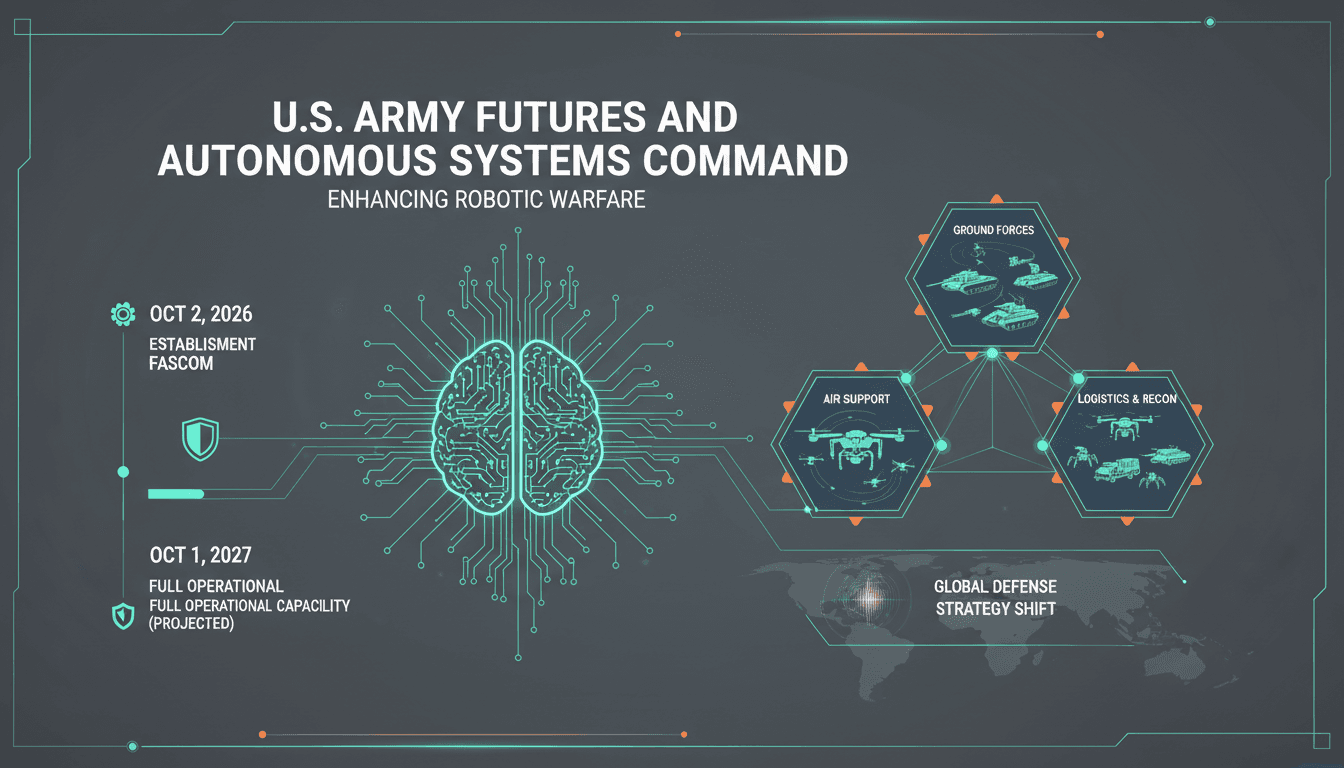
- On October 2, 2026, the U.S. Army announced the creation of the Futures and Autonomous Systems Command (FASCOM) to enhance robotic warfare capabilities.
- Defense Secretary Pete Hegseth outlined two key initiatives, Project Agincourt and Project Meridian, aimed at accelerating the Army's adaptation to autonomous systems.
- FASCOM will integrate autonomous capabilities across six Army formation areas, with a full command expected by October 1, 2027, pending legislation.
The context you actually need
- Post-Cold War vulnerabilities: The U.S. military's focus on legacy systems has left it exposed to low-cost unmanned technologies used by adversaries.
- Urgency for modernization: Hegseth's initiatives reflect a pressing need for the Army to adapt quickly to maintain combat superiority.
- Legislative hurdles: Full establishment of FASCOM requires Congressional approval, which could impact timelines and implementation.
What's really happening
The U.S. Army's establishment of the Futures and Autonomous Systems Command (FASCOM) is a strategic response to the evolving landscape of warfare, where unmanned systems are increasingly utilized by adversaries. This initiative, announced by Acting Secretary of the Army Adam R. Telle, follows Defense Secretary Pete Hegseth's call for a more agile military structure capable of rapid adaptation to new threats.
The Army's focus on integrating autonomous capabilities into six key formation areas—aviation, armor, fires, sustainment, engineer, and training—highlights a shift from traditional military operations to a more technology-driven approach. This integration is not merely about adding new tools; it represents a fundamental change in how the Army will operate in future conflicts. The directive aims to streamline acquisition processes and personnel structures to ensure that the Army can effectively deploy these technologies in real-world scenarios.
The urgency behind this restructuring is underscored by the recognition that adversaries are already leveraging low-cost unmanned systems to challenge U.S. military dominance. Hegseth's initiatives, including Project Agincourt, which focuses on prototyping acquisition models, and Project Meridian, a study on future warfare, are designed to expedite the Army's transition to a more autonomous operational framework.
However, the establishment of FASCOM is not without challenges. Congressional legislation is required for the full command to be operational by the targeted date of October 1, 2027. This legislative process could introduce delays or modifications to the original plans, impacting the Army's ability to implement these changes swiftly.
Moreover, the implications of this shift extend beyond the military. Defense contractors and technology firms are likely to experience changes in procurement processes and partnership opportunities as the Army seeks to collaborate with private sector innovators. The focus on autonomous systems may also drive investment in related technologies, influencing the broader defense market.
In summary, the creation of FASCOM marks a pivotal moment in U.S. military strategy, emphasizing the integration of autonomous systems to maintain combat superiority. The success of this initiative will depend on effective implementation and collaboration with industry partners, as well as navigating the legislative landscape.
Who feels it first (and how)
- Defense contractors: Companies involved in military technology may see increased demand for autonomous systems.
- Tech firms: Startups and established companies developing AI and robotics could benefit from partnerships with the Army.
- Military personnel: Soldiers and support staff will undergo training and adaptation to new technologies and operational procedures.
What to watch next
- Legislative developments: Monitor Congressional actions regarding the establishment of FASCOM and related funding.
- Partnership announcements: Look for collaborations between the Army and private sector firms focused on autonomous technologies.
- Operational trials: Watch for reports on the Army's testing and deployment of autonomous systems in training exercises.
The U.S. Army has established FASCOM to integrate autonomous systems.
Increased collaboration between the Army and technology firms will emerge as the initiative unfolds.
The timeline for full operational capability remains dependent on legislative approval.
Frequently Asked Questions
- Why it matters?
- The establishment of FASCOM signals a significant pivot in military strategy, emphasizing the need for rapid adaptation to emerging threats.
- What happened (in 30 seconds)?
- On October 2, 2026, the U.S. Army announced the creation of the Futures and Autonomous Systems Command (FASCOM) to enhance robotic warfare capabilities. Defense Secretary Pete Hegseth outlined two key initiatives, Project Agincourt and Project Meridian, aimed at accelerating the Army's adaptation to autonomous systems. FASCOM will integrate autonomous capabilities across six Army formation areas, with a full command expected by October 1, 2027, pending legislation.
- What's really happening?
- The U.S. Army's establishment of the Futures and Autonomous Systems Command (FASCOM) is a strategic response to the evolving landscape of warfare, where unmanned systems are increasingly utilized by adversaries. This initiative, announced by Acting Secretary of the Army Adam R. Telle, follows Defense Secretary Pete Hegseth's call for a more agile military structure capable of rapid adaptation to new threats. The Army's focus on integrating autonomous capabilities into six key formation areas—a
- Who feels it first (and how)?
- Defense contractors: Companies involved in military technology may see increased demand for autonomous systems. Tech firms: Startups and established companies developing AI and robotics could benefit from partnerships with the Army. Military personnel: Soldiers and support staff will undergo training and adaptation to new technologies and operational procedures.
- What to watch next?
- Legislative developments: Monitor Congressional actions regarding the establishment of FASCOM and related funding. Partnership announcements: Look for collaborations between the Army and private sector firms focused on autonomous technologies. Operational trials: Watch for reports on the Army's testing and deployment of autonomous systems in training exercises.
Curated tech headlines including AI stories.
"Influential aggregator surfacing the day’s top tech/AI links."
— A47 Editor
Memo: the US Army is creating an autonomous systems command, after Defense Secretary Pete Hegseth announced the Meridian and Agincourt robotic warfare projects (Colin Demarest/Axios)
The U.S. Army is establishing a new autonomous systems command, following Defense Secretary Pete Hegseth's announcement of the Meridian and Agincourt robotic warfare projects. This initiative aims to enhance the Army's capabilities in autonomous warf...
Tech news, hardware, and AI tools coverage.
"PC/tech site increasingly covering AI hardware and apps."
— A47 Editor
The Pentagon is creating a new command just for autonomous and robotic warfare
The Pentagon has announced the establishment of a new command dedicated to autonomous and robotic warfare, as revealed by Hegseth during his State of the Force address on September 30 at Quantico, Virginia. This command will be led by a four-star off...
RT is a Russian state-funded network covering global events from a Russian perspective.
"RT is widely criticized for promoting pro-Kremlin narratives and is considered by many to be a state propaganda outlet."
— A47 Editor
Hegseth announces new AI and drone command
U.S. Secretary of Defense Pete Hegseth announced the establishment of a new Autonomous Warfare Command at the Pentagon, which will focus on artificial intelligence (AI) and robotic systems. This initiative aims to enhance the U.S. military's capabili...