
Turkey and Pakistan Commit to Military Support for Saudi Arabia Amid Houthi Threats
Why it matters
This agreement signals a significant shift in regional military alliances, potentially affecting trade routes and security protocols across the Middle East.
What happened (in 30 seconds)
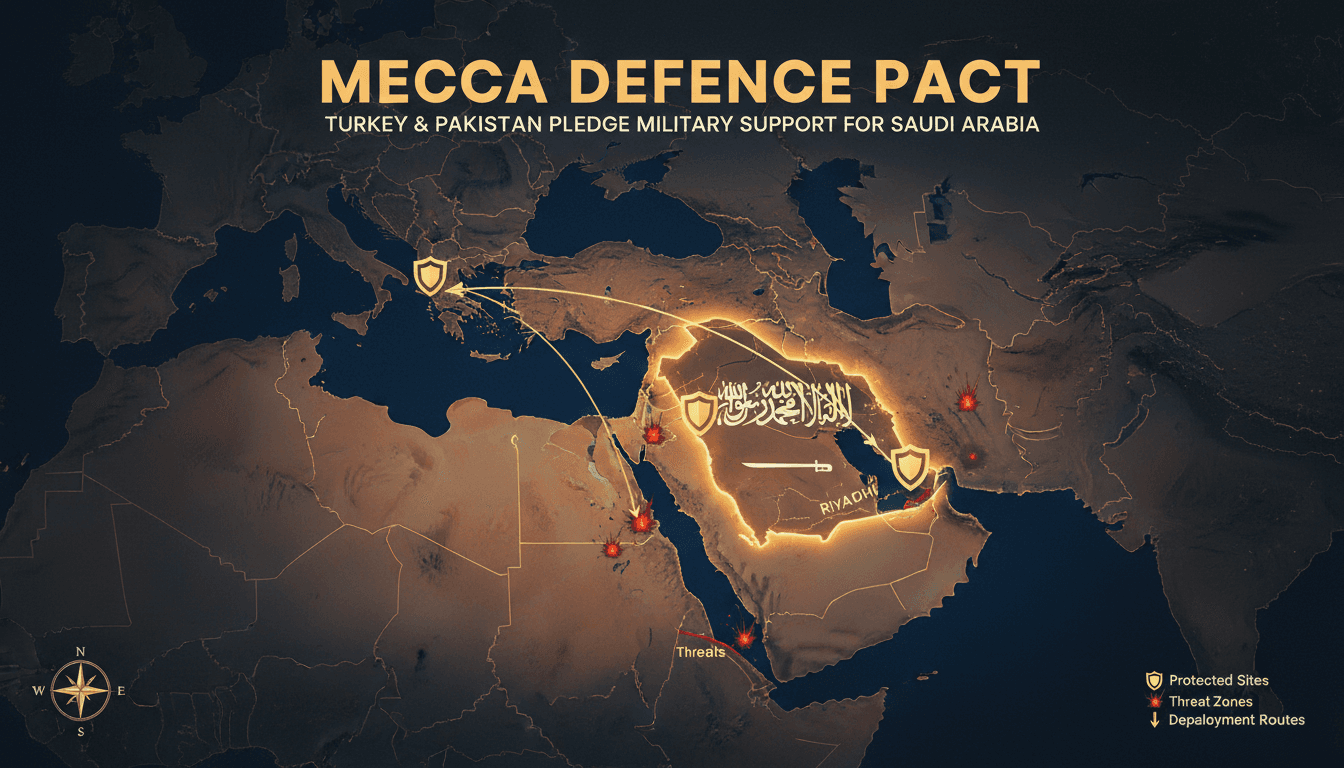
- Turkey and Pakistan pledged to rapidly deploy military forces to Saudi Arabia during an emergency meeting in Riyadh on October 5, 2026.
- The Mecca Joint Defence Agreement was activated in response to escalating Houthi attacks on Saudi territory, including threats near holy sites.
- A joint statement from the three nations reaffirmed their collective security commitments and solidarity against external threats.
The context you actually need
- The Mecca Joint Defence Agreement, signed in August 2026, establishes a framework for collective defense among Turkey, Pakistan, and Saudi Arabia.
- Houthi forces, backed by Iran, have intensified missile and drone attacks on Saudi Arabia, raising alarms about the security of the kingdom and its holy sites.
- Saudi Arabia's counter-offensive in Yemen aims to regain territory from Houthi control, further complicating the regional security landscape.
What's really happening
The recent military pact among Turkey, Pakistan, and Saudi Arabia is a direct response to the escalating threat posed by Houthi forces in Yemen, which have increasingly targeted Saudi territory. This agreement not only activates the Mecca Joint Defence Agreement but also reflects a broader strategy among these nations to bolster their collective security in the face of regional instability.
The Houthi attacks have included missile strikes and drone incursions that have come alarmingly close to sacred sites in Mecca and Medina, prompting a swift reaction from Saudi officials. The emergency meeting in Riyadh brought together high-ranking officials from all three nations, including Turkey's Foreign Minister Hakan Fidan and Pakistan's Deputy Prime Minister Ishaq Dar, to discuss immediate military readiness.
This trilateral military cooperation is significant for several reasons. First, it underscores a shift in military alliances in the region, moving away from traditional partnerships and towards a more integrated defense strategy among these three nations. The agreement is designed to ensure that any attack on one member is treated as an attack on all, thereby enhancing deterrence against external threats.
Second, the rapid deployment of forces indicates a readiness to act swiftly in the face of aggression, which could alter the calculus for Houthi forces and their Iranian backers. This could lead to a more volatile situation in Yemen, as the Saudi-led coalition may intensify its military operations to reclaim lost territory and counter Houthi advances.
Moreover, the pact could have economic implications, particularly for businesses operating in the region. Increased military presence and potential conflict may disrupt trade routes and impact oil prices, which are sensitive to geopolitical tensions. Companies with interests in the Middle East should prepare for potential fluctuations in market conditions as the situation evolves.
In summary, the Mecca Defence Pact not only reinforces military ties among Turkey, Pakistan, and Saudi Arabia but also sets the stage for a more aggressive stance against Houthi forces, with implications for regional stability and economic activity.
Who feels it first (and how)
- Businesses in the Middle East: Increased military activity may disrupt trade and impact supply chains.
- Local populations: Heightened military presence could lead to instability and security concerns.
- Investors: Fluctuations in oil prices and market conditions may affect investment strategies.
What to watch next
- Military deployments: Monitor the speed and scale of troop movements to Saudi Arabia, as this will indicate the seriousness of the threat and the potential for escalation.
- Houthi responses: Watch for retaliatory actions from Houthi forces, which could further destabilize the region and impact economic conditions.
- International reactions: Pay attention to how other nations, particularly Iran and Western powers, respond to this military pact, as it could influence broader geopolitical dynamics.
Turkey and Pakistan have committed to rapid military deployment to Saudi Arabia.
Increased military operations in Yemen by Saudi-backed forces in response to Houthi threats.
The long-term impact on regional stability and economic conditions as the situation evolves.
Frequently Asked Questions
- Why it matters?
- This agreement signals a significant shift in regional military alliances, potentially affecting trade routes and security protocols across the Middle East.
- What happened (in 30 seconds)?
- Turkey and Pakistan pledged to rapidly deploy military forces to Saudi Arabia during an emergency meeting in Riyadh on October 5, 2026. The Mecca Joint Defence Agreement was activated in response to escalating Houthi attacks on Saudi territory, including threats near holy sites. A joint statement from the three nations reaffirmed their collective security commitments and solidarity against external threats.
- What's really happening?
- The recent military pact among Turkey, Pakistan, and Saudi Arabia is a direct response to the escalating threat posed by Houthi forces in Yemen, which have increasingly targeted Saudi territory. This agreement not only activates the Mecca Joint Defence Agreement but also reflects a broader strategy among these nations to bolster their collective security in the face of regional instability. The Houthi attacks have included missile strikes and drone incursions that have come alarmingly close to
- Who feels it first (and how)?
- Businesses in the Middle East: Increased military activity may disrupt trade and impact supply chains. Local populations: Heightened military presence could lead to instability and security concerns. Investors: Fluctuations in oil prices and market conditions may affect investment strategies.
- What to watch next?
- Military deployments: Monitor the speed and scale of troop movements to Saudi Arabia, as this will indicate the seriousness of the threat and the potential for escalation. Houthi responses: Watch for retaliatory actions from Houthi forces, which could further destabilize the region and impact economic conditions. International reactions: Pay attention to how other nations, particularly Iran and Western powers, respond to this military pact, as it could influence broader geopolitical dynamics.
Global news coverage with extensive reporting on Middle Eastern conflicts and geopolitics.
"Al Jazeera is a Qatar-based broadcaster known for wide regional coverage and alternative perspectives."
— A47 Editor
Turkiye, Pakistan to deploy forces to Saudi as Yemen fighting grows
Turkiye and Pakistan have agreed to deploy rapid response forces to Saudi Arabia amid escalating violence in Yemen, particularly from Houthi rebels. This decision was made during emergency talks held in Riyadh, reflecting a coordinated military respo...
English-language news from Qatar covering domestic and regional affairs.
"Gulf Times reflects Qatari perspectives on regional developments."
— A47 Editor
Turkey, Pakistan agree to deploy forces in Saudi
Turkey and Pakistan have agreed to rapidly deploy military forces to Saudi Arabia as part of a new mutual defense alliance, responding to escalating attacks on the Gulf kingdom. This decision was announced by the three countries amid growing security...
UAE-based English-language newspaper covering regional politics, economics, and global affairs.
"The National reflects Emirati policy perspectives while maintaining international editorial standards."
— A47 Editor
Makkah pact countries plan 'rapid deployment of capabilities' in Saudi Arabia
Countries part of the Makkah pact, including Turkey and Pakistan, have agreed to rapidly deploy military capabilities in Saudi Arabia in response to increasing Houthi attacks. This decision was made during emergency talks held in Riyadh, highlighting...
Regional coverage and analysis focused on politics, diplomacy, and business across the Middle East.
"Al-Monitor is known for analytical reporting on Middle East politics and policy developments."
— A47 Editor
Turkey says Mecca pact committee to meet in Riyadh on October 5
A committee of the Mecca defense pact, comprising Turkey, Saudi Arabia, and Pakistan, is set to convene in Riyadh on October 5 to discuss military cooperation and strategies against the Iran-backed Houthis in Yemen. This meeting follows a recent esca...